

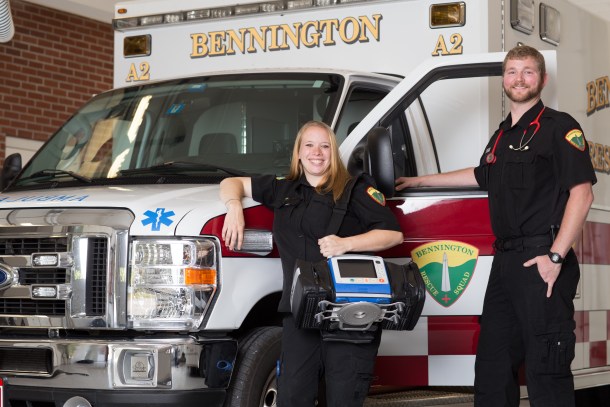
[B]ENNINGTON — Bennington Rescue Squad is launching a paid apprenticeship program that Executive Director Forest Weyen hopes will address staffing issues that reflect those at emergency response organizations around the state.
The initiative, which will coordinate with the state Department of Labor’s apprenticeship program, is offering “a job with a future,” Weyen said, in which candidates for emergency medical technician licensure will be paid during six weeks of on-the-job training.
“This will be a little hit on our salary [budget] line,” he said, “but we are at the point we need people coming in the door.”
Bennington Rescue is the second largest such organization in Vermont, he said, and unlike some smaller community squads, isn’t thinking of closing down or seeking a merger with another organization.
There are about a half-dozen EMT openings currently, Weyen said, and full-time job slots are being covered by overtime spread among the approximately 40 staff members.
That’s an option smaller squads often don’t have, he said, while the entire industry struggles with lower and more restrictive insurance reimbursements and the rising cost of maintaining equipment and operations.
In addition, basic and advanced training requirements, which have increased for both individual employees and rescue organizations, can prove daunting and time-consuming, he said.
“I don’t think there is an agency in the state that is fully staffed,” Weyen said.
Small squads, like those covering a single town, usually work with some combination of part-time volunteers, often paid per call, and some full-time employees. Certain shifts, Weyen said, such as during the daytime when people are at other jobs, can be difficult to cover.
Scheduling can also be hard for a large organization, “and we have a deep bench,” he said.
Becky Dansereau, an apprenticeship field representative with the Department of Labor, said her office’s role is to market the apprenticeship and help establish a format for measuring the person’s progress toward the overall goals while providing record-keeping for coursework and other benchmarks.
It is “above and beyond” what an employer and apprentice would experience through a program set up by the organization or business alone, she said.
The state’s apprenticeship program now is targeting health care as one of the key industries where it should expand, and the Bennington effort will be the first of its kind.
“We are really excited about Bennington Rescue starting a program and registering it with the state,” Dansereau said. “Not only is the training better, but the turnover is reduced when you invest in the employee.”
Seven openings in Bennington
“Right now, I could hire seven full-time people,” Weyen said, referring to EMTs, or those at the first level of certification a squad member can attain.
He also wants to add more paramedics or hire EMTs interested in pursuing a two-year paramedic degree at community college.
Right now, the squad has six full-time and four part-time paramedics, but Weyen said he’d like to have 10 full-time paramedics, adding, “12 would be ideal.”
Weyen said applications for the apprenticeship program are due by Oct. 24, and the squad will hold an open house on Oct. 23 from 4 to 7 p.m. at the 120 McKinley St. headquarters when interested persons can ask questions of squad members.
“Folks can also call, email, or even make an appointment for questions, or for a tour at any point,” Weyen said. “We also have a ‘third rider’ program, so if someone wants to come ride along for a couple shifts to test it out before they apply, they can find that information on our website as well.”
Those chosen for the apprenticeship will begin training on Dec. 10. Over the next year, the squad intends to evaluate the results of the effort and decide whether to sponsor another round of apprenticeships.
EMT trainees will work alongside squad members for six weeks, learning and checking off the skills required for the job, while at the same time doing coursework.
Candidates then sit for a national EMT exam, and once that is completed and they receive a license, there will be a pay raise and offer of a full-time job.
The pay will be about $12 an hour during the training period and about $15 an hour as a starting EMT, Weyen said.
He added that he likely would immediately talk to some of the new EMTs about going to college for a paramedic degree, which could be pursued over a 13-month period full time or on a part-time basis.

