


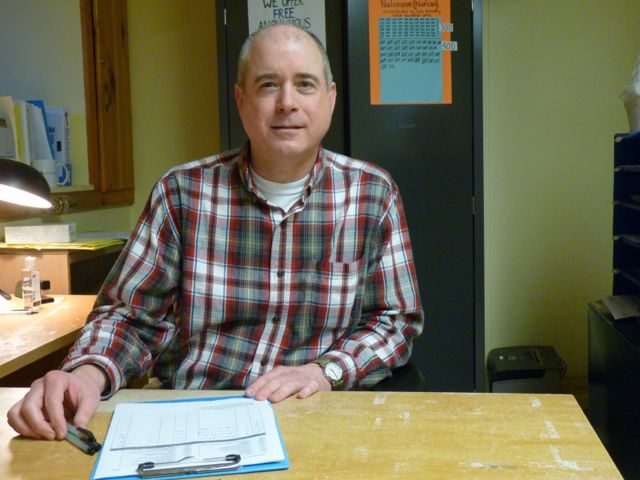
Creative Commons photo
[T]he Vermont Department of Corrections is standing by its inmate health care contractor amid controversy about addiction treatment in state prisons.
A top corrections official on Tuesday said the department remains confident in the performance of Centurion and its Vermont medical director, Dr. Steven Fisher.
The comments came after a prisoners-rights group filed a state Board of Medical Practice complaint against Fisher, claiming that addicted inmates are suffering harm because of inadequate implementation of a new state law expanding addiction treatment behind bars.
Annie Ramniceanu, the department’s director of mental health and addiction services, said there are ongoing efforts to refine and improve the treatment program. But she also said corrections officials are not planning at this point to order Centurion to make radical changes in its approach to inmate addiction.

“We are not doctors,” Ramniceanu said. “And so it’s a simplistic answer to say you can just force somebody to do something. If it hasn’t been determined to be medically necessary, you’re really asking a prescriber to do something that’s against their training.”
Centurion officials are not addressing the issue publicly. A company spokesperson on Tuesday said that “at this time, Centurion of Vermont does not wish to comment about the expansion of (medication assisted treatment) in Vermont facilities.”
Act 176, which took effect July 1, ordered the expansion of prison-based treatment for opioid addiction so that the program more closely resembles the state’s successful hub and spoke treatment system for the general population.
The statute says inmates must be screened for addiction within 24 hours of arriving at a prison. It also says prisoners can begin medication assisted treatment behind bars even if they hadn’t been receiving those medications before their arrest — a departure from past corrections policy.
Additionally, the law eliminated a previous 120-day cap on medication assisted treatment and said inmates should receive that treatment “for as long as medically necessary.”
But the interpretation of “medically necessary” has caused problems. Corrections officials say Centurion – following national prison health policies – has determined that starting longer-term inmates on addiction treatment becomes medically necessary only within 30 days of release from prison.
As a result, Burlington-based Vermonters for Criminal Justice Reform says many inmates with substance use disorder are being denied treatment that they are entitled to under Act 176. The statute says any inmate can request addiction screening and should “receive the medication as soon as possible” if it is deemed medically necessary.
Furthermore, the reform group says the 30-day policy is arbitrary and doesn’t work for many inmates because they don’t receive an exact release date until it’s too late to start treatment.
In the medical board complaint filed against Fisher, Vermonters for Criminal Justice Reform Executive Director Tom Dalton said many inmates “are being released back into their families and communities untreated” and at a much higher risk of fatal overdose.
In an interview Tuesday, Ramniceanu said Centurion has “a long track record” and is working with corrections officials to address inmates’ needs – both in terms of addiction treatment behind bars and care-coordination efforts for those who are being released.
“We do have confidence in (Centurion),” Ramniceanu said. “One facet of having a contractor in Vermont that I think sometimes is overlooked is that the people who are working for this company are all Vermonters. These are our citizens, they care deeply about the state and obviously about this work.”
She reiterated the relative novelty of large-scale medication assisted treatment programs in prisons. Programs like Vermont’s are “such a new and evolving practice and paradigm, and everybody is trying to do the right thing,” Ramniceanu said.
Fisher referred comment on the medical board complaint to Centurion. But Ramniceanu spoke in support of the doctor.
“I know he works tirelessly,” she said. “I know he is a dedicated medical practitioner. I have respect for him, and I think he is at the vanguard.”
Ramniceanu said corrections officials “are in constant daily communication with Centurion” about medication assisted treatment and other health issues.
And she said addiction-treatment policies still are evolving. For example, officials are looking for ways to “try to pinpoint more accurately peoples’ release dates” in order to better facilitate treatment.
State officials also are talking to the National Commission on Correctional Health Care, which developed the 30-day policy that is causing controversy in Vermont. But Ramniceanu stopped short of saying that policy could change.
“That’s really a medical provider’s decision,” she said. “So I would never try to get ahead of that or speak for a doctor on that.”
Meanwhile, Ramniceanu said corrections officials and Centurion have eliminated a backlog of inmates – at one point, more than 500 – who were waiting for addiction screening.
Addressing the backlog “just took some time,” Ramniceanu said. Prior to the passage of Act 176, “we had no idea how many people were going to come forward to request to be screened and assessed.”
That doesn’t mean, however, that there have been large numbers of inmates added to the treatment roster – mostly due to the 30-day rule.
Ramniceanu knows that issue will remain contentious. But she said she’s working with Vermonters for Criminal Justice Reform in the interest of “moving forward together, because I think that’s the way we get things done in Vermont.”
