

Editor’s note: Mark Bushnell is a Vermont journalist and historian. He is the author of “Hidden History of Vermont” and “It Happened in Vermont.”
[B]ad luck clung to Seth Hubbell and his family like burdock on wool as they tried to carve out a homestead in the Vermont wilderness. But through it all, Hubbell seemed to exude calm. He didn’t curse the heavens and demand to know why he was forced to endure it all; he just endured it.
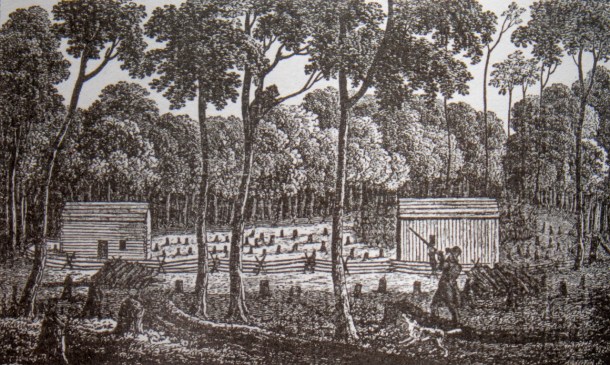
In late February 1789, Hubbell and his wife, Elizabeth Guise Hubbell, had set off from Norwalk, Connecticut, with their five daughters, the oldest only 9 or 10 years old. They were to settle land Hubbell had purchased in Wolcott. The journey would take them some 300 miles north.
The Hubbells presumably picked Vermont, and Wolcott in particular, for the simple reason that there weren’t nearly as many people wanting to settle in Vermont, so land was far cheaper than in Connecticut. Who would choose to settle in a remote wilderness, on land with a tentative title? Vermont was in political limbo, as it had been for decades. Would it join British Canada, as some Vermont leaders had covertly negotiated with British officials earlier in the decade? Would it be subsumed by New York, or maybe New Hampshire, which had both claimed ownership of the region? Or would it become a state in its own right?
Against that backdrop, the Hubbells began their trek. It wasn’t long before the troubles started. While still 100 miles short of Wolcott, one of their pair of oxen became ill. Seeing no other option, Seth Hubbell had the oxen team pull the wagon until noon each day. After that, he would take the sick ox’s place in the yoke.
The arrangement worked until the family reached Johnson, about 14 miles from Wolcott, at which point the ox was too weak to continue. The only hay to be found for the ox was from a farmer in Cambridge. Seth carried the hay, a bundle at a time, the 5 miles to Johnson for about 10 days, at which point the ox died.
We know of the Hubbells’ hardships because of a book Seth wrote and published in 1824. He says he wrote the narrative for himself, but friends persuaded him to publish it because of his “present circumstances.” Presumably he was broke. He gave the 26-page book the none-too-cheery title “A Narrative of the Sufferings of Seth Hubbell & Family, in his Begginning a Settlement in the Town of Wolcott, in the State of Vermont.”
By the 1820s, life in Vermont was comfortable enough that to people who hadn’t lived through the settlement period, Hubbell’s account may have been chilling and foreign. Few Vermont settlers wrote narratives of their experiences, so it is impossible to say whether others suffered fates similar to the Hubbells’. Seth might have embellished the facts to win over readers. But in the back of his book he had several neighbors swear the story was true, so perhaps his family was just singularly unlucky.
The road the Hubbells followed ended at Hyde Park. Leaving their three youngest daughters with a family there, the parents tramped on snowshoes toward Wolcott, following a series of marked trees. The elder daughters followed on the packed trail.
A second family, the Taylors, joined the Hubbells on this last leg of the trek, and together they became the first to settle Wolcott. Their nearest neighbors were two families in Hyde Park, about 10 miles away. To the east, the closest settlers were 18 miles away along a marked trail. To the south, it was 20 miles to some “infant settlements,” Hubbell wrote. To the north was unbroken wilderness all the way into Canada.
When they reached Wolcott, Hubbell wrote, “I had not had a mouthful of meat or kernel of grain for my family, nor had I a cent of money left to buy with.” He had the good fortune to catch a sable, whose skin he carried 50 miles (perhaps to Burlington; he doesn’t say) and traded for a half bushel of wheat, which he carried back home.
Before the wheat ran out, he met a Native American who sold him a moose carcass. Hubbell carried the meat 5 miles home. As with many other exchanges, Hubbell doesn’t say what he gave the Indian in return.
The family arrived during a time of food shortage in the region, so Hubbell hiked 60 miles to New Hampshire for provisions. The family had “so scant a pittance” that Elizabeth and Seth had to ration the children’s food. Eventually, Seth brought his three younger children to their Wolcott home, carrying each on his back, one at a time from Hyde Park.
Hubbell purchased a cow the first autumn. The following June, however, it died in an accident. The cow left behind a heifer calf, some consolation, but the calf choked to death the following autumn.
Word reached Hubbell of a Haverhill, New Hampshire, merchant who was buying “snakeroot and sicily.” Snakeroot is a plant used in folk remedies to treat snakebites. By “sicily,” Hubbell presumably meant cicely, another medicinal herb. With the help of his two oldest daughters, Seth dug up and dried a “horse-load” of the herbs and took them to Haverhill.
The merchant, however, told Seth he knew nothing about these strange herbs, and so offered nothing for them. Perhaps it was just hard bargaining, because the merchant eventually traded a 3-year-old heifer for the herbs. Hubbell was elated: “Though my faith was weak, yet being vigilant and persevering, I obtained the object, and the wilderness produced me a cow.”
With an ax, Hubbell cleared two acres his first year and planted it with corn, but an early frost killed the crop, so the family had no harvest to trade for basic provisions. Fortunately, Elizabeth had apparently been hard at work — Seth mentioned trading two and a half yards of whitened linen for eight quarts of seed corn. He considered the meager return “extortion,” and said the man who traded the corn eventually repented his stinginess, especially since he was “many times reminded of it by way of reproof.”
When the family ran short on grain, Seth walked 40 miles with his sickle to Lake Champlain to harvest some. But the grain wasn’t ripe, so he bartered with a man to carry him across to Grand Isle, where he heard the grain was ripe. It wasn’t. But Hubbell harvested it anyway, repaying the farmer with labor. Hurrying home, Hubbell didn’t wait for the grain to dry and had it ground, “or rather mashed,” as it was too wet to grind. He traded his sickle to have his grain transported to Cambridge to have it ground again.
Seth’s grain-harvesting expedition lasted two weeks. Elizabeth, understandably worried, sent a man after Hubbell, who met him on his return journey. With the grain, “my wife baked a cake, and my children again tasted bread.”
Other times Seth Hubbell earned his grain by working for a settler in Hyde Park. He was paid a half bushel each of meal and potatoes, which he carried home. The weight would have been 55 to 60 pounds.
Once in March, he borrowed a pair of oxen from the miller to haul his grain home on a sled. Crossing a river, probably the Lamoille, Hubbell “perceived the ice settling” under the oxen. He sprang forward and removed the pin connecting the animals to the sled, and dragged the sled back to shore. The oxen broke through the ice.
Hubbell called for help, but there was no one to hear his shouts. There was nothing for him to do but watch. The oxen swam to where he stood and lay their heads on the ice at his feet. He removed their yoke, and they began swimming again, breaking a hole in the ice as much as 30 feet across. One ox swam downstream to the edge of the ice and, “as if lifted out of the water,” was soon lying on its side on the ice. It stood and walked off. The other did likewise.
Hubbell was stunned. He couldn’t shake the feeling that they had been saved “by supernatural means.” How else would a heavy ox pull itself so nimbly from the icy water?
Rather than focus on the seemingly endless stream of obstacles looming before him, Hubbell marveled at how “Providence” always provided a way to overcome them.
Writing his brief memoir at the age of nearly 70, Hubbell claimed that “(n)ot once was I discouraged or disheartened, my benign Benefactor assisted my natural strength both of body and of mind to endure those scenes of distress and toil.”
A later edition of Hubbell’s narrative contains a sad note. In 1806, Elizabeth and one daughter both became ill and died. Hubbell lost his farm, but family members allowed him to stay on. “Though I have been doomed to hard fortune,” he noted, he had ultimately been blessed with 17 children, 47 grandchildren, and six great-grandchildren. Seth Hubbell was an optimist to the end.

