


As the emerald ash borer continues its steady advance across the state, Vermont towns and landowners are ramping up their efforts to withstand the potential destruction caused by the invasive pests.
Under a resolution adopted last week, the Rutland Board of Aldermen proposed that hundreds of ash trees be chopped down in response to the “imminent arrival” of the ash borer.
The city is just the latest Vermont municipality to take action since the iridescent green beetle was first detected in the state in February in a woodlot in Orange. Although the beetle has not been found within Rutland City confines, officials say taking down the trees in advance of an infestation would save money and minimize safety risks.
“The greatest challenge in all of this to me is these are perfectly healthy trees right now,” said David Schneider, the city’s tree warden. “But because of budgetary constraints and the concern for public safety … we want to make sure that we’re advancing on this in a proactive fashion.”
Schneider pointed out that the aldermen had approved a plan with “a lot of flexibility.”
The city will consider treating some larger trees with insecticide, especially if members of the public want to save particular trees, he said. Treating all of the city’s trees would cost twice as much as the city’s annual tree budget, said Schneider, because the treatment has to be applied every two years for an indeterminate length of time.

“I can’t say it’s a lot of fun being the person that has to make the recommendation” to chop down ash trees, he added.
The Department of Public Works plan approved by aldermen Monday would cost the city $91,000 for tree removal, as most of the ash trees can be taken down by Schneider and an assistant forester. Dead ash trees cost more to remove, because foresters cannot safely climb the brittle limbs. As a result, those limbs would have to be removed with a bucket truck at additional expense..
As the city can’t sell trees to sawmills — many of them contain stray metallic particles that could damage mills — the felled trees will likely be given away as firewood to area residents, said Schneider. Residents would then be advised not to move the firewood outside of the city.
More towns identified
Since the emerald ash borer was first detected in Vermont, evidence of the insect has since been confirmed in Groton, Plainfield, Barre, Montpelier and, most recently, Stamford. State officials say EAB is almost certainly already present in trees in locales within a 10-mile radius of the detection sites. A quarantine is in place prohibiting the movement of ash wood out of Vermont.
Lori Shepard, Stamford town clerk, said she had learned from a state official that EAB had been found on “one of the purple boxes” hanging from an ash tree in the Bennington County town on the Massachusetts border. The U.S. Department of Agriculture — which has set up 609 such detection traps on ash trees around Vermont — told the state on July 31 that it had found the invader.
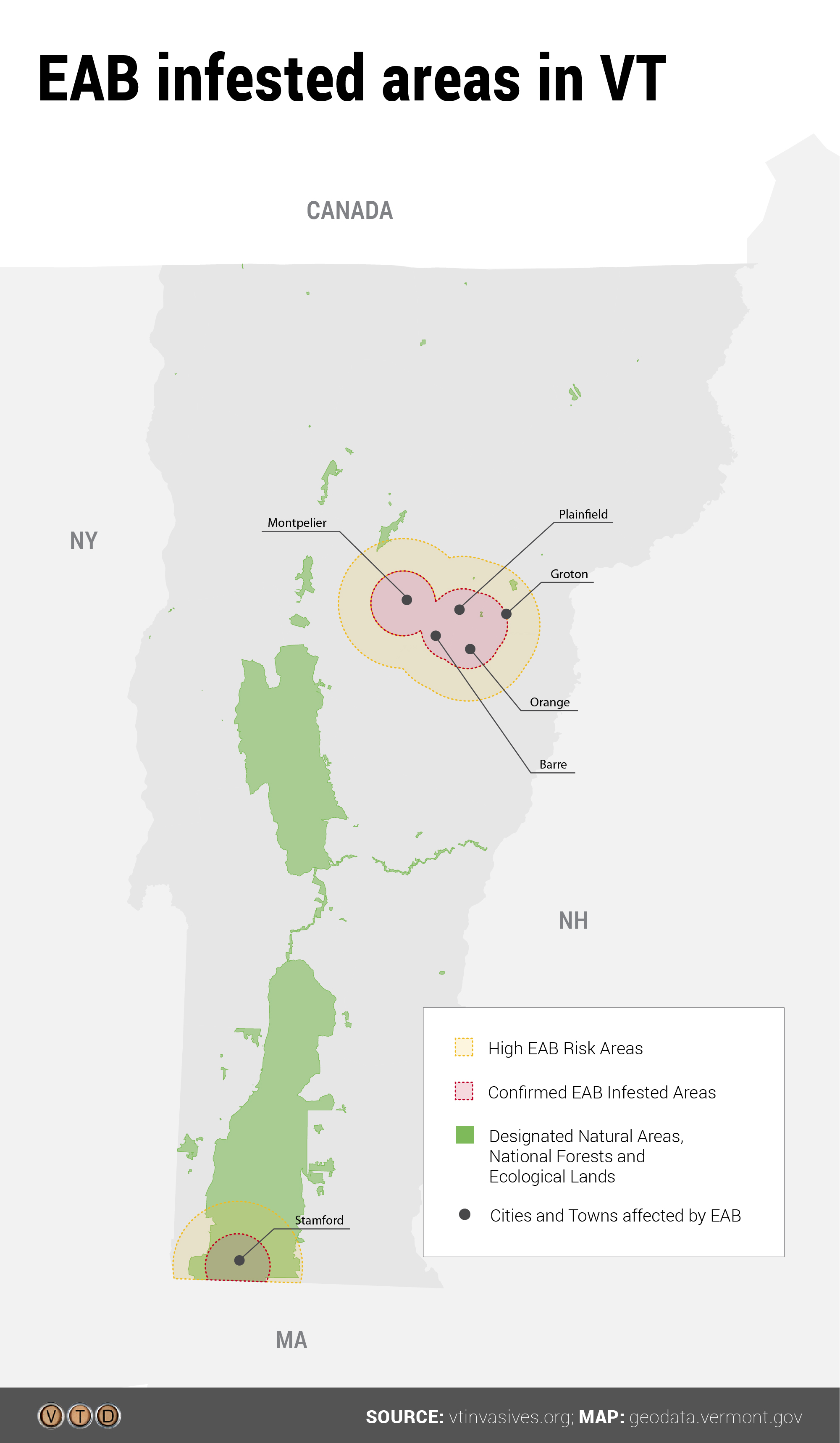
Stamford is holding off on developing a response plan until after a public hearing with state experts takes place, said Shephard. That meeting is scheduled for Sept. 11 from 5:30 p.m. to 7 p.m. at the Vermont Veterans’ Home in Bennington. She said that with the statewide quarantine and “slow the spread” recommendations already in place, “now it’s just more education on what to look for and how to handle it.”
Danielle Fitzko, program manager of Vermont Urban and Community Forestry, said municipalities should first conduct a tree inventory to determine how many ash trees are near public rights-of-way.
For towns and cities around the state, “it’s time to get that information so you can start thinking about what resources you’re going to need,” she said. Fitzko noted that ash trees — which constitute 17-20 percent of street trees statewide — are common in town centers but also can be found along rural roads, often near utility lines. Randolph recently conducted an inventory of just 10 percent of the trees in rural rights of way, and tallied 600 ash trees, she said.
Vermont Urban and Community Forestry will host two workshops in November to help towns and cities develop emerald ash borer response plans. There is also $40,000 in grant funding available to assist municipalities with those plans, Fitzko said.
Proactive approach encouraged
Rutland is not alone in adopting the “proactive” approach to managing elm trees. Williston — whose street trees are 42 percent ash — has already begun removing its ash trees and replacing them with maples, elms and other species. The town hopes this will improve the resiliency of its trees to resist future pest outbreaks and spread out the cost to taxpayers, says Melinda Scott, who serves on the Williston conservation commission.
According to a 2015 inventory, Burlington has 1,275 ash trees along streets and in parks. The Queen City estimates it would cost $1.35 million to remove ash trees, grind stumps and replant other trees. City officials at this point have a “potential plan” to treat 50-75 percent of ash trees and chop down the others, with an upfront cost of $400,000 to $720,000.

Montpelier, one of the epicenters of the EAB outbreak, has around 1,200 ash trees on city property and along streets, said Geoff Beyer, head of the city’s parks department. Beyer said the city and volunteers have been conducting an inventory to assess the health of trees located on busy corridors downtown.
“When ash trees show symptoms, we’re going to remove them,” he said. Montpelier plans to treat as many ash trees as possible — an approach that comes with a $750,000 price tag, said Beyer.
As a small portion of ash trees are resistant to the beetle, he doesn’t want the city to “help” the emerald ash borer. “We had a couple really beautiful elm trees survive,” said Beyer, referring to the Dutch elm disease outbreak that swept through the country in the 20th century.
Schneider said that the city of Rutland cannot afford to spend three quarters of a million dollars on its ash trees.
“We’ve been paying very close attention to this issue since we first heard about it in 2004,” said Schneider, noting that he and other tree professionals in Vermont watched with apprehension as EAB spread east from Detroit. “I feel, unfortunately, very comfortable in assuming that this bug is going to treat Vermont the same way it’s treated 33 other states, which is decimating the tree populations.”
Key role for landowners
As 80 percent of the state’s forests are privately held, landowners will play a key role in preventing the spread of the emerald ash borer. The insect migrates one to two miles annually on its own, but transporting wood speeds that process. Barbara Schultz, forest health program manager with the state’s Department of Forest, Parks and recreation, said that anyone with ash on their property should first determine whether they are within the known infested zones around Vermont.

“Those are the places where we’re really encouraging people to not move firewood out of that area” and to only move lumber during the winter, noted Schultz. Fitzko said that homeowners with beloved ash trees on their properties should consider whether they want to pay to treat those trees.
Forest landowners around the state are encouraged to consult with their foresters to develop a plan for ash trees on their property, said Schultz.

White ash — one of the three ash species in the state — currently makes up 24 percent of hardwood timber harvested annually in Vermont, making it “second only to sugar maple,” wrote Paul Frederick, wood utilization and wood energy program leader for FPR. That harvest provides about $2 million every year for landowners, with more value added by sawmills and manufacturers, he said.
Emily Inoue pointed out that ash trees in forests are “less dangerous” than those along a busy street or in a public park. “You’re also dealing with a lot bigger trees that have a different value associated with them,” she added, noting that landowners should assess if they want to cash in on “high value” ash trees. Ash should be harvested and moved during the winter “non-flight season.”
“What we do encourage people, though, is not to cut every last ash tree,” said Schultz. “The future of ash depends on having ash standing.”
Other pests also of concern
While the emerald ash borer is the most concerning forest pest in Vermont right now, the state is keeping an eye on hemlock woolly adelgid, elongate hemlock scale and red pine scale, she said.
All three have been found in Vermont, but are not yet widespread because the insects — which have posed more of a problem to southern states — largely die off in the winter. “Our cold climate has been our friend,” said Schultz.
State officials are also on the lookout for oak wilt, a fungus that has shown up in New York, and Asian longhorned beetle. “It’s certainly one we want people looking for because it does like maple trees — and so do we.”
Any tree that appears to be infested with EAB, or other forest pests, should be reported to the Vermont Invasives site.

