


Editor’s note: Mark Bushnell is a Vermont journalist and historian. He is the author of “Hidden History of Vermont” and “It Happened in Vermont.”
[A]merica was a frightening place in the late 1790s. The country was rife with rumors that war with France was imminent. To make matters worse, the Federalist Party, which controlled Congress and the White House, used this fear to justify passing the now infamous Alien and Sedition Acts.
The Federalists claimed their actions would protect the country. That’s highly debatable. But it is clear they were acting to protect their own hold on power.
The laws severely curtailed the rights of foreigners and anyone who said anything bad about the government, including elected officials and journalists. They allowed for the imprisonment and deportation of any foreigner who authorities considered, with little or no evidence, to be dangerous to the United States. The laws also restricted when immigrants could vote, raising the residency requirement from five to 14 years.
One Federalist congressman explained his support for the acts by saying that the United States was under no obligation to “invite hordes of Wild Irishmen, nor the turbulent and disorderly of all the world, to come here with a basic view to distract our tranquility.” He didn’t mention it, but those immigrants, Irish and otherwise, were strong supporters of the Federalists’ political rivals, the Democratic-Republicans.

The Alien and Sedition Acts also cracked down on political dissent, making criticism of the federal government a crime.
The tendrils of these laws ensnared two prominent Vermonters. One, Matthew Lyon, is still fairly well remembered today. Lyon, who was then a Vermont congressman, wrote a letter to a newspaper disparaging the government for, among other things, displaying “ridiculous pomp, foolish adulation, and selfish avarice.” The letter earned Lyon a four-month jail sentence and a fine.
The other Vermonter, Anthony Haswell, is largely forgotten.
Haswell was born in England in 1756 and sailed to America at the age of 12 with his brother and their widowed father. Upon arriving in Boston, Haswell’s father apprenticed him to a potter. The apprenticeship would give the boy a trade, his father must have assumed. But Haswell was destined to become a printer, not a potter, which is how he ran afoul of the federal government.
Benjamin Franklin is said to have had a hand in making Haswell a printer. Perhaps Franklin, who had been a printer himself, saw something of himself in the young Haswell. Franklin purportedly helped renegotiate the terms of Haswell’s apprenticeship so he could leave the potter’s employ and serve an apprenticeship with the publisher of the Worcester Spy, in central Massachusetts.
One account of Haswell’s life during the Revolutionary era suggests he lived a Forrest Gump-like existence, witnessing a string of major historic events. He supposedly stumbled upon the Boston Massacre, participated in the Boston Tea Party, helped defend Boston during the British siege and fought at the Battle of Monmouth in New Jersey.
Perhaps. It was a small country and some people show up in the historical record at an array of important events. Or maybe someone padded Haswell’s resume after the fact to elevate his status.
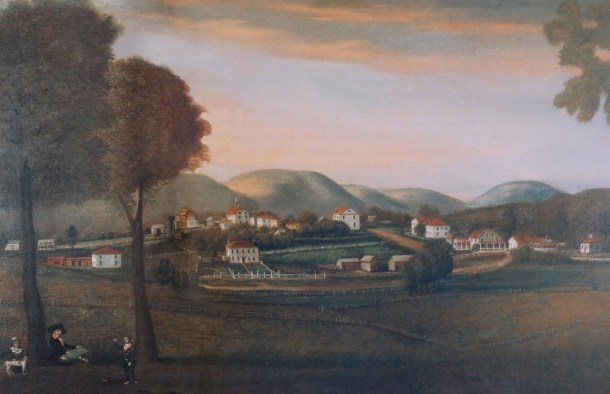
While some of the details of Haswell’s life are murky, we do know that he moved to Bennington in 1783 to become the official government printer for Vermont. The job was an important one, but left him time to take on other ventures. He ran a commercial print shop, became the local postmaster and soon the postmaster general of Vermont. He also helped start a paper mill.
In 1785, he published Ethan Allen’s religious ponderings, “Reason, the Only Oracle of Man: Or a Compendious System of Natural Religion.” The book’s deist viewpoint, which strayed from Christian doctrine, scandalized many people, so by publishing it Haswell gained his share of notoriety.
But another venture, publishing the Vermont Gazette newspaper, is what landed Haswell in trouble. His difficulties were linked with Matthew Lyon’s. Lyon had been sentenced to serve four months in the cold and filthy jail in Vergennes and fined $1,000 plus court costs. After the congressman was jailed, Haswell leapt to his defense.
Haswell supported Lyon in the pages of the Gazette and announced a lottery that would raise money toward paying Lyon’s fine.
This last act was apparently against Lyon’s own wishes. The congressman was willing to make a political martyr of himself; he didn’t want to pay the fine and get out early. He figured he could make his case that the government was overreaching far more effectively while languishing in jail than if he were sprung early.
Haswell took on federal authorities in his newspaper. “To the Enemies of POLITICAL PERSECUTION in the Western District of Vermont,” he wrote, “Your Representative (Lyon) is holden by the oppressive hand of usurped power, in a loathsome prison, deprived of almost the light of heaven, and suffering all the indignities which can be heaped on him by a hard-hearted savage, who has, to the disgrace of Federalism, been elevated to a station, where he can satiate his barbarity on the misery of his victims.”
The “hard-hearted savage” was federal marshal Jabez Fitch, who had a reputation for, well, hard-heartedness. Federal officials in Vermont deemed this attack on a federal employee, however low in rank, sufficient cause to arrest Haswell for seditious libel.
On a cold, wet October day in 1799, two federal deputies appeared at Haswell’s home in Bennington to arrest him. Haswell asked to delay his departure so he could remain with one of his daughters, who was his gravely ill. But the deputies insisted they ride immediately for the courthouse in Rutland; Haswell wasn’t even given time to change. He and the deputies didn’t reach Rutland until early the next morning.

The court released Haswell on bond, ordering him to stand trial the next year in Windsor. The trial’s location, and Lyon’s own experience, must have made it clear to Haswell that he stood no chance of acquittal. Windsor was a strongly Federalist town; federal authorities would have an easy time assembling a jury that supported President John Adam and his Federalist Party.
The jury quickly found Haswell guilty. The judge sentenced him to two months in prison and fined him $200. Haswell was imprisoned in Rutland, far from his family and friends. His lawyer arranged with marshall Fitch to transfer Haswell to a cell in Bennington. There he was able to continue writing for the Gazette and meet with friends. Haswell suffered a tragedy during his short time in prison, however. His daughter died and he wasn’t permitted to attend the funeral.
The rough treatment of Haswell and Lyon became a rallying point for the Federalists’ opponents, the Republican-Democrats, who had a stronghold in southwestern Vermont. Lyon won re-election from prison and was part of a wave of Democratic-Republicans who took control of Congress in 1800. That same election year, Vermont played a key role in ousting Adams from power in favor of the Democratic-Republican Thomas Jefferson.
Haswell’s prison sentence was set to expire on July 9, 1800. In his honor, the town of Bennington delayed its customary Independence Day celebration until that day. A large crowd gathered to the clash of cannon to mark the country’s birthday and Haswell’s release from prison. The 2,000 people who turned out that day to celebrate their hero would no doubt be surprised to learn that he is largely forgotten today.

