


Jon Margolis is VTDigger’s political columnist.
That was not an auspicious beginning.
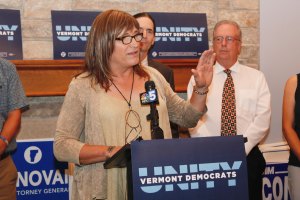
If the best that Vermont Democrats and their candidate for governor can do is what they did at their first major post-primary political event the other day, they’re going to have a tough few weeks.
The Democratic hierarchy and candidate Christine Hallquist violated several basic campaign rules, including:
• Before you throw a stone, make sure that glass is not a major component of your own domicile;
• Before you throw a stone, make sure it can do some damage.
In this case, the Democrats threw a pebble.
Creating as much fanfare as they could muster (speaking from the Statehouse steps) the Democrats revealed to the world that incumbent Republican Gov. Phil Scott’s campaign had received a $1,000 contribution from Purdue Pharma.
That’s one whole thousand dollars, at this point less than one three-hundredth of what Scott has received. Maybe Purdue was thanking Scott for blocking Democratic proposals to tax opioid manufacturers during this year’s legislative session. But Scott opposed all tax increases. It’s hard to argue he was doing the bidding of any industry or any company. Not much of a scandal here.
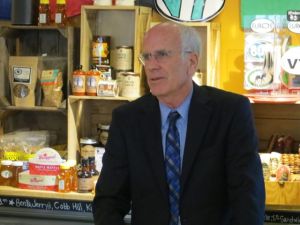
Especially because Democrats take money from drug companies, too. Specifically, Vermont’s own Democratic Congressman Peter Welch has accepted thousands of dollars from drug companies, and then co-sponsored legislation those companies supported. The legislation, it turned out, might complicate efforts by the Drug Enforcement Administration to control the misuse of opioids.
Maybe this Welch-drug company story is somewhat overblown. The bill passed both chambers unanimously, and whatever flaws it may have can be corrected. Still, Vermont Democrats should have known they’d be asked about it if they were going to make a big deal of Scott’s measly one grand from Purdue.
Except it turns out they weren’t going to take questions at all. They thought they could invite reporters to an event out in public and not take questions.
Boy, are they dense.
It isn’t that the Democrats had no case. Purdue is an especially odious company, more responsible even than most of its competitors for the excessive promotion of OxyContin, the ensuing opioid addiction, and the 200,000 overdose deaths these last 20 years. Purdue’s efforts to sell the drug included payments to ethically challenged doctors to endorse the drug and minimize its addictive potential.
This is not gossip. The company has pleaded guilty to felony “misbranding” charges. Federal investigators have found evidence that company officials knew of the drug’s dangers for years but concealed the information. Purdue’s misconduct is the subject of a new book, “Pain Killer,” by Barry Meier (Rodale Press, 2018).
So maybe Democratic State Chair Terje Anderson was only a little over the top when he said Scott “might as well accept money from a drug dealer on the corner,” who might be less morally repugnant (and more interesting) than a Purdue executive.
And maybe Scott should have declined that thousand bucks.
Nor need anyone take seriously the claims of Scott campaign manager Brittney Wilson that contributions have no impact on how Scott governs because “people send in contributions because they either agree with the governor or his policy positions, not the other way around.”
Actually, companies like Purdue give money to campaigns because they want something in return. Vermont Democrats were right to call attention to the contribution so lawmakers, government watchdog groups, and journalists can be on the lookout to see if that happens.
But Democrats have their own contributors who want something in return. Both parties operate within the same system. The whole system is corrupt, but there’s not much political mileage in picking out one modest contribution, even one from an objectionable source.
Besides, the Democrats violated another campaign rule: never outshine your candidate. Anderson might have been a bit excessive. But he was forceful and vigorous. At least as it came across on television (and what else matters?) Hallquist was not. She was admirably more restrained, but she seemed less like the main attraction than like part of the background. Right now, Scott does not seem to have much to fear from his political foes.
But maybe he should be worried about his friends. As if a week could not go by without its contribution, the Republican Governors Association issued a screed asserting that “Hallquist has proven that she can’t be trusted to tell the truth.”
What was untrue, the RGA said, was Hallquist’s claim that she “never said she would raise taxes,” when, as the GOP organization sees it, she has often proposed raising taxes.
But Hallquist made no tax increase proposal during the primary campaign. Nothing on her website suggests that if she were governor she would propose higher taxes. And the RGA’s 3,000-word statement doesn’t really prove that she would.
It does show that she sided with Democrats in the Legislature last spring who would have allowed most of the voter-approved school property taxes to go into effect. But Scott accepted some of that tax hike, too. The RGA statement also noted that Hallquist spoke favorably about a plan to use more income tax revenue and less from the property tax to pay for schools.
But she didn’t unambiguously endorse the plan, which at any rate is a tax shift, not a tax hike.
She’s also indicated she would consider supporting a carbon tax. But that’s not identical to proposing a carbon tax.
The RGA has Hallquist dead to rights on one thing, though. She did say that “just saying no to new taxes is a no-brain activity.”
It is, as office-holders from George H.W. Bush to Phil Scott have learned to their regret. Scott may also learn that Vermont voters are likely to reject simplistic exaggeration from his allies as well as from his opponents.
