

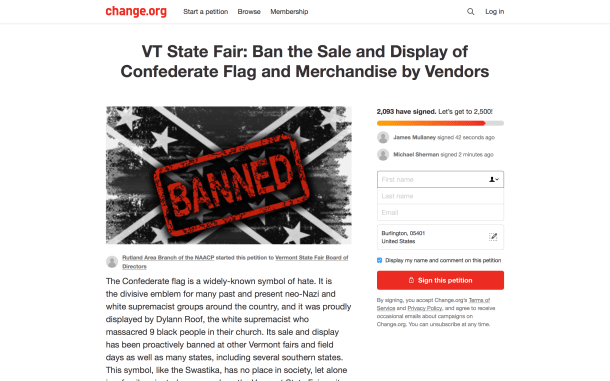
A rapidly spreading petition is calling for a ban on the sale of Confederate flags at the Vermont State Fair in Rutland.
The local branch of the NAACP is spreading an online form at Change.org, which asks the fair’s organizers to proactively stop the display and sale of any Confederate merchandise through formal policy.
The petition began two days ago and had collected more than 2,100 signatures as of mid-afternoon on Friday. The fair opened on Tuesday and ran through Saturday. Fairgoers say although no merchandise has been spotted this year, Confederate flags and T-shirts have been displayed for sale frequently in the past.
“There’s an awful lot of people who will not go to the fair because of it,” said Tabitha Pohl-Moore, president of the Rutland chapter of the NAACP. She said the petition effort came on the heels of previous attempts to stop the sales. She said her organization has received a number of complaints from patrons in the past.
“As an entity that is representing Vermont and you’re an entity in the first state that banned slavery, and you’re not willing to proactively prevent this,” Pohl-Moore said. “It just doesn’t add up.”
In response, the chapter contacted Luey Clough, the president of the Rutland Agricultural Society, last year.
“We were told that there’s nothing he can do, it’s not his responsibility, it’s not a problem,” Pohl-Moore said.
She said that fair management, including Clough, has dismissed the group’s concerns about Confederate merchandise, and has refused to take part in conversations about the vendors.
Pohl-Moore said Clough told the group last year that’s he’s willing to ask vendors not to sell Confederate items, but would not create a formal ban.
Clough did not return a call seeking comment on Friday.
In a 2016 interview with VTDigger, Clough said the fair received complaints about Confederate flags the year before. He said that organizers notified the vendors as a courtesy, but decided since it wasn’t a legal issue, the members didn’t have the authority to remove the merchandise.
“It’s part of history and the country, and we live with it,” Clough said, noting that he was speaking personally.
The Rutland event began in 1846 and is one of the oldest fairs in the country.
The Rutland NAACP chapter sent a letter on Aug. 8 to the Rutland Agricultural Society board of directors, asking for an official policy banning the sale of “stars and bars” flags and merchandise by 2019.
“The Rutland community depends on venues like the Vermont State Fair to fuel our local economy and provide a welcoming space for all attendees and participants, regardless of race, economic status, sexual orientation or age,” the letter states. “Merchandise displaying the Stars and Bars flag or design is similar to displaying merchandise featuring a swastika — while it is a part of our history, it’s offensive and has no place or purpose at a fair.”
The letter notes that several other fairs in Kentucky, Ohio, Indiana and New York have decided to halt the sale of Confederate flags.
In a series of email exchanges, the fair’s board requested that the NAACP chapter provide a list of vendors they believe might sell such merchandise. In response the civil rights organization asked fair leaders for a list of all vendors, which they declined to provide, citing privacy reasons.
“We will give due consideration as regards how best to address your concerns in the event it becomes apparent to us that any vendor is seen to have been selling any Confederate flags at the Fair,” wrote Christy Davis, the agricultural association’s secretary.
Pohl-Moore said all communication with the board of directors ended after that correspondance. The NAACP chapter subsequently decided to turn to a petition, which has been rapidly gathering signatures from the public.
“They understand that [the Confederate flag] is meant to create fear, a sense of inferiority and a sense of hate for other people,” she said.
The Vermont State Fair’s vendor application notes that the event has a “family fair policy” that “disallows anything drug related, obscene, vulgar or distasteful from being offered for sale or put on display.” The policy states that there is “zero tolerance” for “distasteful actions” from any vendor.
Kate Connizzo, a spokeswoman for the ACLU of Vermont, said a ban on Confederate merchandise would not raise First Amendment concerns, as long as the Vermont State Fair remains a private entity.
“If the fair’s standard is that anything distasteful – or even annoying – is disallowed, then the Confederate flag clearly qualifies,” Connizzo wrote in an email, referencing the vendor policy. “For many people, the Confederate flag is a symbol of white supremacy, slavery, and racist violence, so people are within their rights to ask that it not be allowed, consistent with the policy.”
Tim Shea, executive director of the Champlain Valley Fair, said the event does not have a formal policy. The fairgrounds have seen some vendors attempt to sell Confederate flags and other items in the past.
“We had it a few years ago, and we asked them to not sell it, and they complied,” he said.
Rep. Kiah Morris, D-Bennington 2-2, tweeted in support of the ban on Thursday, urging followers to sign the petition.
https://twitter.com/KiahMorrisVT/status/1030212777779060737
Reached Friday afternoon, Rep. Doug Gage, R-Rutland-5-4, said he hadn’t heard of the petition but is opposed to a ban.
“No, I’m not really supportive of it,” Gage said.
He declined to provide further comment or explanation for his viewpoint.
A series of recent events has reignited the debate over the Confederate flag in Vermont and around the nation. Those opposed to the flag see it as a symbol of the history of racism and slavery in the U.S., while defenders of the flag see it as a symbol of Southern pride and heritage.
Dylann Roof, the shooter of nine black churchgoers in South Carolina in 2015, had posted photos of himself online with the Confederate flag and posing in front of pro-slavery heritage sites.
In response to the shootings, then South Carolina Gov. Nikki Haley ordered the flag removed from the Statehouse.
A wave of violent white nationalist and extremist protesters in Charlottesville, Virginia last August further fueled the discussion and clash around Confederate imagery.
South Burlington High School voted last year to remove “Rebels” as their school mascot because of associations with the Confederacy, shown in yearbooks with photos of Southern battle flags on campus in the 1960s.
The situation at the Vermont State Fair in Rutland is nothing new in Vermont.
The Addison County Fair and Field Days board voted to ban Confederate merchandise after receiving a similar petition with over 400 signatures in 2016. That event had primarily one vendor who sold flags and other items, which sparked concerns from fairgoers.
The petition was started by the Champlain Valley Unitarian Universalist Society, after organizers learned that there were African-American congregants at the church who didn’t attend the county fair due to the Confederate flag issue.
