


The South Royalton Legal Clinic, which as part of the Vermont Law School has provided free legal services to thousands of Vermonters over nearly 40 years, no longer has a director.
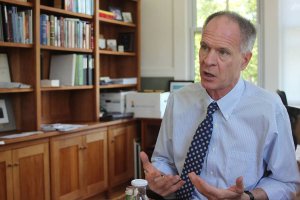
James May lost his position as director July 1. He was one of 14 VLS faculty members stripped of tenure as part of an effort to reduce the school’s debt.
Professors who lost their tenure were offered different options for either continuing work with the school in a limited role or leaving on July 1.
May said he will work as a lawyer at the clinic through the end of December, when he plans to leave VLS entirely.
“I’m in the job market, like so many other Americans,” May, 72, said in an interview earlier this month.
It’s unclear if a new director will be appointed, but VLS President and Dean Tom McHenry said the school would continue offering legal assistance to the public.
“VLS has a long history of strong clinical programs and we will continue that,” he said in an email. McHenry did not respond to a question asking if a new director would be appointed to lead the clinic.
The administration has been tight lipped about the changes, fueling anxiety about the future of one of the country’s top environmental law schools.
“As people are losing their jobs at Vermont Law School one is just left to wonder,” said Susan Apel, a longtime tenured professor who formerly led the legal clinic until she changed roles to focus on family and gender law.
“(The clinic) fills a really critical need in family law cases,” she said.
Apel became professor emeritus at VLS on July 1, retaining an office on campus without teaching duties under her buyout agreement.
Sean Nolan, the academic dean at VLS, declined to comment on the changes at the South Royalton clinic.
The clinic provides about $1.5 million worth of free legal services each year, according to its website.
May joined the South Royalton clinic in 1983, just four years after it was founded. He has led the legal clinic through much of its expansion.
The clinic started providing free services to domestic abuse survivors in 1997. In 2000, it started representing children whose parents were in contentious disputes. It has also represented immigrants, asylum seekers and refugees in the since 2003, and veterans since 2014.
Vermont Supreme Court Justice Beth Robinson said free legal resources in the state “play an invaluable role” in the court system.
In many cases, she said of the general situation in the state, people are not able to afford lawyers. In other cases, there simply aren’t enough lawyers available.
In addition to providing services to low-income Vermonters, the South Royalton Legal Clinic gives students first-hand experience practicing law. Up to 20 students work at the legal clinic at a time, said May.
May said the legal clinic operates with an annual $600,000 budget, which covers salaries and benefits for two staff members and 4.25 full-time equivalent attorneys.
May said he has helped secure at least $5 million in grants and fundraising to sustain the clinic since he started working there.
May’s work has also had an impact outside the country.
In 1994, May helped launch Russia’s first legal clinic at Petrozavodsk State University in the Republic of Karelia. The clinic was modeled after the clinic at Vermont Law School.
May took more than a dozen trips to Russia over almost 20 years, helping launch several other legal clinics in Russia and taking part in the Vermont/Karelia Rule of Law Project, which developed a civil legal aid program in Karelia.
May said his current work at the clinic focuses largely on family law, including domestic violence.
“I have clients to represent, problems to solve,” he said.
May said he hopes to continue doing similar work after he leaves the law school.
“I have a family to support,” he said.
