


Editor’s note: This is the second of a series of candidate profiles that VTDigger will publish in the weeks leading up to Vermont’s 2018 primaries and general elections.
Growing up, Brenda Siegel had great expectations and much to live up to, with both grandmothers working as therapists, one grandfather a Cornell University professor of molecular biophysics, and the other an Emmy-award winning screenwriter — he shared the award for scripting the television miniseries “Roots.”
That’s why, when she arrived at her home in Newfane one night only to find it in darkness, she felt she had let everyone down.
“I didn’t have power,” she recalls of that night two years ago, “because I could not afford to pay the bill.”
Siegel, a self-described “low income single mom,” had little money and long after Tropical Storm Irene swept through the house she shared with her now-teenaged son, little of anything else.
Then again, she says, she has had a lifelong instinct for making good out of bad.
“I’ve always wanted to turn any adversity I’ve faced into action,” she says, “but it’s hard to understand that experience if you’ve never had it yourself. We’ve had a long history of marginalized people not having access to political office. I really want to see regular everyday people have a voice.”
And so Siegel is one of four Democrats on the Aug. 14 Vermont primary election ballot seeking to unseat Republican Gov. Phil Scott.
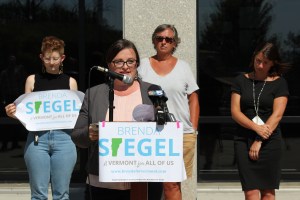
Siegel, born and raised in Windham County, has cobbled together a living the past two decades by offering dance, movement and yoga classes through area schools and organizations. As founder and volunteer executive director of Brattleboro’s Southern Vermont Dance Festival, Siegel has experience working a public stage. But aside from stints as vice chair of her town’s Democratic Committee and supporter of progressive groups such as Rights & Democracy, this is her first try at electoral politics.
“I believe we should be seeking out the office that is best suited to our skill set,” she says of her reach for the top rung of the state leadership ladder. “I’m an overall organizer and visionary.”
Siegel points to her creation of the annual summer dance festival, just held last Thursday through Sunday. Seeing the need for a “long-term economic driver” to help ravaged Windham County after Tropical Storm Irene, she channeled her passion for the arts into an event designed, if not yet proven for lack of hard numbers, to draw performers and the public to local stores, restaurants and lodging.
“Wealth does not trickle down,” she says. “We have to invest in building a bottom-up economy.”
If elected, Siegel said she would see that bills the Republican Scott vetoed this spring — including a move toward a $15-an-hour state minimum wage and paid family and medical leave — become law. She said she would add sick and bereavement leave, and establish a “housing first” program to help the homeless.
“Instead of figuring out a permanent solution, we’re putting people in motels, and that’s very, very expensive,” she says. “I believe there’s a moral and economic imperative to fix these problems. When people are well enough to work and have money in their pockets, they’re able to spend locally, which goes back into the community and creates a much stronger tax base.”
According to the platform she has outlined on her website, brendaforvermont.com, “every bill that reaches my desk as governor,” she says, “will need to meet a high standard of environmental justice, economic justice, racial justice, gender justice and social justice.”
As a teacher, Siegel said she believes in “supporting and promoting our already strong public schools, not closing them or underfunding them.” Rather than continuing with Act 46 school consolidation, she said she would explore centralizing education and state human service offices — not necessarily in the same building, she says, but at least near each other.
As someone who lives in the small town of Newfane, in southeastern Vermont, and works at venues throughout Windham County, Siegel hopes to better organize public transportation to carry more people and cut fossil fuel emissions.
“Fifty percent of our carbon footprint comes from the transportation,” she says. ”Increasing the accessibility to transportation will help connect older and rural communities to their town centers and downtowns as well as improve the lives of low-income Vermonters.”
As someone who has seen close up the devastation it causes, Siegel also stresses the need to tackle opioid addiction. It is an issue to which she has a particularly personal connection. Twenty years ago, she says, she lost her brother to a heroin overdose. A day after she announced her campaign this winter, she says, her brother’s 25-year-old son also succumbed to a heroin overdose.
Devastated, she considered dropping out.
“Then I realized I had something to say and I needed to carry this forward,” she says.
Siegel made news recently by outlining a plan to offer addicts a variety of harm reduction and treatment options as well as support from the criminal justice system. Standing next to Chittenden County State’s Attorney Sarah George, the candidate said she’d pay for such efforts though a tax on cannabis, which she estimates could raise $25 million.
Siegel has raised only modest money for her campaign — $8,962 in contributions and $8,158 in donated services — which is significantly less than her Democratic primary opponents Christine Hallquist, who has raised $132,000, and James Ehlers who has just under $50,000, but more than Ethan Sonneborn, who has collected $1,726, according to records kept by the office of Vermont’s Secretary of State.
Siegel has two paid staffers, and help from volunteers who are making phone calls and knocking on doors. A recent VPR-Vermont PBS poll found 71 percent of people surveyed had never heard of her, compared with 5 percent who rated her favorably, 5 percent who rated her unfavorably and 14 percent who reported having no opinion.
In her campaign to change those numbers, Siegel says the people she meets relate to her personal story, even when it is difficult for her to share.
“One of the hardest things about the campaign is facing my poverty every day,” she says. “I don’t want there to be shame and stigma for anyone else, but apparently I do carry some for myself.”
Then again, her place in life does afford her perspective.
“We need to begin to see a different type of leadership in our government,” she says. “There’s a broad spectrum of people in this state who are struggling. I think when everyone is at the table and working together, then we’ll see the best chance at success. That’s how we’re going to create a Vermont that works for all of us.”
