


Vermonters are starting to see the costs of changes in the global recycling market, and in the state’s own recycling laws, reflected in the bills they receive from trash haulers.
Operators of recycling sorting facilities have had to increase the “tipping fees” they charge trash collectors to make up for the declining revenue from the sale of recyclables and slumping markets of some recycled materials, especially mixed paper.
In a campaign against “foreign garbage,” China — previously the world’s biggest importer of recyclable trash — banned the importation of 24 kinds of solid waste at the start of this year. In March, China also lowered its contamination standards to .5 percent, from the previous industry standard of 3 percent.
The Chinese ban forced some changes in Vermont’s Universal Recycling Law, which in 2012 banned from landfills all materials that could be recycled, including mixed paper, cardboard, cans, glass bottles and plastic containers. The bill S.285, which was approved by the Vermont Legislature in its last session and became law in May, includes a measure that will allow solid waste facilities, such as transfer stations and municipal drop-off centers, to start charging a fee for recycling. Recycled materials previously had been accepted free of charge.
The Chittenden Solid Waste District, owner of one of Vermont’s two main material recovery facilities (MRFs), announced in May that on Sept. 4 this year it will charge a tipping fee of $55 per ton of recyclables.
“The current fee (increase) is a direct result of what we are having to pay to ensure that our mixed paper is being recycled,” said Michele Morris, spokesperson for Chittenden Solid Waste District.
Joe Fusco, spokesperson for Casella Waste Systems, confirmed that the Casella-owned Rutland MRF also has increased its tipping fees, though he noted that the exact increase can vary depending on existing contracts.
Mixed paper makes up almost 40 percent by weight of what the MRF recycles, Morris said. As recently as last year, Chittenden County was receiving $75-$100 per ton for mixed paper on Chinese markets. Now the district is paying as much as $57 a ton to recycle mixed paper in new markets in Southeast Asia.
China’s ban on other recyclables has not had as great an impact on Chittenden County facilities, because there is a healthy domestic market for the materials, said Ethan Hausman, business outreach manager for the district. Aluminum and other metals are recycled at facilities in New England, while cardboard and plastics are recycled elsewhere in North America, he said.
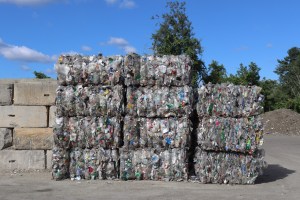
Vermont may yet feel the impact of constricting markets for those other materials. “If the West Coast ends up pushing their materials this way, we could feel a domino effect,” Hausman said.
Glass is an ongoing challenge for the Chittenden MRF and recycling facilities around the country, Morris said. The Chittenden facility uses crushed glass in construction and has been working to reduce the contamination rate so the crushed glass can be used by VTrans in road construction, Cathy Jamieson, director of the state’s solid waste management program, said in a department communication.
The average household in Chittenden County generates only about a quarter of a ton of “blue bin recyclables” per year, so the $25 per ton fee increase on its own is unlikely to increase costs much for individual households, Morris said.
“Recycling is not and has never been free,” said Morris. “People should be focused on reducing (waste) they’re producing.”
The Chittenden County district is attempting to discourage its members from engaging in what Hausman called “wishful recycling” —tossing pizza-stained cardboard boxes and diapers and other non-recyclables into the blue recycling bins.
Casella and other waste management companies in Vermont are trying to come up with a way to price recycling so that operating costs are covered without passing on to customers the added costs of market volatility. The company reported a $2 million loss in recycling revenue at the close of last year due mainly due to the Chinese ban, according to Resource Recycling.
“This is the worst recycling market in a generation,” Fusco said in an interview.
Casella includes a sliding fee on customer bills to “build in those changes in the recycling market” rather than changing rates. “In a good market, those fees go down – in a terrible market, those fees go up,” he said.
Local haulers, and thus consumers, are starting to see increases in their recycling drop-off rates. Denise Tuttle, owner of Swanton-based Tuttle’s Trucking and Recycling Inc., received a letter in March from Casella informing her that fees at the Highgate Transfer Station would increase to $110.52 per ton for recycling.
Tuttle said in an interview Tuesday that she had increased the fees she charges her customers for recycling by $1 in April, but it wouldn’t cover the latest price hike.
“It’s been a trial,” she said of the price increases, noting that she didn’t want to pass on another rate increase to her customers this year.
Tuttle and other haulers in Franklin County voiced concerns to John Leddy, executive director of the Northwest Vermont Solid Waste Management district — one of Vermont’s 16 municipal waste districts.
“For somebody who is trying to create a system where we manage our waste more responsibly, that’s a pretty worrisome trend,” Leddy said of the increases in recycling costs.
The four drop-off centers managed by the Northwest Vermont Solid Waste Management district require residents to separate their recyclables. In contrast to the material recovery facilities, which sort so-called single-stream recycling, the district is still able to generate revenue from mixed paper, Leddy said in an interview on Tuesday.
The district recycling center in Georgia sells bundled paper and cardboard to the WestRock paper mill in nearby Sheldon Springs. Source separation has enabled the district to sell to the local mill because their paper has “extremely low contamination,” Leddy said. Cans, plastics and other recyclables are sent from the Georgia center to the Chittenden MRF.
Leddy said that while his district still does not charge separately for recycling, residents will see an increase of $1 per bag of trash taken to the drop-off centers, to compensate for increased costs at the MRF and higher tipping fees at the Coventry landfill.

