

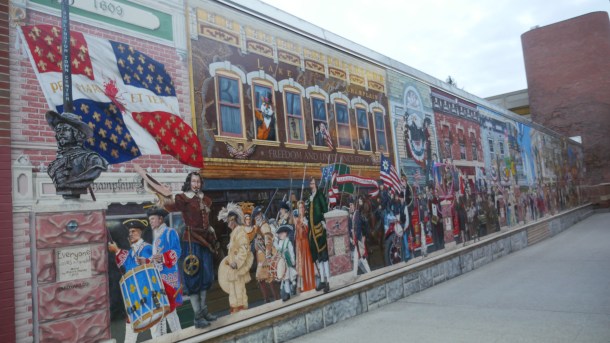
[B]URLINGTON – The Western Abenaki tribal nation hosted an educational event on Burlington on Saturday in response to the ongoing controversy around the “Everyone Loves a Parade” mural displayed along Church Street.
The Abenaki have been at the center of the conversation about how Vermont’s history is told, and who gets to be part of it, but the event was the confederacy’s first public reaction to a debate that has lasted for almost a month.
In October, an activist spray painted the words “Off the Wall,” on the mural, in protest of the lack of Abenaki representation in a work that features many of Vermont’s most prominent figures — mostly white men.
The action prompted calls from community members to take the mural down and eventually led the City Council to create a mural task force to recommend further action (that recommendation is expected next week).
As a result of those conversations, the Vermont Abenaki Alliance, which encompasses four Abenaki tribes — another tribr is not recognized by the state — talked with Burlington Mayor Miro Weinberger about ways to educate the public about the Abenaki throughout the state.
“When the thing happened with the mural, people were speaking for us and we said we speak for ourselves,” Don Stevens, chief of the Nulhegan Abenaki tribe, said on Sunday.
In May, Weinberger and Stevens released a joint statement saying that in lieu of an Abenaki representatives joining the mural task force, they would join forces with the city to promote an annual event on Church Street that shed light on and celebrated Abenaki culture and heritage.
“As leaders within our Abenaki communities, the Chiefs have decided not to participate in the ‘Everyone Loves a Parade’ Mural Task Force, but to find other positive avenues to promote our culture within the City,” Stevens said.
Stevens did give input on the mural, however.
“If the mural is to be changed or altered, we do feel that the Native person depicted on the mural should accurately and historically represent Abenaki people from this region,” he said in the statement.
The themes of Saturday’s event mirrored those that have come out of the debate around the mural: existence, visibility and cultural awareness.
Stevens was one of the hosts of the full-day event on the top block of Church Street, where organizers spoke the Western Abenaki language, taught those passing by about the significance of Wampum belts, told stories and had a drumming ceremony.
At one point a child joined the drumming circle for the friendship drumming.
“This is our future right here,” Stevens said. “Our youth is very important, like your children, we like to teach ours to be proud of who we are.”
That public pride is a newly reignited part of the confederacy, as many Abenaki were forced into hiding their identity, culture and traditions during the eugenics movement that officially ended in the 1970s, Stevens and other leaders said.
Roland Bluto Jr., of Milton, a council member for the Nulhegan tribe, said his parents were “hiding in plain sight” when he was a child, out of fear of the eugenics movement, which led to state sanctified-forced sterilizations of Abenaki people, along with others the deemed undesirable.
The Abenaki tribes themselves were not recognized by the state until 2011.
The activist who spray painted the mural last year, Albert Petrarca, has called the mural “fake history” for leaving out an entire group of people who lived in Vermont since 1100 AD.
The mural’s timeline begins in 1640 with the arrival of French explorer Samuel de Champlain. It also includes prominent Vermont figures from singer Grace Potter to Sen. Bernie Sanders.
Over the course of the nine months since the incident, the city has grappled not only with the social and historical ramifications of the mural, but who has the legal rights to the mural and whether or not the city can alter it without the artist’s permission.
Pierre Hardy, the artist who painted the mural, has said it was never intended to tell Vermont’s entire history, and suggested that more of the story can be told with another mural on a facing wall. He also said the proportion of white faces reflects the racial makeup on Vermont.
A mural task force has met several times to help the city determine the fate of the mural. They are planning on making a recommendation to the City Council on July 16 on how to move forward on the mural.
Corrections: The event was held Saturday, not Sunday as previously reported. Roland Bluto’s name has been corrected as has some of the specific tribal, alliance and confederacy references.

