

Editor’s note: Mark Bushnell is a Vermont journalist and historian. He is the author of “Hidden History of Vermont” and “It Happened in Vermont.”
[H]istory can seem oddly close at hand. Calvin Coolidge was born on the 4th of July 1872 and died 85 years ago, but visit his homestead in Plymouth Notch and you might feel like you just missed him.
The tiny community that formed the universe of his childhood, and which helped form him, remains intact. A visit to Plymouth Notch, now a state historic site and a national historic landmark, provides a glimpse of the man that no book can offer.
To many people, the idea of reading a book about Coolidge, much less visiting his homestead, seems like a joke. In the popular imagination, Coolidge has become a caricature of himself, dry and dull.
The caricature is a poor likeness. Coolidge was a man of few words, but those words were well chosen. Few presidents can match his eloquence or, despite the stolidity of his appearance, his passion. At the homestead’s visitors center you’ll find a display featuring a few of Coolidge’s most profound quotes, like his remarks at the 150th anniversary celebration of the Declaration of Independence:
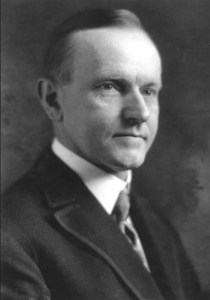
“We live in an age of science and of abounding accumulation of material things. … The things of the spirit come first. Unless we cling to that, all our material prosperity, overwhelming though it may appear, will turn to a barren scepter in our grasp.”
Look around the homestead and you will see the forces that shaped Coolidge. He adored the sheer beauty of the place, nestled in the hills and surrounded by rolling farm fields, and loved his family and neighbors. He was particularly attached to his mother, Victoria, who bore him in a small bedroom attached to the general store his father ran. You can still visit the store, now run as a gift shop, and look into the bedroom, complete with its original furnishings. Much of what you will see at the homestead is original, from the clothes hanging in the bedrooms to the carriages in the barns, because the property remained in the possession of family members until they donated it to the state of Vermont.
The Coolidge family moved across the street to a larger house when Calvin was 4. It was there, beside the cheese factory his grandfather founded, that the future president grew up. It was there, also, that Victoria Coolidge died when her son was only 12.
“The greatest grief that can come to a boy came to me,” Coolidge wrote of his mother’s death in his autobiography. “Life was never to seem the same again.”
Coolidge’s affection for his hometown didn’t die with his mother, however. Even after college and career took him to Massachusetts and later to Washington, he returned regularly. It was there in August 1923, while visiting as vice president of the United States, that he learned of the sudden death, apparently from a stroke, of President Warren Harding.
The homestead had no telephone at the time, so an employee of the Bridgewater telephone office had to deliver the message in person, arriving after midnight. Coolidge’s father, John, answered the door, then went upstairs to wake his son and tell him he was now president.
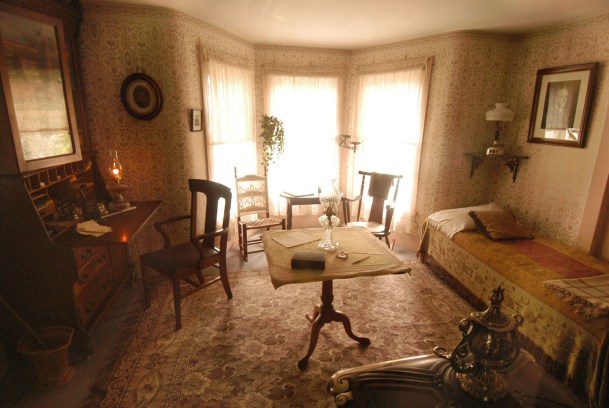
Coolidge immediately wired Washington for the oath of office. The text arrived a couple of hours later. Coolidge, now dressed and shaved, gathered with his father, his wife, Grace, and several others shortly before 3 a.m. in the family parlor, which was lit by a single kerosene lamp. Then he placed his hand on the family Bible and had his father, a justice of the peace, administer the oath. The room today is much as it was that night. Light filters hazily through gauzy white curtains. A kerosene lamp sits on a small square table that stands in the middle of the room.
Though he lived in the White House, Plymouth Notch continued to draw Coolidge, especially when he needed comfort.
It was there that he returned in 1924 in the aftermath of a personal tragedy involving his elder son, Calvin Jr. Photographs at the homestead show Calvin Jr. as a boy, posing beside some tobacco leaves he has helped harvest at a local farm. He has a wide grin. A shock of dark hair covers his forehead. He is a beautiful child. Another shot shows him with his parents at the White House. Perhaps he has just cracked a joke, because, uncharacteristically, his father’s lips are pulled tight in a broad smile.
Calvin Jr. died while his father was president. He developed blood poisoning from a blister he got playing tennis. In the days before penicillin, there was little the doctors could do.
“When he went,” Coolidge later wrote, “the power and the glory of the Presidency went with him.”
Just weeks after Calvin Jr. died, Coolidge spent 12 days in Plymouth Notch. With him came his staff and 18 Secret Service agents. Telephone and telegraph wires had to be strung to the village. Above the store, Coolidge Hall, which was ordinarily used for community dances and Grange meetings, became the Summer White House. Photographs show workers sorting through bags of mail at the long, simple tables that were made for White House use, and which remain in the hall today. All that mail flowing through Plymouth Notch was a boon to the local postmaster, Florence Cilley, who was paid based on the amount of postage she sold. Ordinarily, she made about $50 a year. During those two weeks, she earned $1,500.
With the president came the press corps, which turned the summer into one long photo op. Photographers sent the world images of Coolidge chatting with neighbors, cutting hay with a scythe, and fishing. When he did farm chores, the president donned his grandfather’s old farm smock, a formless, coarsely woven garment that seems like the ones in paintings of feudal serfs. People mocked the photos, saying the president looked ridiculous wearing that old thing. They considered it a bumbling effort to seem like a hardworking man of the people.
In fact, Coolidge wore the smock because that was what he always wore when he did his chores; it’s just that no one ever bothered to publish his picture doing it before. Coolidge was hurt by the criticism. Afterward, he took to doing chores dressed in a coat and tie.
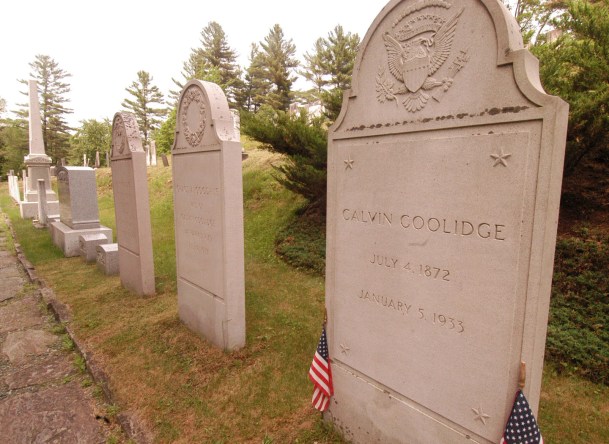
Today the old smock hangs on the wall of one of the homestead’s bedrooms. Below it are two pairs of Coolidge’s shoes, small and neatly polished. Looking at them, you half expect the man to enter the room, grab one of the pairs, sit on the bed and lace them up. But Coolidge doesn’t. He now rests just down the road at the Plymouth Notch village cemetery. His grave, with its simple headstone, sits beside those of Grace, Calvin Jr., and their younger son, John.
Unlike many former presidents, Coolidge does not have tour buses pulling up regularly to gawk. Most days you can visit the gravesite alone and experience the tranquility of the place Coolidge was proud to call home.

