

[T]he U.S. Senate advanced its first appropriations bills for the next fiscal year Monday evening with strong bipartisan support.
The package of three spending bills was the first measure to come to the Senate floor since Sens. Richard Shelby, R-Ala., and Patrick Leahy, D-Vt., brokered a deal to take a bipartisan approach to setting federal spending levels.
The Senate passed a $145 billion “mini-bus” of three of the 12 annual spending bills — energy and water, the legislative branch, and military construction and veterans affairs.
The bill won overwhelming support across the aisle, passing the chamber on a vote of 86-5.
The vote comes amid an effort to set federal spending through multiple bills, rather than through an omnibus, as has become the norm in recent years.
When President Donald Trump signed the fiscal package for the current year in March, he vowed not to approve a major omnibus again.
The “mini-bus” package will need to be reconciled with the House version of the legislation.
The House passed a $144.5 billion package of the same three spending bills earlier this month. The vote was largely split along party lines.
Shelby, the committee chair, told reporters last Thursday that there is still a ways to go on the appropriations process.
“It’s never drama free here because it’s not over yet,” Shelby said. “We’re just beginning.”
However, the senator was positive about the bipartisan process so far.
“We’re working together and it pays us to work together,” he said.
He was optimistic about continuing to work across the aisle on the spending packages.
“If we can continue to do this, we got a new day,” Shelby said.
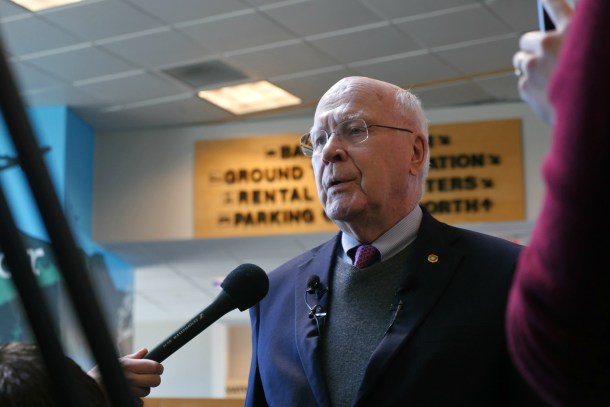
Leahy called the Senate appropriations process so far a “dose of sanity” in an interview Tuesday.
Leahy and Shelby agreed to a process to set the federal spending levels for the next fiscal year during a trip to a NATO meeting earlier this year. They are attempting to keep measures out of the spending bills that set policy, leaving those to the relevant committees instead, he said.
“We’ve had a lot of Republicans and Democrats on the floor saying, ‘about time,’” Leahy said.
This year, senators are trying to avoid attaching controversial proposals to the appropriations bills.
“You have this game of chicken, whether you’re going to kill Obamacare, whether you’re going to shut down the government, whether you’re going to get abortion or antiabortion language in,” Leahy said, “none of which has any place on appropriations bills.”
He was hopeful about the process for moving through the rest of the appropriations bills. Asked if he believes it is possible for lawmakers to finish setting the spending packages by the end of the fiscal year Sept. 30, he said he believes that depends on the House.
“If the House shows the same kind of leadership we have, we can easily,” he said.
The Senate mini-bus includes funding for weatherization and an energy efficiency program.
According to Leahy’s staff, the bills include new funding for the bills include $20 million for the Northern Border Regional Commission, a program that delivers economic development grants to communities in northern Vermont and nearby states. It also funds a post-traumatic stress disorder research center associated with the VA in White River Junction.
Lawmakers voted on a number of amendments to the bills, and approved some including one offered by Sen. Bernie Sanders, I-Vt., which appropriates $4 million to a test center for solar technology in Williston.
Sanders was among the senators who voted for the bill Monday. A spokesperson said the package “isn’t the bill Sen. Sanders would have written,” but he supported it because it funds veterans’ services and energy efficiency programs.

