


[A] joint Senate committee approved a third budget proposal of the session on Wednesday, but Gov. Phil Scott’s administration doesn’t appear to like it any more than the last one.
With 10 days until a government shutdown, “Budget 3.0” does not look like it’s going to be the vehicle for a compromise to bring an end to a legislative session that has now lasted 168 days.
A day after House Republicans killed the last budget bill by voting to back Scott’s veto, Democrats were back to work on a new budget deal.
A panel of senators from the appropriations, finance and education committees voted to approve a proposal Wednesday that they called a compromise with the governor because it used an additional $20 million of surplus revenue to buy down property tax rates next year.
But that is about $20 million short of what they would need to allocate in order to keep the tax rate level, which has been the governor’s chief demand throughout budget negotiations.
The Scott administration pitched its own plan which — just like its last two plans — would have involved using about $40 million to buy down taxes next year and achieve the governor’s pledge of no tax increases.
And once again, the Legislature said it was irresponsible, as it would create a bigger hole in the education fund that would have to be dealt with next year.
“We did not feel it fiscally prudent to have a $55 million hole in the education fund,” said Sen. Jane Kitchel, D-Caledonia, who chairs the Senate Appropriation Committee. “We felt that was a very large shortfall that would have to be addressed all at one time.”
While the surplus money proposed by lawmakers would keep average residential property tax rates level at $1.50 per $100 of assessed property value, nonresidential property tax rates would be set at $1.58, a 4.5 cent hike over this year’s rate.
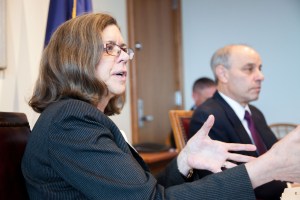
Secretary of Administration Susanne Young she didn’t want to get ahead of the governor by speculating on whether or not he would sign the bill, but said his stance on tax rates was well established.
“It’s the governor’s position that with the excess surplus, with over $55 million in excess tax revenues, we don’t need to raise the nonresidential by 4.5 cents, or by a penny even, or by anything,” she said.
Young said she did not foresee a $55 million hole on the horizon, due to a booming economy, education policy changes that will generate savings, and conservative school budgets she expects districts to put forth next year.
“This is not the first time a legislature and administration have used one-time money to fill the gap in the education fund,” Young said.
Democratic lawmakers say it would be reckless to pass a budget based on speculative savings, and argue that using one-time money to cover an ongoing expense violates sound budgeting principles.
Scott himself argued against using one-time money for ongoing expenses when he was a candidate for governor.
Senators also chided the administration Wednesday for offering up a proposal that failed to move any closer in their direction.
“They haven’t changed their position yet again and I’m very sad about that because I don’t think that’s the way we do democracy and the way we negotiate in this building,” said Sen. Ginny Lyons, D-Chittenden.
“The administration has not moved one iota,” said Sen. Michael Sirotkin, D-Chittenden. “I don’t see the compromise at this point.”
Young argued that the administration had offered concessions, just not on its central demand to pay down tax rates.
“My impression is that they’re not going to see anything that we offer short of a tax increase as negotiation and that’s just unfortunate,” she said.
The administration framed its proposed use of $81.1 million in surplus revenue as a compromise because some of it would go to Democratic priorities such as buying down teacher pension liabilities.
However, much of that money has only entered the conversation in recent weeks, allowing the administration to achieve its own priorities with some money to spare.
The surplus of “one-time” money come from the windfall from a state settlement with the tobacco industry, an unexpected $44 million boost in tax revenue and an assumed $19 million of additional tax revenue ($8 million of which has not been officially forecasted).
However, to fully buy down the nonresidential rate, the Legislature’s Joint Fiscal Office said that the state would need an additional $11 million not currently reflected in collected tax revenue, according to Stephen Klein, the office’s chief fiscal officer.
He said the funds are “beyond anything that we’re booking at this time.”
The administration said it would be willing to risk making budget cuts to prevent tax increases, in the event additional tax revenue didn’t come through.
Lawmakers rejected the idea of banking on “theoretical revenues.”
“We don’t budget on what we think or hope will happen, we respect our revenue forecasting process,” Kitchel said.
Kitchel said the amendment that contains “Budget 3.0” will be tacked onto a House bill that addresses vital records, and will be up for a vote in the Senate on Thursday.
She hopes it will reach the governor’s desk by Monday evening.
