



[G]ov. Phil Scott’s administration entered a new round of budget discussions insisting that it’s the Legislature’s responsibility to avert a government shutdown by producing a spending and revenue package that meets the governor’s uncompromising property tax demands.
The governor is refusing to prepare for a potential shutdown, despite requests from the treasurer and state employees for information about what would happen in such a scenario.
On Thursday evening, Scott struck down a budget proposal from the Legislature because it left open the possibility of a nonresidential property tax rate increase next year, which has become the sole sticking point preventing the signing of a spending bill before the June 30 deadline.
Both Scott and lawmakers have committed to negotiating a list of outstanding disputes after the budget is passed, but neither side will capitulate on the default tax rate, which is in a separate statute but would kick in if the two sides fail to negotiate a different rate for next year.
Democratic legislators say adding language to prevent a tax rate would take away their only leverage with the governor, while the governor says signing a bill without it would take away his leverage.
With just over two weeks until the funding deadline, a joint panel of House members called in senior administration officials to testify Friday, hoping they would explain how the governor is planning for a shutdown scenario if there is no deal by the end of the month.
However, Scott’s cabinet didn’t come equipped with answers about how a shutdown would pan out, and instead stressed that they’re not planning for one. They said they expect the Legislature to put forth a spending package in the coming days to meet the governor’s tax rate demand.
“In my opinion … the best way to prepare for June 30 and July 1 is to pass a budget that the governor can sign,” Secretary of Administration Susanne Young told legislators in a Statehouse meeting room.
“Take the remaining disputes out of that bill, get it passed, get it signed and put people at ease that we are going to be operational on July 1 and we are operating on that expectation,” she said.
Noting that the Legislature has “the power of the purse,” Young said it’s primarily up to lawmakers to assure the government appropriates funds in time for July 1.
Lawmakers rejected this argument, sometimes angrily, pointing out Scott’s decision to strike down two budgets this session.
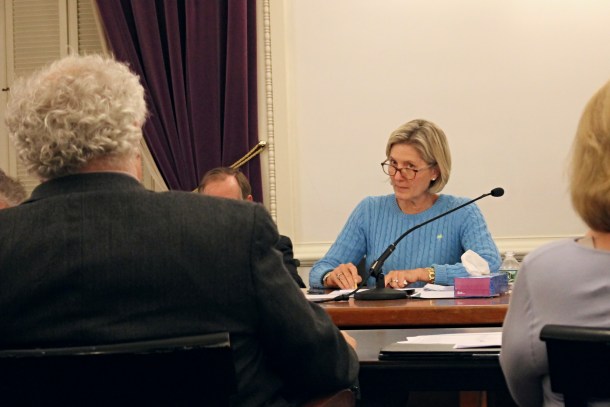
“We need two dancing partners at the table because one partner cannot appropriate money alone and one partner cannot certainly be responsible for shutdown of government alone,” Rep. Kitty Toll, D-Danville, the House Appropriations Committee chair, told officials Friday.
Democrats say the budget Scott vetoed on Thursday, H.13, was a bill Scott should have been quick to sign, as it leaves the areas of disagreement between lawmakers and the administration to be settled in a separate legislative agreement.
H.13 incorporates most of the initial budget and tax bills that were passed last month with broad bipartisan support, while carving out provisions in the few areas in which Democratic lawmakers and the Republican governor disagree.
The bill does not set tax rates, allocate surplus revenue or address education finance policy reforms, for example, and Democrats have sent letters to Scott promising to sit down for good faith negotiations in a separate bill — if he signed H.13.
Legislative leaders have said that their latest proposal represents significant compromise. It effectively levels residential property tax rates and sets aside the $34.5 million in surplus funds the governor wants to harness to buy down taxes next year.
Rep. David Sharpe, D-Bristol, chair of the House Education Committee, told Young Friday that lawmakers have moved in the governor’s direction without seeing reciprocal compromise.

“The response from you and the administration has been to dig in your heels and say unless you do exactly what we want we’re going to veto everything,” Sharpe said.
“I think to not plan for the fact that at some point the Legislature is going to dig in it’s heels and say ‘No more’ … to not plan for some sort of shutdown is irresponsible on the part of the executive branch,” he said.
Young said that by failing to address the nonresidential property tax rate in H.13, and then refusing to negotiate for the five days that the bill was on the governor’s desk, lawmakers stalled the negotiating process.
“As a result we have wasted a week of time where we could be negotiating our remaining differences outside the budget construct and we would have a budget in place so we could ensure continuity of operations on July 1,” she said.
Democrats will most likely attempt to override Scott’s veto next week, but will need to convince at least a few Republicans to vote against the governor, and their caucus.
Young noted that if lawmakers wanted to prevent a shutdown, they also have the option of putting a temporary appropriation on the table. Such a bill could ensure that government has enough funding to stay open for a short period of time at the start of the new fiscal year.
Lawmakers have only relied on a temporary funding bill once in Vermont’s history. In 1961, the Legislature appropriated money for one month, so that government operations could continue while negotiations over a budget impasse dragged on into July.
But Democratic leadership says it’s resistant to making temporary appropriations.

Sen. President Pro Tem Tim Ashe, D/P Chittenden, said Thursday that using spending bills that fund government for one or two months would set an “unacceptable precedent.”
“Because then what will happen is it will lead to a second one or two month funding bill and then every year, any governor — it doesn’t matter which party — if he or she doesn’t get what he or she wants, we’ll say OK well we can do one month spending bills,” Ashe said.
While lawmakers remain somewhat uncertain about what the ramifications of a government shutdown in Vermont would look like, attorneys with the Office of Legislative Council wrote in a memo Thursday that without a spending bill “most, if not all, state programs would ultimately lack funding to operate.”
Young herself said Friday that state employees ”will not be reporting to work and we will not have services available to the vulnerable” if there is a shutdown.
As the weeks of the special session drag on, concerns over a shutdown have mounted, particularly among state employees who worry they may stop receiving paychecks and benefits if there isn’t a budget in place by July.
Members of the Vermont State Employees Association, a union which represents about 6,500 people, walked out of the room as Young addressed lawmakers Friday, unsatisfied with administration’s approach to addressing the looming budget deadline.
Aimee Towne, VSEA’s first vice president, said the administration ruined an opportunity it had to diffuse fear over a government shutdown, by blaming the Legislature.
“I thought it was incredibly telling that the administration isn’t prepared for a government shutdown,” Towne said. “As a taxpayer, state employee, I have serious concerns regarding the shutdown and I left feeling more upset than I did going in.”
Colin Meyn contributed reporting
