

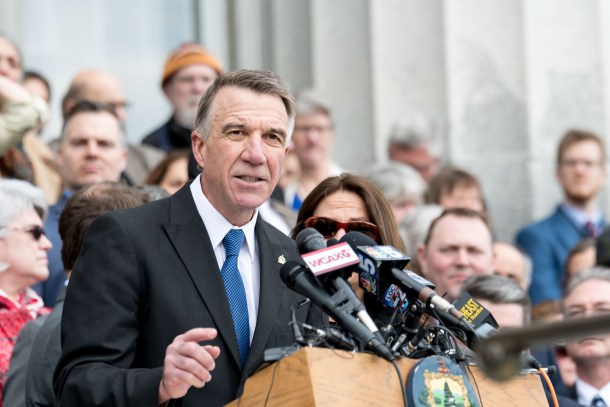
[G]ov. Phil Scott is polling at 52 percent favorability, according to a May poll of more than 700 Vermont voters, a significant fall from the 70 percent favorability he enjoyed in the lead-up to the 2016 governor’s race.
A total of 18 percent of respondents said they held a very favorable view of the incumbent governor, while 34 percent said they held a somewhat favorable view, according to the poll conducted by Public Policy Polling in mid-May and commissioned by the American Civil Liberties Union.
The poll found that 27 percent of respondents held a somewhat unfavorable view of Scott, while 18 percent held a very unfavorable opinion of him. Four percent of respondents said they weren’t sure what they thought about the governor.
The Castleton Polling Institute, which closed earlier this year, conducted a favorability poll months in advance of the 2016 gubernatorial election asking voters if they recognized candidates, and what they thought of them if they did.
In that poll, 77 percent of Vermonters said they recognized Scott’s name, the highest in what was then a crowded field. Among that group, 40 percent held a very favorable view of Scott, while 30 percent held a somewhat favorable view.
The margin of error for the survey, which was conducted via automated telephone interviews, is +/-3.7 percent. The majority of the questions related to Vermonters’ opinions about the criminal justice system and the role of state’s attorneys, with a few political popularity and demographic questions at the beginning and end.
Another question on President Donald Trump found that he had a 31 percent favorability rating among Vermont voters, with 60 percent holding a very unfavorable view compared to 6 percent somewhat unfavorable. That’s compared to 30 percent of respondents who said they voted for Trump in the presidential election, while 50 percent said they voted for Hillary Clinton.
Asked if they planned to vote in the August primary and/or the November general election, 81 percent said they planned to vote in both. Respondents were also asked about their party affiliation: 39 percent identified as Democrat, 20 percent as Republican, 6 percent as Progressive and 35 percent as independent or another party.
With the Castleton Institute closed, public polling is scarce in Vermont. The most recent polls of Scott’s popularity before ACLU’s survey was a Morning Consult poll conducted in the first quarter of 2018 gauging the favorability of America’s governors. Scott scored one of the highest ratings in the country with 65 percent of voters approving of his performance and only 21 percent disapproving.
Another Morning Consult poll conducted in the last quarter of 2017 showed Scott with a slightly lower 63 percent approval rating and steady at 21 percent disapproval.
Those polls were conducted before Scott signed a series of bills restricting firearm sales on April 11, which he conceded was likely to anger some of his conservative supporters. The ACLU poll was conducted just days after Scott called legislators back for a special session — he remains locked in a spending standoff with Democratic leaders in the Legislature with only three weeks to go until a government shutdown.
Brittney Wilson, the spokesperson for Scott’s campaign, said the Morning Consult and ACLU polls were conducted in different ways — one using an online polling tool and another using robocalls — and that it was not possible to discern meaning from comparisons of the resulting data.
“These two public surveys use different methodologies, formulas, and demographics that cannot be compared — it’s unscientific to make any determinations based on the two inconsistent sets of data,” she said in an email.
Richard Clarke, the former director of polling at Castleton, said that he suspected the ACLU poll omitted many landline users because of the technology used in their polling, potentially skewing the data. But even if Scott’s favorability has dropped, he said the governor still appeared to be in a strong position heading into campaign season, particularly given the history of Vermonters giving governors a second term.


“It’s not surprising, the guy in office is never as popular as the guy out of office. We have this reflective negativity towards people in office and politicians generally,” Clarke said.
“You think about it, you have a Republican governor in a largely Democratic state. To be above water, I don’t think is too bad,” he added.
Eric Davis, professor emeritus of political science at Middlebury College, said a falling favorability rating was to be expected the more time Scott spent in office — as was the case with predecessors Jim Douglas, Howard Dean and Peter Shumlin.
“At the time Scott was elected he got high 50 percent [of total votes], if you look at Douglas or Dean, or Shumlin even, their first re-election they tend to do as well as or even better, and they lose support after that,” he said.
On the other side of the race, it remains unclear whether any of the Democratic candidates can raise the money and reach enough voters to pose a serious challenge, Davis said. He said that former energy executive Christine Hallquist and environmental advocate James Ehlers seemed to have the best shot, and that campaign finance filings next month would bring some clarity to the strength of their campaigns.
“At this point I think it’s too early to make a judgement,” he said of the Democratic field.
Generic measures of Scott’s favorability don’t necessarily reflect how he will perform in a head-to-head comparison with his opponents, said Mike Smith, who is the CEO of Vermont Information Technology Leaders and previously held senior roles for Gov. Douglas.
“Electability is often more dependent on who is your opponent,” he said. “Many candidates that may have low favorability ratings win elections because the opponent is less liked.”
Smith said he was skeptical of public or advocacy driven poll results generally, explaining that internal polling was much more rigorous.
“Although these external popularity polls can illustrate trends, they are often not precise. My guess is that Scott is somewhere in between the two poll results,” he said of the Morning Consult and ACLU polls, which are 11 points apart.
“Even using the ACLU poll as the benchmark, so far Scott is in good political shape headed into a re-election,” he added.
Editor’s note: This article has been updated to include more information about the methodology used in the various surveys, and a comment from Brittney Wilson, Scott’s campaign spokesperson.
Correction: A previous version of this article mistakenly stated that Mike Smith works for the Scott administration. He is the CEO of Vermont Information Technology Leaders, which receives funding from the state.
