



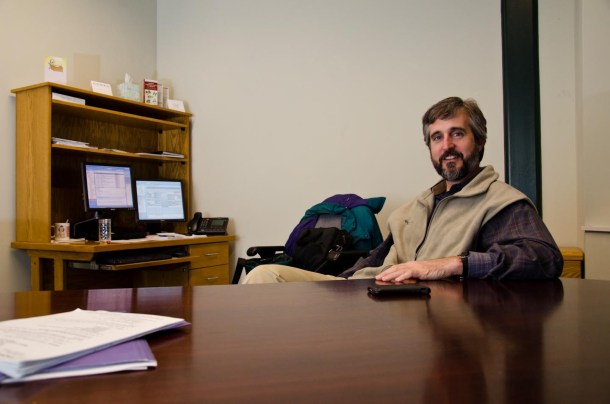
[D]avid Mears, director of Vermont Law School’s Environmental Law program, announced that he is stepping down from his position at the end of this month.
Mears said in an interview Monday that he will be leaving the school “for the chance to pursue other new opportunities” in Vermont or elsewhere in the nation.
“It’s an exciting and important time in the environmental law and policy world,” said Mears, who added that he wants to remain “engaged in moving the needle in a positive way” in light of national politics.
Vermont Law School President Thomas McHenry said that Mears had “made a tremendous impact to the school in the three positions he held here,” adding that he hopes to replace him with someone “equally dynamic and engaging.”
Mears has a long history with the South Royalton college, having obtained a JD and master’s in environmental law and policy from the school in 1991.
He went on to hold several attorney positions for the state of Texas and in the Department of Justice in Washington, D.C. He returned to Vermont Law School in 2005 as a faculty member, eventually heading the Environmental and Natural Resources Law Clinic.
The school has kept pace with the increasing complexity of environmental problems, Mears said, with creation of programs in which students partner with outside clients to address legal and policy challenges in fields like energy and sustainable agriculture.
“It has grown in some really important ways in terms of recognizing that environmental law and policy is no longer just about stopping pollution coming out of a pipe into a river,” said Mears.
Mears served as commissioner of the Vermont Department of Environmental Conservation under former Gov. Peter Shumlin from 2011 to 2015. Following his departure from the DEC, he has advocated for Vermont to establish a long-term source for clean water funding, which Gov. Phil Scott has opposed during his time in office.
Mears argued at a forum last December in favor of a parcel fee on developed land to address the myriad contributors to stormwater runoff. Facing opposition from Scott, the Legislature stripped funding mechanisms from the clean water funding bill, S. 260, this past legislative session.
“At top of the list is following through on the state’s commitments to address water quality issues in our surface waters, starting with Lake Champlain and moving onto the Connecticut River watershed and Lake Memphremagog,” Mears said when asked to name the key environmental challenges facing Vermont.
“I’m a little nervous that the state is going to lose momentum by the tripartisan failure to grow our capacity to fund and address that work,” he added.
Mears’ announcement comes amidst “restructuring” in the law school that will lead to changes in faculty positions.
Although Vermont Law School has consistently ranked as the top environmental law school nationwide, the school has not escaped the financial woes plaguing post-graduate legal institutes across the country since the recession.
The school went through a series of layoffs in 2013 and trimmed its operating budget by $4 million. It received a $17 million loan from the USDA in 2017 to restructure debt.
Vermont Law School began examining its faculty positions for “efficiency gains,” leading to some professors becoming professors emeritus and other faculty being asked to take on more or less work, according to the Valley News.
McHenry confirmed in an interview Monday that the school is undergoing negotiations with faculty members, but declined to comment further to protect the confidentiality of those discussions.
Despite these changes, Vermont Law School will retain its focus on environmental law, McHenry said, citing additions of two more full-time faculty members to the school’s Center for Agriculture and Food Systems.
“We are going to continue to have the preeminent environmental law and policy program in the country,” said McHenry.
