


[T]he Vermont chapter of the American Civil Liberties Union says it is putting a focus on the elected county prosecutor positions in the state this election season as a new poll conducted for the organization shows wide support for criminal justice reforms.
The Vermont ACLU this week sent out a roughly 20-question survey to all current candidates for state’s attorneys running for office this year in counties across Vermont.
A state’s attorney is elected for a four-year year term in each of the state’s 14 counties, earning about $110,000 a year. The filing deadline for major party candidates for the August primary was May 31.There are contested races in Lamoille, Bennington and Essex.
“Part of the point of this campaign is to draw people’s attention to this office,” James Duff Lyall, executive director of the Vermont ACLU, said Tuesday.
State’s attorneys, he added, are “so important not just to the criminal justice system, but to the health and safety of communities in the state in so many ways.”
In a poll recently conducted for the Vermont ACLU, 42 percent of respondents felt they knew little or nothing at all about state’s attorneys’ duties. In that same poll, after hearing a brief description of the duties of a state’s attorney, 92 percent of respondents said they played an important role in their community.
The questions in the survey sent to the candidates cover a variety of topics from bail and sentencing to transparency and law enforcement accountability.
Once compiled, the verbatim responses from the candidates to the survey questions will be made available on the Vermont ACLU website.
The Vermont ACLU will also be organizing public education events, including canvassing efforts and candidate forums. The ACLU of Vermont will not endorse or oppose candidates for elected office.
“We often say that state’s attorneys are the most powerful politician you’ve never heard of,” Lyall said in announcing the survey of candidates for state’s attorneys.
“If we’re going to build a smarter, fairer system of justice in this state, that has to change,” he added. “Every day, state’s attorneys make life-altering decisions in the name of their constituents, and Vermont voters have a right to know if those decisions reflect their priorities and their values.”

The survey questions ask the candidates to “please give a clear ‘Yes’ or ‘No’ and any explanation.”
Washington County State’s Attorney Rory Thibault, a Democrat and currently running unopposed, said Tuesday that he intended to respond to the survey. However, he added, even when including an explanation, some questions cannot be answered with a clear “Yes,” or “No.”
He said many times issues require greater “nuance.”
“The questions are fairly complex,” Thibault said. “Unfortunately, I think sometimes in the world of justice, issues are seldom black and white. Sometimes there are clear answers, other times, the exceptions or the caveats are important to ensure equity and justice.”
Thibault said while the Vermont ACLU is highlighting the powers of prosecutors, those powers do not go unchecked, pointing to voters and judges.
“We do have elections, and elections have consequences in terms of the view of what those prosecutors do,” Thibault said. “I can make a request for bail, or a certain sentence in case, or a plea deal, but it’s ultimately the court or the presiding judge who accepts or rejects those arguments or agreements.”
The following are a couple of the questions that are contained in the survey:
“If elected, would you commit to implementing policies and practices that will reduce your county’s incarcerated population by a specific percentage by the end of your term? Please give a clear ‘Yes’ or ‘No’ and any explanation. If ‘Yes,’ please identify your goal and what specific combination of reforms you anticipate will achieve this goal.”
”In past legislative sessions, Vermont’s Department of State’s Attorneys and Sheriffs has opposed criminal justice reform measures in the legislature while supporting tougher criminal penalties. Will you commit to speaking out in support of legislation to reduce incarceration, even if it means taking positions that are counter to the Department’s? Please give a clear ‘Yes’ or ‘No’ and any explanation.”
Addison County State’s Attorney Dennis Wygmans, also Democrat and running unopposed, said he, too, would respond to the survey “at least to the to the extent I am capable,” but expressed similar concerns about providing a clear “Yes,” or “No,” with each answer.
He said it would likely take him quite a few hours to respond “meaningfully” to the questions. Wygmans said he would have preferred if the Vermont ACLU had reached out to him and his office earlier if they had questions about views on criminal justice reform.
“I never heard from the ACLU or the Vermont chapter in the year and five months that I’ve been in office,” he said. “We live in a small state, there are a lot of personal interactions. I would love to work as a collaborative partner with folks, and I don’t think this was a great first step in that direction.”
The Vermont ACLU initiative aimed at improving prosecutorial accountability is part a nationwide advocacy effort aimed at criminal justice reforms called Campaign for Smart Justice, which the organization kicked off with a Statehouse press conference in January.

The campaign seeks to reduce the number of incarcerated people in Vermont and across the country, as well as address racial disparities for those jailed. In Vermont, the prison population is currently about 1,700, including more than 200 inmates serving time in an out-of-state facility in Pennsylvania.
To achieve its goal, campaign initiatives includes bail and sentencing reforms, drug policy changes and greater investment in rehabilitation programs.
In announcing this week the survey of candidates for county prosecutor offices in Vermont, the ACLU also released results of recent polling regarding criminal justice reforms matters.
The poll was conducted last month for the Vermont ACLU by Public Policy Polling, which is based in North Carolina.
The firm surveyed 705 registered Vermont voters on May 17 and 18, using interactive voice responses, known as IVR in polling circles. It means it was a recorded poll and people responded to the questions using their touchtone phone. The margin of error for the survey is +/- 3.7 percent, according to the firm.
According to the polling results, 77 percent of respondents reported that they were more likely to back a candidate who would hold police and prosecutors accountable for misconduct, and 72 percent reported being more likely to support a candidate who committed to making prosecutors’ decisions more transparent by sharing data with the public.
Here are a sampling of some of the other questions and responses:
“A State’s Attorney candidate who commits to reducing the number of people in our prisons by placing greater emphasis on alternatives to incarceration, like drug treatment, mental health services, and restorative justice. Would you be more or less likely to vote for this candidate, or would it not make a difference?
– More likely to vote for, 67 percent
– Less likely, 19 percent
– Wouldn’t make a difference, 8 percent
– Not sure, 6 percent
“A State’s Attorney candidate who commits to ensuring nobody is held in jail only because they are too poor to afford bail. Would you be more or less likely to vote for this candidate, or would it not make a difference?”
– More likely to vote for, 46 percent
– Less likely, 28 percent
– Wouldn’t make a difference, 18 percent
– Not sure, 7 percent
“Which do you think is a better way for your State’s Attorney to protect public safety: to aggressively prosecute people who have committed serious crimes because they are unlikely to change and will almost always be a danger to society, OR to give people who have committed serious crimes the possibility of turning things around and living productive and responsible lives.”
– Aggressively prosecute people who have committed serious crimes, 46 percent
– Give people who have committed serious crimes the possibility of turning things around, 45 percent
– Not sure, 9 percent
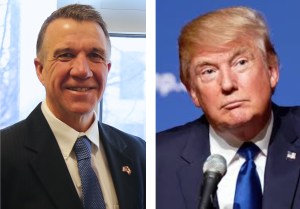
The poll also asked Vermonters about their feeling toward the chief executive officers of both the state and country.
Those two questions and results follow:
“Do you have a very favorable, somewhat favorable, somewhat unfavorable or very unfavorable opinion of Donald Trump?
– Very favorable, 22 percent
– Somewhat favorable, 9 percent
– Somewhat unfavorable, 6 percent
– Very unfavorable, 50 percent
– Not sure, 3 percent
“Do you have a very favorable, somewhat favorable, somewhat unfavorable or very unfavorable opinion of Phil Scott?
– Very favorable, 18 percent
– Somewhat favorable, 34 percent
– Somewhat unfavorable, 27 percent
– Very unfavorable, 18 percent
– Not sure, 4 percent
