


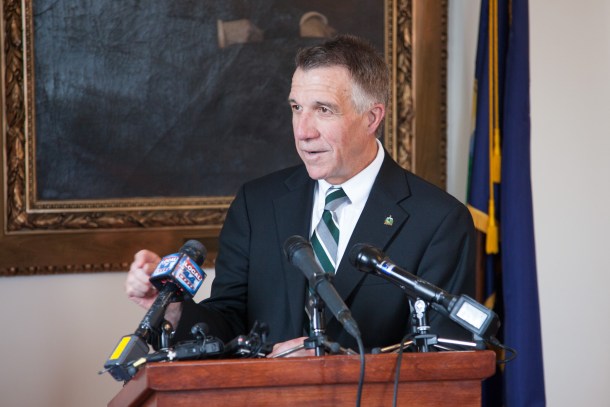
[G]ov. Phil Scott vetoed a bill on Wednesday aimed at eradicating “systemic racism” in state government, arguing that it contained an “unconstitutional” provision that would require a panel to approve his firing of the person appointed to be in charge of the new body.
Lawmakers and the Office of Legislative Council say Scott’s legal argument doesn’t hold water.
While Scott rejected the Legislature’s version of the proposal, S.281, he incorporated much of it — including provisions to create a five-member panel and cabinet-level position of “Executive Director of Racial Equity” — into an executive order he signed this week.
Scott’s order will still establish the panel and position, however it eliminates a provision in the bill that would have prevented governors from firing the equity director without the consent of the five-member body.
In the governor’s veto message, explaining his rationale for killing the bill, Scott said limiting a governor’s ability to terminate cabinet-level appointees violates the state’s constitution.
“Unfortunately, during the last days of the session, language was added that would usurp the executive’s Constitutional authority to remove a cabinet member responsible for performing an executive function,” Scott wrote.
“The exercise of executive authority by an inter-branch entity over a Governor violates the separation of powers dictated by the Constitution,” he added.
The bill as passed by the Legislature would have given the governor the power to select the cabinet officer from a group of nominees selected by the panel.
But the provision lawmakers added to the bill in conference committee would have required the governor to have the backing from a majority of panel members to fire the equity officer.
The panel would be comprised of five members, appointed by the chief justice of the Supreme Court, the speaker of the House, the Senate Committee on Committees and the Human Rights Commission. One nominee would be selected by the governor.
Crafters of the systemic racism bill say they added the provision in question to make sure the cabinet officer has some independence from the administration.

“When you’re trying to tackle something like systemic racism the conversation is not always going to be easy and you need to have that independence,” said Sen. Chris Pearson, P/D-Chittenden.
“You’re talking about culture change here, this isn’t going to be easy. The director is going to confront agency heads and point out flaws in their system … that isn’t always going to be without friction,” he said.
The House bill was changed drastically from the initial legislation drafted by the Senate, which would have given the equity officer complete independence and subpoena power to investigate cases of racial abuse or discrimination.
Those changes were made largely in an attempt to get the administration on board.
Rep. John Gannon, D-Wilmington, who was also a member of the conference committee, said the administration was not able to show lawmakers with “any precedent” to prove the provision was unconstitutional.
“We heard that argument from the administration and we didn’t think it was a strong argument and thought that it was important that the chief officer have some independence,” he said.
The Office of Legislative Council isn’t convinced either.
Responding to a request from Senate leader Tim Ashe, D/P-Chittenden, for an analysis of Scott’s argument, legislative lawyers said the bill “does not violate the separation of powers requirement” and that lawmakers “may dictate the terms of removal of an Executive Branch officer.”
In the memo sent to Ashe on Thursday, the attorneys said that unlike in other states, Vermont’s constitution “does not grant the Governor specific authority to remove Executive Branch officers.”

In response to the memo, Rebecca Kelley, a spokesperson for the governor said the administration “believes the constitutional violation is clear.”
“Our constitutional concerns were raised throughout the Legislative process – including during the Committee on Conference – therefore, it’s unclear why Sen. Ashe (or those supporting this provision on the Conference Committee) would wait until after the veto to request an opinion from his legal counsel,” she said in an email.
According to those who drafted the bill, state workers who are black are more than twice as likely to voluntarily leave state employment than their white counterparts.
Gannon, who has been a leading proponent of the bill, noted on the House floor in April that state workers of color make 10 percent less on average than white workers.
In his veto message, Scott said that his executive order “goes beyond what was contemplated in S.281” by mandating training on implicit bias and recruitment for increased diversity for leaders in all state agencies and departments.
“This Executive Order is modeled after S.281 but goes further in our effort to ensure racial, ethnic and cultural diversity, equity and equality,” he said.
