


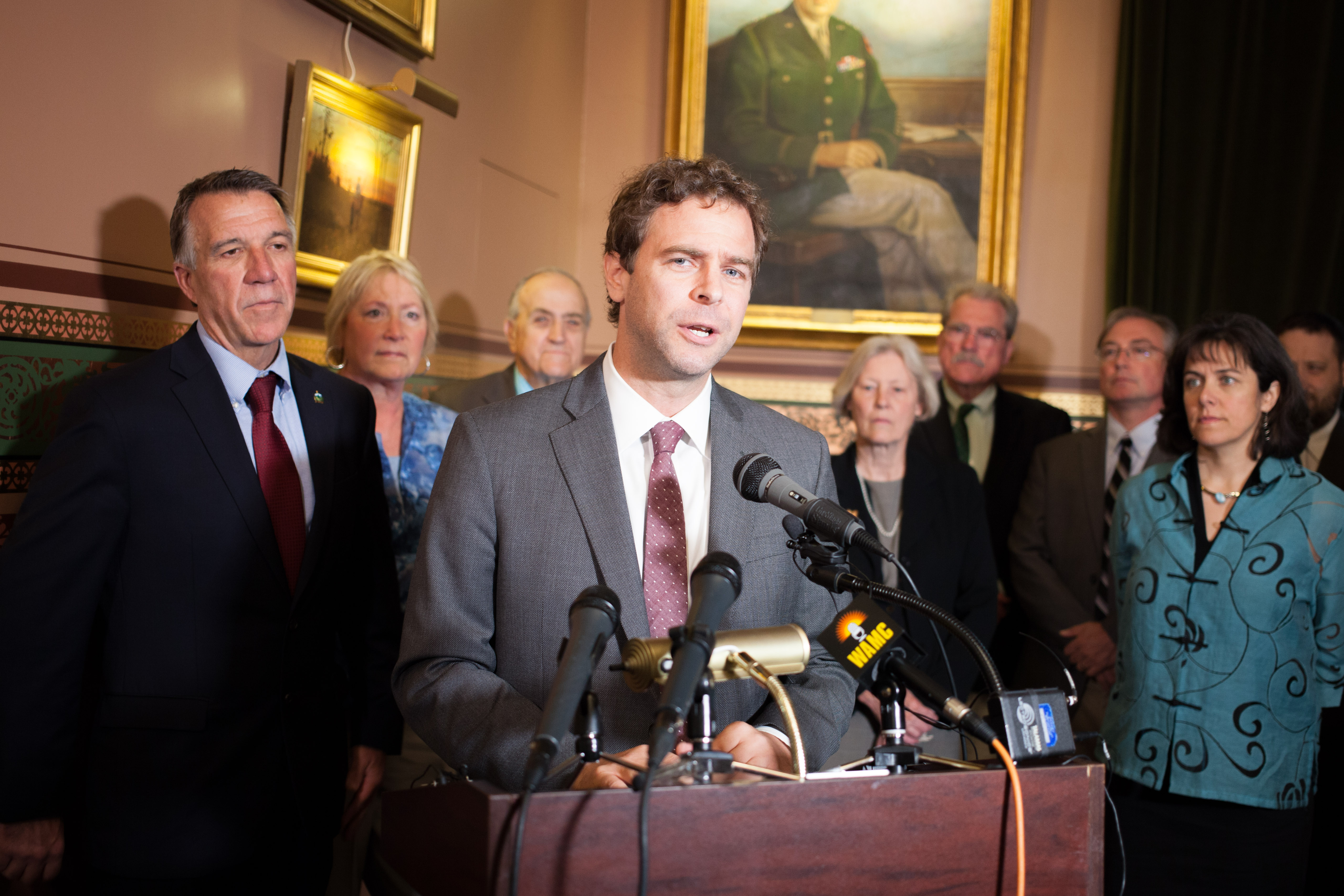
It’s all just “dirty politics” said one Republican House member to another on their way to the cafeteria after yet another meaningless meeting.
If only it were that interesting.
In its second week, the special session of the Legislature is becoming a very dull show. The rhetoric on all sides (there are more than two), never sparkling in its originality, has become tiresome through repetition.
“I’m not signing a bill that raises taxes and fees,” said Republican Gov. Phil Scott the other day. “End of story.”
What the governor proposes is “putting the state’s finances on a credit card,” said Democratic House Speaker Mitzi Johnson.
Yes, that’s what they said last week, the week before, and the week before that, going back at least to late April. The lines have been drawn in the sand. And redrawn. The debate has now sunk to the level of “there ain’t room enough in this town for the both of us” without either the dramatic potential or the inherent rhythm of that line.
If nothing else, everybody needs a better drama coach.
At least some of the actors in this production sense that it isn’t very interesting, and that their audience — actual Vermont residents and citizens — is dwindling. “It’s the start of summer,” said one veteran Statehouse operative. “People are planting their gardens and planning their vacations. They are not tuned into what is happening here.”
Perhaps especially because what is happening here is not that momentous. Eventually all sides will agree on a plan that either raises some property taxes or (more likely) doesn’t, and that puts in place some mechanisms for holding down public school spending in the near future.
But the (unlikely) tax increase would be small. It would not apply to owner-occupied homes. And future school spending is already being held down. So far, only a few local districts have combined due to the incentives (some say coercions) of Act 46, but Agency of Education officials expect many more such mergers this summer, with the potential for administrative cost-cutting. There were 551 fewer classroom teachers last year than there were in the 2012-13 school year, according Agency of Education data, and the Legislature has passed laws designed to cut spending on special education and teachers health care.
Whether all this will hold down costs enough depends on how “enough” is defined and who defines it. But whatever the Legislature and the governor agree to will build on an existing process.
Besides, some lawmakers, lobbyists, reporters, and even (very quietly) a few Scott administration officials are wondering whether this whole production was necessary. The state has a total of some $160 million more than it expected to have in the bank.
That’s a lot of “look what I found” money, possibly enough for all sides to get what they really need in a spirit of peace and harmony.
Instead, all sides decided to fight over it. The Democrats rejected Scott’s proposal to put enough of that “found” money into the education fund to avoid any property tax increase this year. The Democrats said and keep saying that Scott is effectively borrowing the money from the future (Mitzi Johnson’s “credit card”), and that it would be far more fiscally responsible — and save more money for taxpayers — to use more of it to pay down the state’s long-term teacher pension liability.
What Scott proposes is borrowing the money. But he claims he can pay it back over five years by using his own plan to suppress future education spending. The Democrats are dubious about his data. So are independent numbers-crunchers. And anyway, one need not be a numbers-cruncher to find flaws — or at the very least unsupported and optimistic assumptions — in his plan.
So now the dispute is at least political, if not personal. It’s mano a mano. It’s not exactly, “there ain’t room enough in this town for the both of us.” It’s more like, “I refuse to be the first one to blink.”
Even some Democratic legislators agree that their side is likely to be the one that blinks. They’ve already done a little blinking, agreeing, as Johnson said, to “no tax increase on residential property.” Scott has not blinked a bit.
Democrats know that. Talking with a Republican colleague Wednesday, one Democrat decried the prevailing “we win, you lose” attitude. “At some point, there’s got to be a little win on both sides,” said the Democrat.
Phil Scott may not think so. He doesn’t have to; his message is simpler.
Not that his political situation is all that secure, which could help explain why he has not yet rejected the Democratic proposal to pass what might be called a feel-good budget — everything except the controversial stuff about property taxes — to make sure that state government keeps functioning after fiscal year 2019 starts on July 1. No governor would want to be blamed for what would happen if no budget is approved by then.
The governor seems to understand that he doesn’t have the full support of Republican lawmakers, many of whom voted for the tax and budget bill including the property tax increases. Those GOP legislators seem to think levying those taxes was responsible governing, following the wishes of the voters who approved almost all school budgets in March.
“As Phil Scott likes to say,” Mitzi Johnson said, “Vermonters handed us divided government.” She seemed to be holding out hope for some compromise that would not be interpreted as the Democrats caving in.
Anything is possible. But the Scott campaign — the campaign: “Team Scott” not the administration — started the week by releasing what could best be described as a screed assailing a “legislative majority defending a broken funding system driving unsustainable costs and growing inequality.”
No compromise there. No subtlety, either. It was some 900 words of tendentious, turgid, overwrought, fact-challenged prose. A bad grade in writing class, but sometimes this stuff is politically effective.
