


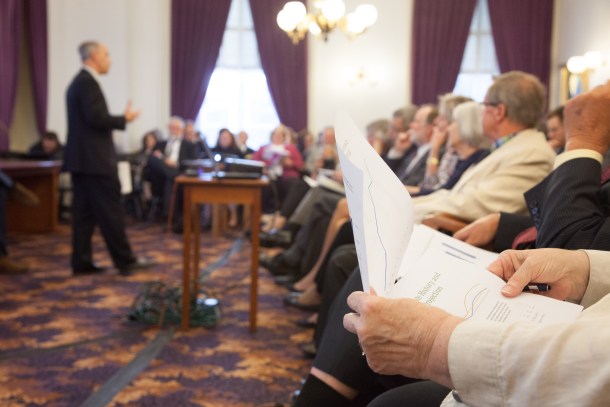
[L]awmakers returned to the Statehouse on Wednesday for a special session to hammer out a deal with the governor, but there was little talk of compromise on either side as the administration continued pushing a proposal that has been roundly derided by Democrats.
A day after vetoing this year’s priority progressive bills — on minimum wage and paid family leave — Gov. Phil Scott sent senior officials to try to sell an education funding plan that has proven deeply unpopular with the Democratic majority.
There were almost no discernible changes to what was billed as a “counterproposal” from the administration, after its plan was panned at the end of the normal session.
Instead, senior officials again walked legislators through a proposal to inject $44 million of “one-time” money — mostly unexpected excess revenue — into the education fund, and then enact a slew of education policy changes to generate savings to pay it back over a few years.
Benefitting from an extra couple weeks of running the numbers, the Democrats found new lines of attack to make the same point: it’s unclear if the governor’s plan will work, and it could just make things worse.
The Joint Fiscal Office also gave a series of presentations showing holes and unintended consequences in the administration’s plan, including projections showing that the governor’s plan might actually keep tax rates artificially high in a few years by freezing the rate in place.
Although only $34 million divides the governor’s plan from the budget and tax bills passed by the Legislature, both sides stood by positions that they have called “non-negotiable.” The governor will not raise the property tax rate, and legislators say meeting that objective is a waste of taxpayer money.
“Our belief is that we should not be using one-time money to artificially pay down these tax rates for one year only to face the same problem next year,” Senate leader Tim Ashe, D/P-Chittenden, said of the Legislature’s negotiating position.
The budget the Legislature passed last month puts most of this excess revenue towards paying down teacher pension debt — a move lawmakers say could save $100 million over time.
Scott argues these savings won’t materialize until 2038, and that the money generated through the savings outlined in his plan can be used in the coming years to pay down that pension liability if lawmakers want.
The savings in Scott’s plan would be generated through a number of initiatives: reforms of the special education system, a statewide teacher health care plan, a task force to accelerate school consolidation and a threshold that penalizes districts that spend above a certain level on their schools.
Lawmakers had various issues with how the administration came up with savings projections that exceeded $500 million. On the statewide health care benefit, for example, the amount of savings will be largely dependent on negotiations that haven’t happened.
For the second time this month, analysts with the Joint Fiscal Office told lawmakers they can’t figure out how the administration has arrived at its total projected savings. JFO’s original critique of the plan found that special education cost reductions were double booked and, calling into question nearly $200 million of the net $300 million in savings.
The lion’s share of the net savings would come from changes to student-teacher ratios, but there is no mandate for districts to meet certain ratios, and legislators argue that because the administration’s plan would invest local savings in state programs, there is little incentive for districts to cut costs.
What’s a ‘tax increase?’
Lawmakers noted that the foundation of Scott’s plan — that there will be no property tax increase — is not correct. Many taxpayers will still see property tax increases, even if the governor keeps statewide average rates level.
According the the JFO, 127 Vermont towns would see tax rate hikes under his plan, even with the one-time funding.
“So people who live in 127 towns are going to see a tax rate increase, and that’s OK?” Rep. Janet Ancel, D-Calais, who chairs of House Ways and Means, asked of administration officials Wednesday.

Tax Commissioner Kaj Samsom said the administration has always focused on bringing down the average statewide rates, which means that towns that spend more on schools will continue to face higher property taxes.
“We’re not proposing to say that a town that spends 50 percent more than the average per pupil spending or the yield should not feel a higher rate,” he said.
Samsom also noted that those towns would still see more property tax relief under the governor’s proposal than they would under the Legislature’s tax bill.
Bad math?
The central piece of the savings plan remains increasing staff-student ratios across the state. And although the administration has backed off mandates or additional taxes on noncompliant districts, it has stood by a projection of $250 million in savings.
Rep. Kitty Toll, D-Danville, who chairs the House Appropriations Committee, said she doesn’t see how that’s possible.
“I just don’t see $250 million in savings over five years in student-teacher ratios, I really question that,” Toll said in an interview.
“To book those savings on a recommendation that hasn’t been done yet and the study hasn’t been performed, it looks like the cart is way before the horse when you’re talking about this much in savings,” she said.
There were also problems with the administration’s projected savings of $62 million over five years from switching to a statewide teacher health care benefit, according to Joyce Manchester, JFO’s analyst.
Mainly, her office could not figure out how the administration reached the figure, so could not corroborate those projections, and was not getting any clarity from their colleagues in the executive branch.

Sen. Jane Kitchel, D-Caledonia, who chairs the Senate Appropriations Committee, told administration officials that her committee was struggling with the looseness of the proposal’s figures.
“A five-year plan is really valuable but it has to be real,” she said. “That’s what we’re struggling with, what are the right figures, what are the right amounts to make assumptions around?”
She said she was concerned about using “theoretical savings where there’s a high risk that they won’t materialize.”
Adam Greshin, the commissioner of the Department of Finance and Management, said that any investment plan has its skeptics.
“We think this is a worthwhile investment,” he said. “We’ve done our homework. We’ll do more homework.”
Legislative committees handling the budget and main tax bill are expected to continue work throughout this week, but the full House and Senate won’t come back to work until next Wednesday, when they could vote on bills if they are ready.
Although the contours of a deal were not apparent on Wednesday, House Speaker Mitzi Johnson, D-South Hero, said she was keeping an open mind.
“I think the Legislature has been signaling all along that we’ve been willing to compromise,” she said, adding that staking out “non-negotiable” positions was not conducive to actually getting the work of government done.
Both Ashe and Johnson said they were not prepared to start thinking about a government shutdown, but also were not going to cave to the governor’s “no taxes and fees” pledge just because he says he won’t budge.
“The governor is not the only party in these discussion that is entitled to a non-negotiable position,” Ashe said. “And so the Legislature will keep trying to do the fiscally sound thing and we hope he will move in our direction.”
