


[O]wners of new solar energy systems will see a reduction in the fees they get for energy they return to their local utility, under an order issued by the state Public Utility Commission.
The systems, generally known as net-metered projects, will see a 2-cent reduction in the rates they receive for selling renewable energy credits to their utilities from new projects, phased in over two years. There also will be a 1-cent cut for developers who sell power from the largest net-metered installations, rated between 150 kilowatts and 500 kilowatts.
In announcing its decision, the commission said that renewable energy “is flourishing in Vermont and has reached a level of maturity where it can continue to be deployed with lower incentives.”
It cited a record number of solar permit applications as proof that the industry no longer needs to be subsidized by higher rates.
The reductions will go into effect in July, with the second 1-cent cut coming in July 2019.
The solar subsidy program has been so popular that the state has already surpassed one annual statutory requirement for in-state renewables. In 2017, by statute, electric utilities needed to source 1 percent of retail electric sales from new renewable-energy generators smaller than 5 megawatts. That quantity increases by 0.6 percent each year until 2032, when utilities must source at least 10 percent of retail electric sales from new, renewable-energy generators smaller than 5 megawatts.
That requirement amounts to between 25 megawatts and 30 megawatts of new renewable-energy generating capacity statewide annually.
According to the commission order, 43.8 MW of new net-metered renewable generators went online in 2016, and 42.2 MW in 2017.
The cheaper types of renewable-energy arrangements that the Public Utility Commission wants to encourage as an alternative to net metering — so-called “standard offer” contracts, along with power-purchase agreements and utility-owned generating systems — represented another 37.1 MW in 2016 and 15.6 MW in 2017.
Jake Marren, a staff attorney for the commission, said because new net-metering systems will easily supply what utilities will require to fulfill these statutory obligations, it is “appropriate to unwind some of the financial incentives” that were intended to “jumpstart” Vermont’s renewable-energy efforts.
Although the order speaks primarily of keeping rates down, Marren said the order also speaks to the larger issue of global warming. The cheaper that electricity is in Vermont, he said, the more likely Vermonters are to convert the state’s most polluting activities — such as transportation, accounting for 40 percent of Vermont’s greenhouse gas emissions — from being powered by fossil fuel to being powered by electricity.
Renewable-energy groups say the lower rates will discourage developers and homeowners from installing new solar systems.
The state policy change will be another blow to the renewables industry, which is already under siege, according to Olivia Campbell Andersen, executive director of industry group Renewable Energy Vermont. Gov. Phil Scott’s administration has already put a moratorium on large wind development, she said. On the federal level, President Donald Trump has put a 30 percent tariff on solar panels from overseas and cut funding for research and development in clean energy by 72 percent.
“Lowering the price for net-metered electricity from projects that typically serve towns, schools, hospitals and universities just makes it further challenging for them to save on their electric bills and go solar,” Campbell Andersen said.
The commission’s decision further saps the momentum of in-state renewable energy development at a time when evidence increasingly calls for dramatic interventions to prevent climate change, according to Nick Charyk of Williston-based All Earth Renewables.
“It’s an additional frustrating disappointment,” Charyk said. “This is the wrong direction. We need more renewable energy, we need it now, and we need it fast. We only get one chance at this.”
Riley Allen, the deputy commissioner of the Department of Public Service, which regulates the utility industry, says the commission’s order will slow solar development in Vermont, but in the long run the decision will help the state lower its fossil fuel use in other energy sectors.
That’s because cheaper power will encourage Vermonters to convert the state’s two largest sources of carbon emissions — driving and home heating — from being powered by fossil fuels to being powered by electricity, Allen says.
Vermont has the second-cheapest electric rates in New England, but because New England must import virtually all of its energy, the New England region as a whole has higher electric rates than anywhere else in the country other than Hawaii and Alaska. Due in large part to the state’s energy-efficiency utility, however, Vermonters currently pay significantly less on average per month than most Americans for their electricity — while the state’s electric rates are the eighth-highest, the average electric bill is the tenth-lowest in the country.
Converting the state’s heating and transportation sectors from fossil fuels to electricity will be more effective in reducing the state’s greenhouse gas emissions than net-metering subsidies for small, new solar developments, which will only make the state’s electricity supply marginally greener, Allen said.
“In a very immediate sense, I think the argument could be made that this is adverse to our climate change objectives, but I think when you step back, it actually, I think, helps to serve our objectives for addressing these climate challenges,” Allen said.
Most of Vermont’s fossil fuel emissions come from vehicles and residential heating sources, accounting respectively for 45 percent and 28 percent of greenhouse gas emissions statewide in 2012, according to the state’s Comprehensive Energy Plan.
A keystone of that plan, and current state policy, aims to convert drivers’ fuel source from gasoline and diesel to electricity, because more than half of Vermont’s electricity currently comes from renewable sources — primarily Canadian hydroelectric dams.
Riley said Vermonters are more likely to make that shift if it doesn’t cost them very much.
“The more affordable electricity is, the easier it is to shift energy demand from carbon-intensive transportation and building heating, and to transform it to electricity,” Allen said. “The pursuit of lowest-cost pathways, I think, helps to ensure that — in a democratic society, it helps reinforce the political will to pursue those objectives.”
The impact on net-metering
Net metering is a state-subsidized program that encourages Vermonters to generate their own renewable electricity and sell it to in-state utilities.
Because net-metered installations are among the smallest renewable-energy projects, they’re also among the most expensive to develop, per kilowatt.
The current price for net-metered power is between 14 and 18 cents a kilowatt. Power from Hydro Quebec, which represents 20 to 25 percent of the power used by utilities in Vermont, is thought to cost utilities around 6 cents a kilowatt. Power from the New England grid costs in the range of 4 cents a kilowatt.
Net metering costs more because Vermonters — like the residents of 31 other states — sought to spur solar and other renewable development in order to advance the technology and to give the market a foothold, Allen said.
Net metering and other forms of in-state power generation offer still further benefits that in part explain their relatively high price, Allen said.
For instance, in-state power generation benefits the Vermont economy through what’s known as the “multiplier effect,” he said — meaning that $1 spent on goods produced inside the state spurs the economy to a greater degree than $1 spent on imported goods.
Solar power also carries a value for the New England grid, in that solar power reduces the level of investment New Englanders must make to keep their grid appropriately sized, Allen said. That’s because New England’s power grid must accommodate the maximum, or “peak,” demand consumers place on it; that peak falls on sunny, summer days in New England, which is when solar generators put out the most power. Solar power carries a year-round value for utilities, he said, because it’s produced in the greatest volume when it’s most needed, and because it takes up relatively little volume on the grid at other times.
The returns for net metering were set high to incentivize Vermonters to install solar systems. And small-scale net-metered solar developments remain the most popular form of renewable-energy generation in the state.
In 2017, the state received 2,556 applications for net metering. The year before, 3,185 were filed with the commission.
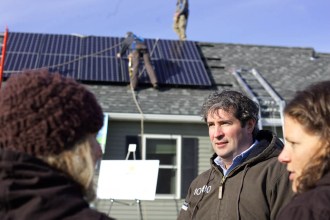
While the number of applications is high, the amount of power expected to be generated by the projects tell a different story, according to James Moore, co-founder of SunCommon, Vermont’s largest solar installer.
The net-metering projects applied for in 2016 could supply up to 66,000 kilowatts; the net-metering projects applied for in 2017 could supply up to 33,600 kilowatts, Moore said, citing the commission’s May 1 order.
There was a much sharper drop in the capacity represented by the largest net-metering applications, Moore said. That figure dropped from 35,000 kilowatts in 2016 to 10,000 kilowatts in 2017.
The sharp decrease was the result of another commission order from 2016 that was meant to slow the pace of solar development as well — and primarily the pace of development for the largest and cheapest net-metered projects, Moore said.
“The hits keep coming, in solar, and we’ll roll with it,” Moore said.
SunCommon aims to reduce the cost of solar electricity every year, Moore said, and at some level it’s “prudent” for the Public Utility Commission to keep rates low. But he says “the conversation around it, and how it’s done, will have real impacts on Vermonters and the pace at which we make the change.”
Environmentalists are disappointed to see the commission add to what they say is a growing list of impediments from the Trump administration and Scott administration that have gutted meaningful action on climate change mitigation.
“It’s not any one thing — it’s a death by a thousand cuts, and right now Vermont isn’t actually living up to its obligation to ensure we can collectively act on climate [change],” said Ben Edgerly Walsh, Climate and Energy Program director at the Vermont Public Interest Research Group.
Scott has sought to eliminate Vermont’s Clean Energy Development Fund, to institute a tax on electric vehicle use, and to cut the state’s energy-efficiency utility budget by 10 percent, Edgerly Walsh said.
By further slowing solar development, Edgerly Walsh said, the Public Utility Commission “is pushing us away from meeting our climate goals.”

