

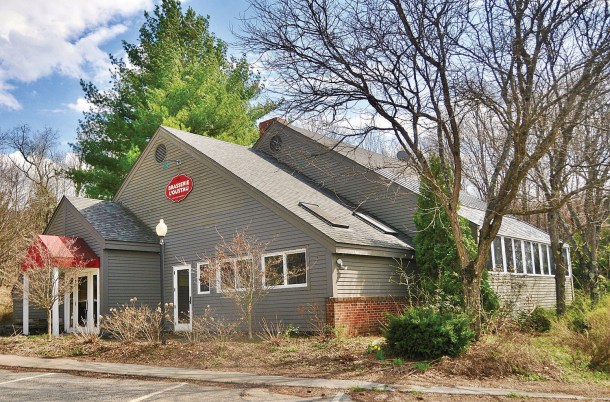
[M]ANCHESTER — The buyer of a Manchester restaurant, stricken by an apparent case of buyer’s remorse two days before the closing, cannot be forced to go through with the purchase without other options being explored, the Vermont Supreme Court has ruled.
The high court reversed a Bennington Superior Court decision ordering R.E.E.& C. Capital Management Services to complete the purchase of the former Brasserie L’Oustau restaurant, which it had acquired at a foreclosure auction in November 2016.
R.E.E.& C. Capital had bid $500,000 for the 4,500-square-foot, 125-seat restaurant, at an auction following a foreclosure action by the mortgage holder People’s United Bank against the former owners, Alana Provencale Inc., which had been approved by the Bennington court a month earlier.
Two days before the scheduled closing in February 2017, the winning bidder withdrew, citing the lack of conventional financing, and his investment group’s reluctance to take a chance on the property. Before it had been a brasserie, the property had operated under the name Laney’s Restaurant, which closed in 2011.
In a letter to the bank, a representative of R.E.E.&C. Capital said the company had weighed not following through with the purchase and forfeiting the $10,000 deposit or asking to extend the closing date “to allow me time to put another [investor] group together” and had opted to withdraw.
People’s United sued to compel the sale, and in June 2017 Bennington Superior Court Civil Division Judge William Cohen ruled in favor of the bank.
The Supreme Court’s April 27 ruling sent the case back to Superior Court “for proceedings consistent with this opinion.”
In his earlier ruling in favor of the bank, Cohen noted that a second auction “would result in a substantially lower bid, as indicated by [the auctioneer’s] interviews with the next two high bidders. Were the court to allow R.E.E. & C. to back out of its agreement now, it would deprive the parties of the active bidding that took place.”
Under Vermont foreclosure statutes, attorneys for R.E.E.&C. argued, failure to close on the property should have resulted only in forfeiture of the $10,000 deposit.
The high court agreed that a successful bid in a court-approved foreclosure sale and the subsequent court confirmation of the sale “renders a buyer a limited party such that the court is authorized to issue orders directing the buyer’s action relative to the property’s purchase.”
But considering the remedy imposed by the trial court, an enforced purchase, the Supreme Court said that such an option “is a remedy available only when there is no adequate alternative remedy, and the plaintiff [People’s Bank] has the burden to prove that alternative remedies are inadequate.”
The trial court “must determine whether there is an alternative plain, adequate, and complete remedy that could make the bank whole, and then weigh that alternative remedy against the bank’s argument regarding the insufficiency of that remedy. In this case, the trial court did not consider the adequacy of other potential remedies.”
An attorney for R.E.E. & C. Capital Management said the former buyers are “assessing the available options following the court’s decision, with the intent of reaching a satisfactory resolution for both parties in order to put this property back into productive use.”

