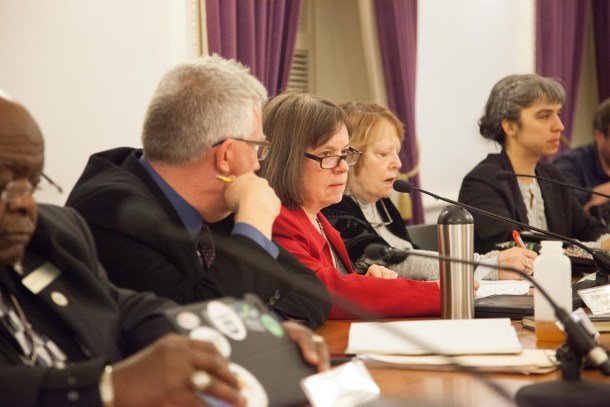
[A]t a packed public hearing Thursday night, Vermonters urged a House committee to pass a bill that would raise the minimum wage to $15 an hour by 2024.
About 30 people gave testimony at the hearing. An overwhelming majority encouraged the House Committee on General, Housing and Military Affairs to advance S.40, the proposal the Senate passed in February that would hike Vermont’s base pay rate incrementally over six years.
Local residents said they can’t meet basic living expenses on the current minimum wage of $10.50 an hour.
“My spouse and I are actually working well over 80 hours a week, yet making under $2,000 monthly combined,” Elaine Stehel, 33, of Northfield, said.
Stehel said that after moving to central Vermont last summer, she’s worked at a total of six full- and part-time jobs, only two of which have paid above the state current minimum wage.
Her pay doesn’t square up with her cost of living, she told the committee. Stehel and her spouse’s monthly expenses include $1,300 for rent and utilities, $500 for food and hundreds of dollars more for transportation and health care costs, she said.
“It may be years before we’re able to purchase our own home or save for retirement and I hope that the committee will please raise the wage,” Stehel said.
S.40 aims to raise the wages of tens of thousands of Vermonters. But opponents of the proposal, including Gov. Phil Scott, say if the higher wage becomes law, workers will ultimately lose jobs as businesses look to offset higher salaries with layoffs.
If the wage reached $15 an hour in 2024, there would be 950 fewer jobs that year, according to a fiscal note from the Joint Fiscal Office.
The JFO also projects that with the higher minimum wage, there would be an average loss of 2,250 jobs between 2028 and 2040.
But overall, the bill would increase wages for 65,000 people by 2024, according Sen. Michael Sirotkin, D-Chittenden, one of the bill’s sponsors.
Amy Huyffer, a dairy farmer and the owner of Strafford Organic Creamery, told the committee she’s concerned that upping the wage to $15 an hour will make it harder for her to hire good employees.
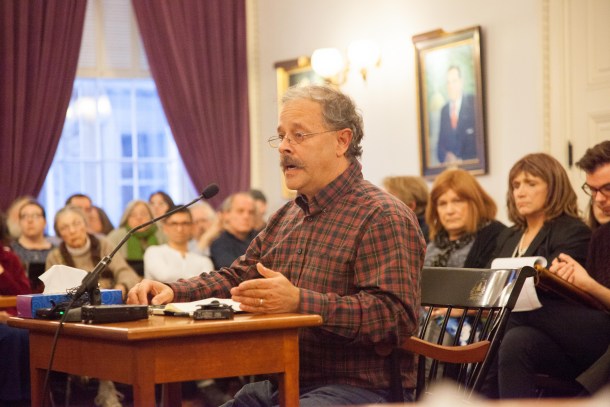
She already pays staff at the creamery a base wage of $15 an hour, she said. If that pay rate becomes the minimum wage, she told the committee it will be harder for her to retain employees.
“If you’re going to pay that to somebody who’s just going to show up and work at a job that’s much less demanding, then that puts me at a severe disadvantage,” she said.
Others who testified suggested raising the wage could solve some of Vermont’s economic woes.
College students and recent graduates told the committee that a higher base pay rate could help the state to attract and retain young people at a time when its population is rapidly aging.
Renee Barry, a 26-year-old graduate of Sterling College, said S.40 would help people who are burdened with student debt.
“If Vermont had a more just and sustainable minimum wage, it could be an asset which attracts young folks like me who are dealing with these debilitating loans firsthand,” Barry said.
Karen Lafayette, of the Vermont Low-Income Advocacy Council, said a higher minimum wage would reduce poverty.
“We feel strongly that the move to a livable wage is the best way in reducing income inequality,” Lafayette said. “Moving to a $15 minimum wage will contribute to the overall well-being of our families, our communities, our businesses and state.”
The chair of the committee, Rep. Helen Head, D-South Burlington, said it’s too soon to know when the panel will vote on the bill.