


[A]lthough it’s been widely touted as one of Gov. Phil Scott’s key economic development proposals, his administration’s plan to attract hundreds of new residents to Vermont is struggling to gain traction in the Legislature.
ThinkVermont/MOVE — an effort to lure new residents through a data-driven marketing campaign and financial incentives — failed to make it into the House budget proposal and the governor’s office is hoping to find a path forward in the Senate.
The administration originally recommended spending $3.2 million on the program, which it hoped to launch in fiscal 2019. However, House lawmakers did not include even a scaled-down version of the plan in the budget proposal it adopted last month.
Michael Schirling, secretary of Vermont’s Agency of Commerce and Community Development, said that for the remainder of the legislative session, the administration will be looking to add parts of ThinkVermont/MOVE to other workforce development legislation. However, the general outline of the proposal will remain.
“How do you weave together some existing good ideas to make a robust package?” Schirling said. “That’s the kind of thinking that we’re putting on it right now.”
The administration has stressed that by encouraging people to relocate to Vermont, ThinkVermont/MOVE would be a critical step in addressing the state’s labor shortage.
“We do think at the end of the day that some investment in attracting new workforce to Vermont is an essential piece of the overall workforce development strategy,” Schirling said. “We can only go so far by activating and reactivating untapped labor pools that are already in Vermont.”
Most recently, lawmakers in the House Committee on Economic Development were reviewing a $2.5 million version of the ThinkVermont/MOVE proposal.
The plan, which Schirling said the administration pared down “largely at the behest of legislators,” calls for funding for a campaign to target the people who are most likely to move to Vermont.
On the table was funding for a “surgically precise social media strategy,” according to the program’s executive summary.
In addition, the proposal would allocate $350,000 to expand the roles of job placement specialists at the Department of Labor.
Under the proposal, these employees would serve as relocation agents and provide “concierge service to assist interested ‘future Vermonters’ in finding employment and helping individuals or families become residents,” according to the document.
Embedded in the plan is $1.25 million in incentives for families to move in state: $750,000 in grants that could go to families purchasing their first homes in Vermont as well as $250,000 for relocation reimbursements and $250,000 for referral bonuses. The bonuses would go to state residents who, through an online portal, refer out-of-state workers who end up moving to Vermont.
After reviewing the proposal, the House Committee on Economic Development declined to recommend that the Appropriations Committee find a place for the program in the budget.

“We felt that in the amount of time we had, there were areas that were not as thoroughly vetted as we would have liked to have seen,” the committee’s chairman, Rep. Bill Botzow, D-Bennington, said in an interview.
Schirling said that on the House side, ThinkVermont/MOVE has “fallen victim to the limitations of time. They’ve done so much work on other things that there just wasn’t enough time to explore in-depth the full range of options relative to MOVE.”
The Economic Development Committee has put forth several workforce development bills this session, including legislation that incorporates other Scott administration proposals. The full House passed H.767, a vehicle for the administration’s $400,000 ThinkVermont/Innovation proposal.
This plan offers grants aimed at accelerating small business growth and could help fund projects including workforce training, broadband connectivity and the development of facilities that attract workers and businesses such as co-working spaces.
In its budget bill, the House also included a line item in the ThinkVermont/MOVE proposal: $250,000 to boost the state’s economic development marketing efforts.
The Scott administration had originally hoped to fund the $3.2 million ThinkVermont/Move in the fiscal 2018 budget adjustment. The program would not have gone into effect in 2019, but the administration wanted to secure early funding and said revenues from the project could be used to pay off debt from the ailing magazine, Vermont Life.
Officials have said the ThinkVermont/Move program would result in an increase in rooms and meals tax revenues.
This could allow the program to become self-sustaining and also raise money to be funneled into paying off the roughly $3.2 million debt that’s been accrued by the magazine.
But the House Appropriations Committee didn’t sign off on the budget adjustment request because approving the proposal would have involved pre-funding a program for fiscal year 2019.

“We were not going to work on the 2019 budget in ‘18,” said Rep. Kathleen Keenan, D-St. Albans, a committee member. “I think that it’s bad practice to start funding programs in the next fiscal year when you’re trying to reconcile the present fiscal year’s budget.”
Schirling said the administration would be working on the Senate side with members of the economic development and budget committees in the coming weeks on the issue.
Officials are already eyeing a bill aimed at attracting remote workers to the state that could overlap with part of the MOVE initiative. S.94, which passed the Senate in late March, would provide $250,000 in financial incentives for remote workers to relocate to Vermont.
“It may make sense to explore whether there’s a wider footprint of workforce that could take advantage of that kind of incentive,” Schirling said.
The administration has already rolled out a pilot version of a tourism program included in the MOVE proposal: Stay-to-Stay.
Through the program, visitors attend receptions hosted by local chambers of commerce or networks of professionals, explore regional attractions and meet with potential employers.
The state has slated $50,000 in the existing marketing and tourism budget for the pilot program scheduled to take place in Rutland, Brattleboro and the Bennington-Manchester area on four weekends this year.
In developing the ThinkVermont/MOVE proposal, Scott asked millennial legislators to weigh in.
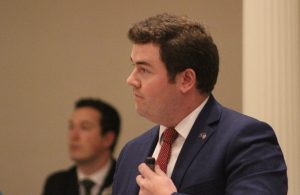
Rep. Corey Parent, R-St. Albans City, was part of a group of legislators the administration surveyed on how to target young workers who might want to move to the state.
“We are hearing from the business communities, ‘we need more workers,’ and we are hearing from the younger folks ‘the jobs aren’t there,’ so we’re looking to bridge that gap,” Parent said.
Parent said many people want what Vermont has to offer. If there’s a campaign to educate out-of-state residents on opportunities for housing and jobs in-state, more people are likely to move to Vermont, he said.
Other lawmakers and experts are skeptical of the proposal.
“So this is a snazzy, innovative marketing campaign is what I am hearing,” Rep. Mary Hooper, D-Montpelier, said of the proposal not long after it was rolled out. “What’s the evidence this is going to work?”
The administration has cited a program in South Dakota, as evidence that digital campaigns to attract new residents can work.
Dakota Roots is a website employment database created to bring young people who once lived in South Dakota back home.
As with the proposed Vermont initiative, Dakota Roots targets those who have some kind of connection with the state, such as those with family members, said Marcia Hultman, secretary of the South Dakota Department of Labor. She said her research has shown that the program is adding one person a day to the state.
Arthur Wolff, an economics professor at the University of Vermont specializing in the Vermont economy, said there must be a portion of the proposal that measures efficacy to determine whether Think Vermont/MOVE’s cost is worth the return.
“I am not sure how much a state-sponsored initiative would mean to someone in their 20s or 30s,” he said. “It all depends on how good a marketing campaign it is; there are good marketing campaigns and there are bad ones.”
Schirling said the program’s digital strategy would involve closely tracking the campaign’s results.
“We can tell with relative specificity what messages are resonating with who and how many people are actually pulling on the threads we’re presenting and how far do they make it into the process of relocating,” he said. “We don’t want to do anything that doesn’t show a return on the investments.”
