

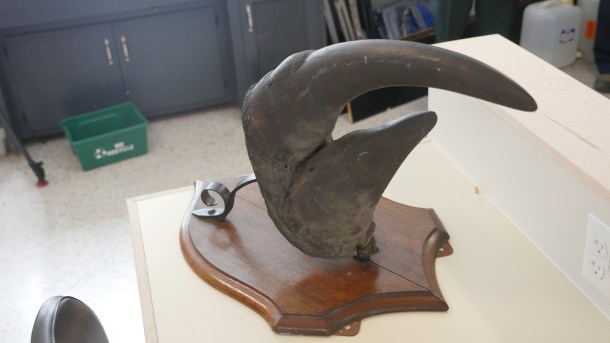
[B]URLINGTON — A valuable rhinoceros horn that was stolen nearly a year ago from the University of Vermont has been recovered, police say.
The century-old black rhinoceros horn, estimated to be worth more than $200,000, was stolen from UVM’s Department of Wildlife Biology last April. Several police agencies were involved in the search for the stolen horn, which led them to a suspect in Connecticut.
Investigators did not have enough probable cause to search the suspect’s property, so UVM Police and the Chittenden County State’s Attorney’s Office decided to make a deal. Give the horn back, they told the suspect, and you will be immune from criminal prosecution.
The gamble paid off, and the horn was recovered.
The investigation is still ongoing, said Tim Bilodeau, UVM’s deputy police chief, who said it was unclear whether the horn had changed hands through a sale or otherwise since the original theft.
If a suspect were charged with the theft in Vermont, the charge likely would be grand larceny, which is a felony, Bilodeau said.
The horn is in good condition, said William Kilpatrick, a UVM biology professor, who said it was amazing to have the artifact back.
“I was sure we would never see it again,” Kilpatrick said.

Black rhinos are the smaller of the two African rhinoceros species, distinguished from the white rhino by its hooked lip and the fact that it’s a browser and not a grazer. The black rhino population declined dramatically in the 20th century, initially because of hunting by Europeans then later because of poaching.
Despite there being no factual basis for it, rhino horn has long been believed to have curative powers, for every ailment from hangover to terminal cancer to impotence.
After near extinction in the 1990s the rhinoceros has made a comeback from its low point of about 2,500, but remains critically endangered. Poaching and black-market trafficking of rhino horn continues to threaten the recovery of all five species of rhinoceros worldwide. It also keeps the price of illegally poached rhino horn high — about $65,000 per kilogram, according to Kilpatrick.
It was feared UVM’s rhino horn would be sold on the black market, he said.
The horn was acquired in the early 1900s by the university’s Fleming Museum. It resided initially in Williams Hall, which was home to the museum’s natural history collection and to the UVM zoology department, VTDigger reported when the horn was stolen.
In the mid-1980s, the rhino horn and the collection moved to Torrey Hall. It is part of the Zadock Thompson Natural History Collections, which are maintained for teaching and scholarship, and are not open to the public.
UVM’s horn has scholarly value as a teaching tool and because it contains DNA, Kilpatrick said. It’s by far the most valuable natural artifact the university owns, he said.
The horn has been moved to a more secure building on campus with swipe-key access, where it will be locked away in a case. The university is also consider adding cameras, Kilpatrick said.
