

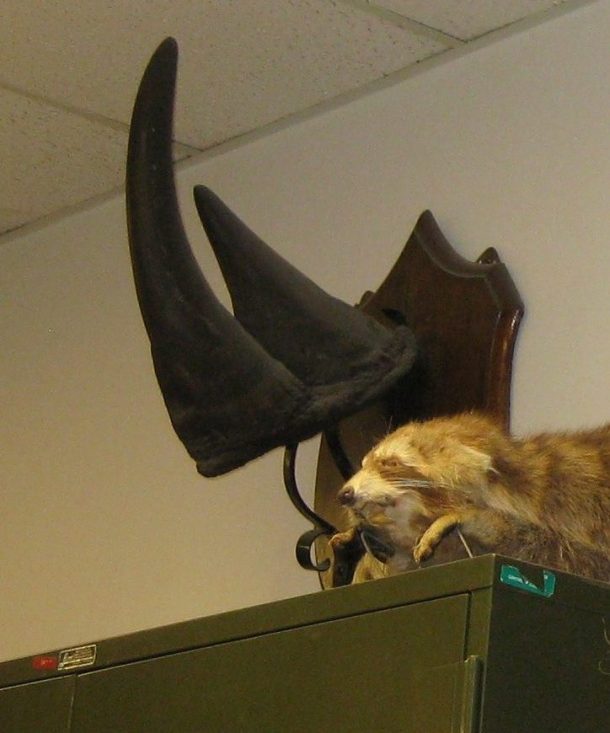
The horn is considered significant from a scientific standpoint because it contains genetic material that could provide insight into the species’ history.
Officials said the horn also could fetch a high price in the illegal rhino trade in Europe. “It could be worth about $30,000,” U.S. Fish and Wildlife Service Special Agent Robert J. Rothe said. “That’s a bit of money. We haven’t had too many occurrences in the United States. It’s something that museum collections need to be aware about.”
The university’s biology department staff noticed that the mounted horn was missing April 27 and alerted campus law enforcement.
“The investigation is still underway, and we have no additional information to report,” said UVM Deputy Chief of Police Services Tim Bilodeau.
The university is offering a $500 reward for information leading to the horn’s recovery. The U.S. Fish and Wildlife Service said a $2,500 payment is also available for information leading to the arrest and criminal conviction of whoever is responsible.
“If someone stole it with the intent to sell it over state lines or smuggle it, then we’d pay the reward,” Rothe said.
The rhino horn was acquired in the early 1900s by the university’s Fleming Museum and then housed in Williams Hall, the site of the museum’s natural history collection and UVM’s zoology department. In the mid-1980s, the rhino horn and the collection moved to Torrey Hall. It’s part of the Zadock Thompson Natural History Collections. The selections are earmarked for teaching and scholarship and aren’t open to the public.
William Kilpatrick, a UVM biology professor, is also concerned about the growing illegal market and said academic centers as well as museums must be vigilant.
“This illegal trade is endangering the survival of all species of rhinos, and on average three rhinos are poached every day from South Africa alone,” he said. “While there have been several thefts of rhino horns over the past decade from museums and zoological parks in Europe, this is the first theft that is known from a U.S. museum. I was surprised of the theft since the presence of a black rhino horn in our natural history collection was not widely known, and the specimen was in a locked room that is generally not open to the public.”
Kilpatrick said the black rhino horn was the only one in the collection, but the biology department is “increasing security measures to protect other material in our collections.”
He also said he is concerned about the theft’s long-term effects.
“The value of the material is to science, not to the department,” Kilpatrick said. “With the continued poaching of black rhinos, the populations decrease in size, as does the genetic variation present in those remaining populations. Specimens … collected when populations were much larger allow science to examine levels of genetic variation that was originally present. With modern genetic techniques, adaptive alleles that had been lost from the population could be genetically engineered from the genetic material in these historical specimens and inserted into reintroduced or recovering rhino populations to increase their chances of survival.”
Rothe the investigation hasn’t yielded much fresh information. Campus police contacted Fish and Wildlife after the theft was discovered. “Our agency will help if they need anything,” he said. “As for right now, there’s nothing right now.”
