

[H]ardly anyone who has spent time around any state legislature – and almost no reporter who ever covered one – is unfamiliar with the old line that “no man’s life, liberty, or property are safe while the legislature is in session.”
So said Gideon J. Tucker (1826-1899), who – having been a New York state legislator himself – may not have been 100 percent serious about it. Whatever his intent, his quip has proved a godsend to those tempted to demean and/or ridicule legislatures.
And what a delicious temptation it is, being often deserved and therefore requiring little in the way of wit or knowledge. Legislators can be fumble-mouthed, long-winded publicity-seekers engaged in a confusing process with rules that seem like so much mumbo-jumbo. Making fun of them is child’s play. That’s why we all do it.
But here’s a funny thing about reality. It refuses to be described in full by assumptions, presumptions or fabled old sayings. A good look at the Vermont Legislature (and no doubt many others) reveals a far more nuanced and sometimes heartening picture.
It is a picture of 180 people who work very hard for very little money, who sometimes seek publicity but more often toil in obscurity over boring details, who are obviously devoted to their duties, to the institution, to the state.
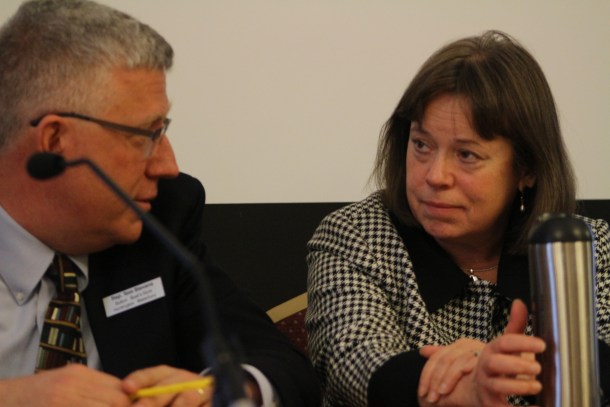
Consider a recent meeting of the House Committee on General, Housing, and Military Affairs in Room 44 of the Statehouse.
Like almost all legislative committee rooms, Room 44 is … well, it is not capacious. Most people have at least one larger bedroom at home. Like all legislative committee rooms, most of this one is taken up by a table, around which sit the members – six Democrats, four Republicans, one independent. Others – a few administration officials with business before the committee, and assorted onlookers (anyone may enter) – sit on benches or folding chairs along the walls.
One could call it cozy. Or one could say everybody in the room is smooshed together.
Harmoniously, for the most part. A visitor who did not know which House member belonged to which party would not be able to figure it out from hearing their discussion. There is no partisan wrangling. Committee Chair Helen Head, D-South Burlington, invited Republican as readily as Democratic members into the discussion. She ran the meeting in an easy-going but formal manner. Though all the members know each other well and often socialize, Head addressed them all by title.
The bill on the table was not controversial. It was H.906, designed “to facilitate professional licensing for veterans and members of the U.S. Armed Forces.” It’s part of Gov. Phil Scott’s effort to get National Guard members to move to (or at least stay in) Vermont. If it passes, skilled cooks, nurses, plumbers, electricians and mechanics with military experience could be licensed to ply their trade in civilian life without having to take exams.
Because the bill was not “news,” and because the subject before them was dreary, the House members might have been tempted to rush through their deliberations and simply approve the bill as drafted by the administration and the Office of Legislative Council.
They didn’t. That’s because they take their jobs seriously, and they knew that the bill would affect the lives of real people. Not many people – certainly no more than a couple of thousand and perhaps only several hundred. But the precise wording of the legislation that becomes law might make the difference between whether or not these people can get a good job.
So there was discussion about just what credentials were needed to be certified as a nurse, or a culinarian.
No, the committee members didn’t really know what a culinarian was, either. Seated on a bench along one wall, Damien Leonard of the Office of Legislative Council got on his laptop and reported that according to the American Culinary Federation a culinarian is “a person skilled in the preparation of food,” and a “certified culinarian” is a person skilled in the preparation of food who has “at least two years of experience and has taken three 30-hour courses in the field.”
“So it’s a cook,” said Rep. Tom Stevens, D-Waterbury.
(For the record, the American Culinary Foundation, based in St. Augustine, Florida, is an organization devoted to “promoting the professional image of American chefs worldwide through education of culinarians at all levels.” And, no, the committee members didn’t seem to know what it was, either).
OK, the culinary credential matter having been solved, could the committee now approve the 11-page bill?
Not yet. Rep. Vicki Strong, R-Irasburg, had a problem. To qualify for the streamlined credentialing awarded by the bill a person would have to have finished his or her active military duty “not more than two years prior to submitting an application for licensure.” Strong wondered whether that requirement was too rigid.
Nitpicking? Maybe, but at worst nitpicking with heart. After military service, Strong noted, “life can be in chaos.” Suppose, she said, someone applies two years and two months after being discharged.
As it turned out, other provisions of the bill ease the way for ex-service members to get licensed even if they miss the deadline. Strong was satisfied, and the committee sent the bill to the “notice calendar,” its next step on the road to passage.
Most of the world will little note nor long remember what the committee did. But some folks will live better lives because of it. And this is just one of 28 committees (15 in the House, 13 in the Senate) that have been doing similar work three days a week since January. It’s not glamorous work. It’s dull. It requires painful attention to detail. It’s a slog. The legislators do it every day.
Gideon J. Tucker was wrong. Every person’s life, liberty, and property is protected by law, and therefore by those who make the law. Legislators as individuals and the Legislature as an institution are powerful, and like all who are powerful should be watched lest they abuse their power.
But they should also be thanked for their service.
OK: back to making fun of them.

