

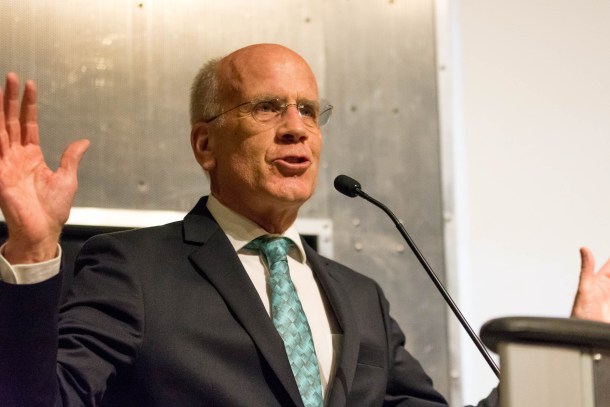
WASHINGTON — Vermont’s sole member of the House of Representatives is leading an effort to curb the production and related environmental impacts of corn ethanol.
Rep. Peter Welch, D-Vt., introduced legislation Thursday with Sen. Tom Udall, D-NM, aiming to reform national policies that incentivize the production of corn ethanol. It would instead increase incentives for more environmentally friendly biofuels.
Welch voted in favor of increasing the amount of corn ethanol blended into fuel in 2007. However, he said during a Thursday press call that the policy turned out to be “a well-intended flop.”
Welch said the corn ethanol policy has been damaging to the environment because it has expanded greenhouse gas emissions and has encouraged the conversion of sensitive environments like grasslands and forests into fields for producing crops. Meanwhile, it has not encouraged the development and use of more sustainable fossil fuel alternatives, such as cellulosic, he said.
The legislation Welch and Udall introduced would phase out the corn ethanol mandate over six years. It would immediately put a 9.7 percent cap on the amount of ethanol that can be blended into conventional fuel.
The bill also aims to mitigate environmental impacts of ethanol. The legislation would launch an effort to convert land that is currently used to grow corn back to wildlife habitat. It would pay for this by levying a 10 percent fee on ethanol credits.
It also extends a mandate that is designed to increase the use of cellulosic biofuel.
Corn ethanol has had adverse effects in Vermont, according to Welch’s staff. Dairy farmers have been impacted by feed prices driven up by the program, spokesperson Kate Hamilton said. People have also reported damage to small engines because of ethanol, she said, such as those on boats. The congressman’s own chainsaw was damaged by the fuel, she said.
Former California Democratic Rep. Henry Waxman said the 2007 law did not live up to the expectation that it would be a bridge to new fuels that would have less environmental impact.
“A lot of people say if it ain’t broke don’t fix it,” Waxman said. “Well this law is broke and we need to fix it.”
Officials from the National Wildlife Federation and the Sierra Club joined the call to express their support for the legislation, saying that corn ethanol has damaged wildlife habitat, spurred and increase in harmful runoff, and taken other environmental tolls.
Udall said that as a 2022 deadline for the Renewable Fuel Standard, or RFS, approaches, he expects the appetite to address the issue will increase on Capitol Hill.
Sen. John Cornyn, R-Tex., has been working on a bill that would reform biofuels policies.
Welch and Udall’s proposal drew sharp criticism from the Renewable Fuels Association, which represents ethanol manufacturers.
The group’s president and CEO Bob Dinneen, issued a statement challenging the lawmakers’ assertion that the proposal would build on the RFS, saying that it would “throw the program into reverse, erasing more than a decade of progress.”
Dinneen cited an analysis by the U.S. Department of Agriculture that found corn-based ethanol reduces greenhouse gas emissions compared with standard gasoline. He also derided the effort to cap the amount of ethanol blended into conventional fuel at 9.7 percent.
“The RFS is delivering on its promise to expand consumer access to cleaner, higher octane fuels like ethanol, helping to break Big Oil’s near-monopoly at the pump,” Dinneen said. “This bill is a solution in search of a problem and would ultimately harm consumers.”

