

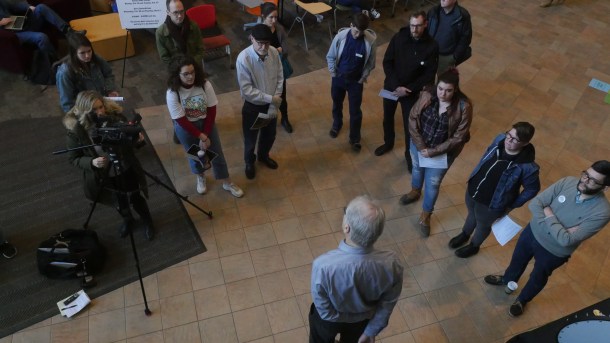
BURLINGTON — The University of Vermont’s faculty union staged a rally on Wednesday to protest a proposal to eliminate more teaching positions in the university’s College of Arts and Sciences.
Thomas Streeter, president of United Academics, released a statement to news media at the rally, which was held in the university’s Davis Center. The statement contained details of the university’s proposed budget plan for the College of Arts and Sciences that included a number of proposed reductions in faculty.
The proposal would eliminate about 40 percent of the college’s part-time faculty, the statement said. Another 20 lecturers could be laid off over the next five years, it said. The college also would not replace the estimated 50 senior professors expected to retire over the next five years, according to United Academics.
The union said this could result in a loss to students of as many as 450 classes. About half of UVM’s students are enrolled in the College of Arts and Sciences, the largest of the university’s academic colleges.
United Academics based the news release on information obtained from several department chairs who were privy to the budget proposal, Streeter said. He stressed that they did not know whether the proposals would become policy.
“We don’t know exactly how the proposed budget cuts in the College of Arts and Sciences will be carried out, if they will be carried out at all,” said Streeter, a UVM sociology professor.
Faculty members have long contended that loss of university faculty translates to a reduction in the quality of the education UVM offers, and in its reputation.
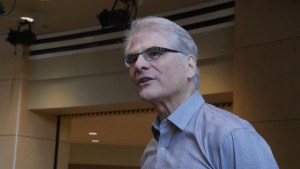
“The saying ‘faculty teaching conditions are student learning conditions’ is more than just a slogan,” Nancy Welch, an English professor, said at the rally.
University administrators say that proposed plan to which United Academics is referring is just that — a proposal. Administrators also said the proposal comes out of a national trend away from the liberal arts.
UVM, like many colleges around the country has seen fewer students interested in liberal arts, said Bill Falls, dean of the College of Arts and Sciences. The resulting drop in enrollment in Arts and Sciences classes has led to a teacher surplus, and a $4 million budget shortfall.
The university has not yet adjusted the size of the college’s faculty to reflect declining enrollment, Falls said. UVM administrators are in fact giving the college $2 million per year to allow for wiggle room as the budgets are adjusted.
“We have a faculty that was sort of built for enrollments we had in 2010,” Falls said. Since then enrollment has decreased by about 17 percent, and while in recent years there have been a slight upswing, enrollment is still below what it was in 2010. The college has a student to faculty ratio of about 14 to 1. Falls said he would like to increase the ratio to 16.5 to 1.
The proposal that concerned the faculty union is one of two models the UVM provost, David Rosowsky, asked the college to use in planning its budget for the next five years. Falls said the numbers Streeter quoted were from one of the two models. They are not set in stone, Falls said, and may well be changed in the coming months and years.
“The provost said, ‘show me how you can get to a balanced budget in five years,’” Falls said.
Falls acknowledged that some departments rely on part-time, local faculty to teach certain courses. For example, fine arts departments like Studio Art and Dance and Music use local artists and practitioners to teach, and Falls said it would be important to retain those positions.
“We spend a lot of money on part-time faculty, and we have to ask ourselves, are there other efficiencies? Can we get these courses taught by our regular faculty through curriculum revisions?” Falls said.
United Academics and the UVM administration are currently stalled in negotiations over a new three-year contract. Negotiations are at the fact-finding phase, which could last into the spring. The only remaining point of disagreement between the two sides, however, is a wage increase.
The union is asking for a 4.5 percent increase. The administration has offered 2 percent.
The university’s position is that its budget is tight, and is heavily reliant on tuition, which makes up about 73 percent of general fund revenue. Vermont’s flagship university suffers to an extent from a lack of support from Vermont. The state’s appropriation to the university, at $42 million, is one of the lowest in the country.
Streeter’s position is that there is money to pay faculty and staff, and to prevent cuts. There is, for example, the $1.6 million UVM paid to a branding consultant in 2016, Streeter said, as well as costly investments in campus infrastructure, that while important, should be weighed alongside retaining and compensating faculty.
The problem, Streeter said, is not “lack of money coming into the university, but that money is being moved around within the university.”
