


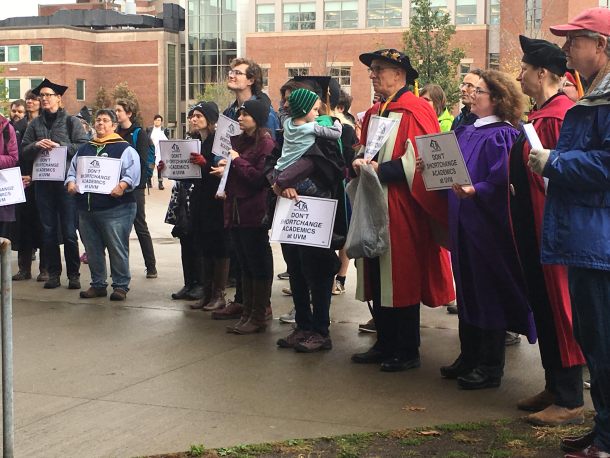
BURLINGTON — Frustrated in their efforts to reach an agreement on a three-year contract, negotiators for the University of Vermont and United Academics, the university’s faculty union, this week turned to fact-finding.
Both sides met with the fact finder, Michael Ryan, on Monday, to start the process of laying out their arguments, not for a salary increase — both sides agree that one is needed — but how much faculty salaries should be increased.
The university administration has offered faculty a 2 percent raise; the union, which represents 725 full-time faculty, has asked for 4.5 percent.
The last three-year contract expired in July. Negotiations stalled over the issue of salaries, and reached an impasse last fall. Both sides have until March 23 to submit materials and arguments to Ryan, after which Ryan will have 30 days to issue a report.
The fact finder’s report is non-binding. It would be made public if the two sides were to reject Ryan’s recommendation, in which case the dispute would likely go before the Vermont Labor Relations Board for a final ruling.
University administrators told Ryan in a meeting yesterday that their offer of a 2 percent salary increase is fair, especially considering the two other unions representing university employees have accepted a 2 percent increase. In a news release university spokesman Enrique Corredera said that 2 percent also is competitive with similar institutions.
Any salary increase above 2 percent would mean increasing tuition, cutting academic programs, or both, the university news release said. The cost of every percent increase in salary is $900,000, according to the statement.
Thomas Streeter, president of United Academics, countered that the university is not stretched so thin that it would have to increase tuition or cut programs.
Streeter said it was a matter of priorities. Spending on improvements like a skybridge between the campus library and a new dorm, and fundraising for a major multipurpose center, could be pared down, he said.
“Our general argument is, if you look at university spending overall, every year there are millions of dollars spent on things that are one-time funds whose uses aren’t ironclad,” Streeter said.
Streeter said he understood administrators’ concern with the university’s reputation. It is a shared concern, he said. But reputations are built over the long term, he said, and if the university cut some of its short-term expenses, such as building costs, it would have the means to invest in the university’s long-term reputation, by paying its faculty more.
“The administration gets absorbed in a certain way with short-term marketability,” Streeter said.
Amenities may make a difference to prospective students who are trying to decide between UVM and a comparable school, Streeter said, but the quality of the faculty has a larger impact in the long term.
The UVM administration is arguing that the two other unions who have university contracts — the Teamsters, which represents police, service officers, and university dispatchers, and the United Electrical workers — both have agreed to a 2 percent increase.
The university administration itself has shrunk over the years, in part due to union pressure. Comparable universities employ an average of 13.4 management and executive staff per 1,000 students. UVM is at 7.9 per 1,000 students, according to the university.
Whatever salary increase is eventually agreed upon, it will be retroactively applied to faculty paychecks. Streeter said Tuesday he is confident that an agreement could be reached.
