

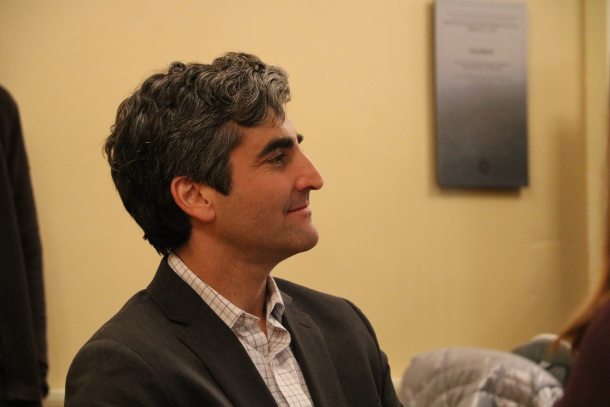
This is the second in a series of profiles of Burlington’s three mayoral candidates running in the March 6 Town Meeting Day election.
BURLINGTON — Mayor Miro Weinberger has a lot to show for his six years in City Hall.
New buildings are popping up. Bike lanes are being built. Sidewalks are being repaired.
But it is Burlington’s financial turnaround — a central promise of his first campaign — that Weinberger said has given him the greatest sense of achievement.
“We’ve done it,” he said in a recent interview. “I’m proud of this.”
When he took office in 2012, the city was mired in the Burlington Telecom scandal. Weinberger’s predecessor as mayor, Bob Kiss, had improperly diverted $17 million in taxpayer funds to prop up the ailing telecom company. Weinberger was faced with a lawsuit by Citibank related to the telecom deal, the formidable task of rebuilding the city’s credit, which also had taken a beating, and restoring the city to financial health.
The city is back in the rating agencies’ good graces, which Weinberger said will cut the cost of borrowing, a savings that could be passed on to taxpayers. Burlington’s auditors, in the annual review of city finances, released in December, reported no financial weaknesses for the first time in 15 years. And the trust deficit Weinberger also inherited has dissipated, he said.
“There was just this sense of distrust that was corrosive, and things did not happen,” Weinberger said. “To me this is a story of rebuilding confidence in city government.”
Weinberger says he is seeking a third three-year term — facing serious opposition for the first time, some say — so that he can keep doing what he has been doing for six years.
“I’m not going to change a lot,” Weinberger said, when asked about his plans, were he to win a third term. “I think the message from the public has been we’re on the right track.”
And that, his opponents say, is the problem.
Both of Weinberger’s challengers, independents Carina Driscoll and Infinite Culcleasure, claim to be speaking for the people whose voices are not being heard in City Hall.
“The main vehicle for public input is public forums at City Council meetings,” said Jane Knodell, the Progressive president of the Burlington City Council and a Driscoll supporter. “But there’s a real limitation to that format.”
“I think that the mayor, once he makes up his mind about something, he then switches into trying to persuade others, rather than continuing to be flexible,” Knodell said.
Rather than “I’m going to decide what I think is right and then try to convince everybody else,” Knodell said, the mayor’s approach should be “I’m going to hear from people with different points of view and lead us toward a strong consensus position.”
Knodell cited as an example the city’s decision to change North Avenue from four lanes to two, with a center turning lane and bike lanes. North End residents who were opposed to the project, and who felt left out of the decision-making process, may take their frustrations out on Weinberger when they go to the polls March 6.
John Franco, a longtime Burlington attorney who has known Driscoll since she was a child, and who was an assistant city attorney when Bernie Sanders was mayor, also cited the North Avenue bike lanes as a project without a process. People felt it had been predetermined, he said.
“There’s been a real culture of secrecy in this administration,” Franco said, as evidenced by the number of public record lawsuits recently filed against the city, including a suit over the recusal of a city councilor during the Burlington Telecom sale, and one filed by the ACLU to obtain the release of police body camera footage, against the Burlington Police Department.
Franco represented the Coalition for a Livable City, a citizens group opposed to the Burlington Mall redevelopment, in a suit last year against mall developer Don Sinex.
The suit was settled last July, when the developer agreed to add hundreds of new parking spaces to the project, and to establish a grant for small businesses. “We came to the conclusion that in order to facilitate this project the administration swept major infrastructure issues, particularly parking, under the rug,” Franco said.
Other issues also damaged public trust, Franco said. Keep Burlington Telecom Local, the co-op option during the Burlington Telecom sale that was widely supported but underfunded was not given a chance, he said.
Weinberger has consistently defended his administration’s handling of public processes, and said input from residents had had an impact on a number of different projects in various stages of completion, including the Burlington Town Center redevelopment, Memorial Auditorium, the Burlington Telecom sale.
“It’s a misdiagnosis to say that the reason they were controversial was because of poor public process,” Weinberger said. “There was no choice in any of those cases that was going to please everybody.”
If his administration were as out of touch with the city as his opponents suggest, Weinberger said, there is no way he would have been able to move so many projects forward.
“There’s no way that an administration with those characteristics would be able to work so collaboratively or collegially with the City Council,” he said.
Weinberger also pointed out that in the course of his six years in office, voters approved all 17 of the ballot items he put before them, from city bonds to changing zoning to allow for the Burlington mall redevelopment project. Driscoll has said she supported all of the ballot items, too, and that support for ballot questions could not be equated with support for Weinberger.
‘I don’t like to just wing it’
Weinberger admits he has struggled as a public speaker, saying it was a weakness that almost cost him the election in 2012. He has improved over time, he said, but he still approaches public speaking with caution.
“I don’t like to just wing it,” Weinberger said. “I definitely get down into the weeds too much.”
Weinberger was a political novice when he decided to run for mayor of Burlington. His only prior elective experience: the Burlington Airport Commission. He worked right out of college for Sen. Patrick Leahy, D-Vt., and on the re-election campaign of Sen. Harris Wofford, D-Pa.

The son of an architect and a school teacher, he grew up in Hartland, with two younger sisters, Rebecca and Sarah. He graduated from Yale in 1993 with a double major in environmental studies and American studies, then went on to Harvard in 1998, where he studied public policy and urban planning.
He enjoyed a brief fling with sports writing. A summer internship at the Boston Globe was “fun” he said, but he left with no regrets. “The lifestyle of a sports writer is pretty grueling,” he said.
Weinberger co-founded the Hartland Group, which he operated out of Burlington. For nearly a decade, he said, he focused on developing affordable housing. He married his wife, Stacey, in 2000, and they have two daughters. Weinberger walks to City Hall most days, but sometimes rides a Jamis commuter bike purchased from the Old Spokes Home.
At a campaign stop in the South End, Weinberger could have been addressing a crowd of 200 but in fact it was a gathering of about a dozen, many already longtime supporters. Even so he chose his words with care, pausing often, making sure to hit his talking points.
“We’re succeeding on many fronts,” he said. “We are becoming a more affordable city because of the housing policies we’ve been pursuing. Our infrastructure is heading in the right direction, rather than the wrong direction. We are on the cusp of turning the corner on this terrible opioid crisis.”
Patrick Halladay, a former chair of the Burlington School Board and longtime friend of Weinberger, said the mayor has his head deep in policy, and rarely thinks or speaks in sound bites. Halladay co-hosted Weinberger’s first house party, during his first mayoral campaign.
“Bond ratings, water pipes, these are not the sexiest issues,” Halladay said. “But I would rather have our foundations be solid.”
Jason Van Dreische, who hosted the South End house party Weinberger recently addressed, is the interim director of Local Motion, a bike training and advocacy organization. Van Dreische said Weinberger is a leader, not a facilitator, and that can be the difference between staying stagnant or moving ahead on major city projects.
“I’ve certainly had plenty of times where I’ve been frustrated with one or another thing that the administration has done, but I have always seen really careful thought and engagement and leadership on his part,” Van Dreische said.
Van Dreische suggested Weinberger’s critics may just be unhappy about not getting their way.
“People say I’m not being heard, when what they really mean is I’m not getting what I want. And there’s a difference,” he said. “This city is incredibly good at having people be heard, but not everyone is going to get everything they want.”
Joan Shannon, another Weinberger ally and Democratic city councilor representing Burlington’s South District, said that if Weinberger wins, it will be simply because people like the city’s direction.
“Burlington does not speak in one voice,” Shannon said. “But I think as a whole, people are more satisfied than they are dissatisfied.”
Shannon pointed out that, while activists and opposition groups regularly pack City Council meetings, people who are happy with the city’s direction tend not to speak up.
“The one thing we definitely know is that people are far more motivated to come out and talk to us when they are unhappy, than when they are happy,” Shannon said.
“There are often valid concerns brought forward by the public about what we are about to do, and sometimes we can make changes to address those concerns, so I don’t want to diminish the concerns of people,” she said.
There are things Weinberger said he wishes he’d done differently in the last six years. He recalled sitting in the viewing balcony of the Vermont House when then-Gov. Peter Shumlin delivered his State of the State speech in 2014 that covered one issue: opioids.
“I was moved by the speech, believed it, all of it. It crystallized some of what I was sensing as well, and somehow it took me about 18 months from that speech, until I realized, wait, he is really speaking to me,” Weinberger said.
The delay is Weinberger’s greatest regret from his six years in office, he said. “I have this kind of haunting sense that we could have impacted, maybe saved more lives had we done that sooner,” Weinberger said. “That haunts me.”
It wasn’t until the city hired Burlington Police Chief Brandon del Pozo in mid-2015 that the city and police department started to focus on combating the opioid crisis. It has been high on the city’s list of priorities since then, he said.
Burlington hired an opioid policy manager, Jackie Corbally, who works out of the police department, and every month a cohort of city and nonprofit leaders meet at City Hall to talk about progress, problems and ideas around the opioid crisis.
“The mayor of Burlington is sitting in one of the most important seats in the state to actually turn this around,” Corbally said. “A leadership change right now would be a real setback.”
Weinberger said that the city and state should expand Vermont’s “hub and spoke model” of treating opioid addiction, which has been shown to be successful.
If he does win on March 6, Weinberger says he will interpret it as a message from voters to carry on.
He hasn’t commissioned any polling — because it would be too expensive and not informative, he said, but he feels reasonably good about his chances.
“I’m cautiously optimistic. I don’t take anything for granted,” he said.
Read about Burlington mayoral candidate Infinite Culcleasure here. VTDigger’s profile of contender Carina Driscoll can be found here.
