

Editor’s note: This story by Nora Doyle-Burr was published in the Valley News on Feb. 13.
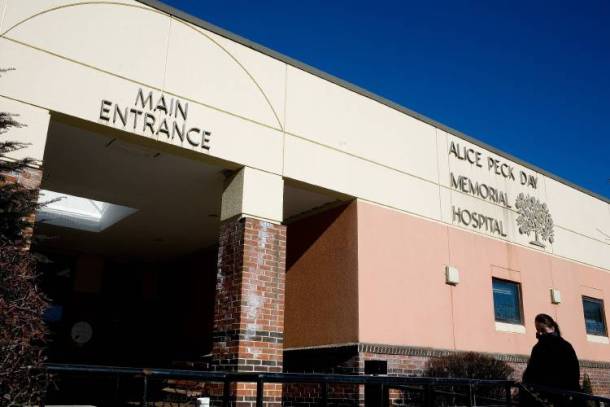
[L]EBANON, N.H. — Alice Peck Day Memorial Hospital will close its maternity ward after a planned merger of obstetrical services with Dartmouth-Hitchcock Medical Center is completed this summer, the hospitals announced in a news release on Tuesday morning.
Under the merger, which comes following APD’s formal affiliation with Dartmouth-Hitchcock in 2016, Alice Peck Day providers will continue to offer prenatal and postnatal care on APD’s campus. But, beginning on July 15, APD patients will give birth at Dartmouth-Hitchcock Medical Center, leaving APD’s six-bed birthing unit available for other uses.
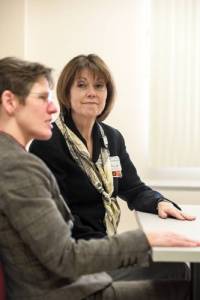
“We are not getting out of the obstetrics business,” the hospital’s CEO Sue Mooney said in a joint interview with Dartmouth-Hitchcock CEO Joanne Conroy on Tuesday afternoon in an APD conference room. “It’s that inpatient piece that we will be transferring and doing up at Dartmouth.”
The hospitals’ CEOs said there are several reasons for the merger, including challenges in recruiting providers and maintaining consistent staffing in the face of low birth numbers. Following the 2016 affiliation, APD began delivering babies only in low-risk situations. In 2017, there were just 217 babies born at APD, which is down from an average of about 300 annually before the merger, according to a 2015 Valley News story.
“We’d be pursuing the same process if we had low volume services anywhere,” Conroy said.
The CEOs also noted that New Hampshire has a declining birth rate and that reimbursement for obstetric services is relatively low and medical malpractice insurance is expensive. APD is not alone in discontinuing its labor and delivery services. Once this merger is complete, Springfield (Vermont) Hospital and Gifford Medical Center in Randolph, Vermont, both federally qualified medical centers, will be the only Upper Valley hospitals other than DHMC that still have birthing units.
The hospitals’ announcement, which was published on the Valley News’ website and on social media on Tuesday, prompted many people to respond with sadness.
Fairlee resident Jenn Dalton, 34, said she had a great experience at APD during the birth of her son, Cameron, 11 years ago.
“It was amazing,” she said.
During the birth, which included an emergency C-section, her obstetrician “never left her side,” she said.
Dalton now is contemplating having another child and said she worries she won’t have access to the same personalized care she received at APD.
“Where the hell am I going to go?” she said.
Similarly, Canaan resident Linda Paulsen said she worried that with APD’s birthing unit closed, Upper Valley residents will be left with just one option for care.
“The Upper Valley had two choices: We had APD and we had Dartmouth,” she said. “If you did not want to be at a large facility, APD was your choice.”
Paulsen gave birth to two children, now 22 and 20, at APD.
“It was a wonderful, warm, intimate experience,” she said. “I wouldn’t have changed it. I appreciated the fact that there was a very limited number of beds and the care was one-on-one, personal.”
Wilmot, New Hampshire, resident Devon Piquette, 33, said she gave birth to her two daughters, now 5 and 1½, at APD. Though her preference would have been to have a home birth, she said, her home — located 45 minutes from Lebanon — was just too far away from a hospital to feel safe giving birth at home.
She said she found APD to be “a good middle ground” between her home and a medical environment.
“I just don’t think that birth needs to be a medical intervention thing most of the time,” she said, noting that she was lucky to have easy births that did not require any intervention.
Mooney, who first came to APD in 2000 to work as a full-time obstetrician-gynecologist, said she understands the sense of loss that some members of the community might be feeling.
“I think we can respond and recognize the emotion and the fact that folks are feeling as though this was a really valuable piece of APD and a piece of its history,” Mooney said. “I think we also have to recognize that it is a changing world and that we are committed, both organizations are really committed, to (improving) the quality of care of patients in the Upper Valley. I get that this is hard. I think we also have a responsibility to use our resources wisely.”
Several women also commented on social media on Tuesday about positive birth experiences at DHMC.
Among them was Kayla Scheiner, of Rochester, New Hampshire, who gave birth to two sons at DHMC, the youngest just five months ago. Her older son, born in 2014, had to be put on a ventilator immediately after birth.
“The nurses (and) doctors were very caring,” she said in a Facebook message. “They would always keep me up to date on his progress.”
Though DHMC has an active midwifery practice, Conroy said, the merger gives DHMC providers the opportunity to learn some of the “high touch” practices that APD providers have been known for.
Mooney described such practices as those that support a physiologic, or natural, birth process, as opposed to a “medicalized” one that involves interventions such as pain medication.
As part of the merger, 12 people will lose their jobs, including nurses and a unit secretary for the birthing center, Mooney said. She anticipates that most of APD’s four certified midwives and two obstetricians will participate in the integrated services, providing prenatal and postnatal care at both APD and DHMC and assisting with deliveries at DHMC.
Mooney said those losing their jobs will receive assistance finding a new position at APD, DHMC or elsewhere within the Dartmouth-Hitchcock health system.
For its part, DHMC is preparing for the change by adding three beds to its birthing unit, bringing the total number of beds there to 24, Dartmouth-Hitchcock spokesman Rick Adams said. In the fiscal year that ended on June 30, 1,179 babies were born at DHMC, he said in an email.
Both Mooney and Conroy said there are no immediate plans to integrate other services at the two hospitals, but Conroy said the Dartmouth-Hitchcock health system is putting together a strategic plan, expected to be completed in the fall, that will include how APD will put the six soon-to-be vacant beds in the birthing unit to use moving forward.
“Every institution needs their own signature service that helps define who they are,” Conroy said.
