


Editor’s note: Jon Margolis is VTDigger’s political columnist.
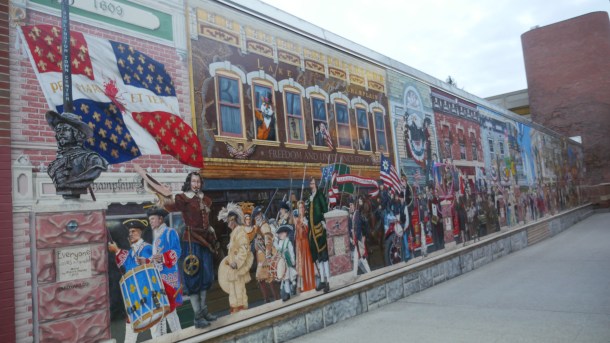
[T]he most obvious thing to say about “Everyone Loves a Parade,” the 124-by-16-foot mural by Canadian artist Pierre Hardy that covers the wall of a pedestrian alley off Burlington’s Church Street Marketplace is that it is not a great work of art.
It probably isn’t as good as the one Diego Rivera painted on a wall at Rockefeller Center. The “probably” is required because nobody alive has seen that mural, which Nelson Rockefeller ordered destroyed in 1934.
But because Rivera was one of the great artists of his century and Pierre Hardy is not, it seems safe to say that Rivera’s was better.
Rockefeller went on to do worse (as well as much that was admirable), but in the art world (and beyond) his decision to destroy Rivera’s mural is still held in contempt. That’s partly because of the brilliant poem about the Rockefeller-Rivera quarrel by E.B. White, in which “John D’s grandson, Nelson,” keeps asking Rivera what he paints, and Rivera replies, “I paint what I see.”
But it’s also because in a free society no one should destroy a work of art because some find its political message distasteful. That applies to mediocre art. If a mediocre mural stands in the way of a proposed park, road or other public improvement, and it can’t be moved, knocking it down it may be acceptable.
Obliterating it because someone objects to its political message is what totalitarian societies do. Kind of like book-burning.
Now Burlington seems on the verge of destroying this mural because some folks find it offensive. Is Burlington also on the verge of becoming a totalitarian society?
If so, its totalitarians have a weaker argument than Rockefeller did. He owned the wall, and there was a political message in Rivera’s mural – a portrait of Lenin, one he snuck in at the last minute; it had not been in the sketches he had earlier shown Rockefeller.
Lawyers are now pondering who owns the wall on which “Everyone Loves a Parade” is painted. And the mural contains no political message.
Led by self-styled activist Albert Petrarca and Ward 7 City Councilor Ali Dieng, some say they see a message. The mural, they say, is “racist.”
It is not, at least not if the discussion is being conducted in English. Racism is a belief, the belief that one race is superior to others. Nothing in the painting suggests that Hardy believed any such thing.
It does display what might be called sociological myopia. Both the style and the subjects of the mural are decidedly middle-brow. Hardy and his sponsors decided their mural would depict prominent Vermonters in the 400 years following Samuel de Champlain’s arrival in 1609.
In fact, some of the sponsors and their businesses are right in the mural. In return for helping to finance the project, they get advertising for their stores or restaurants.
What else is new? For hundreds of years, people of means have been commissioning works of art to serve their egos and interests. Paying the piper, they get to help call the tune.
It follows, then, that most of the historically and currently prominent Vermonters depicted in the mural – from Champlain to Mayor Miro Weinberger – are, as prominent people tend to be, reasonably wealthy, respectable, proper folks.
Yes, and white folks. Of the 93 identified figures in the mural, only Alexander Twilight (1795-1857), the legendary Northeast Kingdom educator, is African-American. That’s only 1.1 percent. But the black population of Vermont in the 2010 Census, the last one before the mural was painted, was about the same. The racial distribution reflects historical accuracy, not bigotry.
So there is no comparison between this discussion and the argument over removing statues of Robert E. Lee and Jefferson Davis. Those statues do celebrate racism and the treason (the Confederacy) undertaken to preserve slavery. Besides, the movement to take them down is just that – to move them, not destroy them.
Hardy might have made an effort to include some not-so-prominent subjects. No one in the mural represents a mill-hand, a dock worker, a teamster in a lumber yard. People like that were an important part of Vermont’s history. Another artist might have chosen to display the grittier side of life.
But that’s not what this artist chose to do. No less than Diego Rivera, Hardy painted what he chose to paint. And his approach was reasonable, if limited. The choice of what to paint, sculpt or write is always limited. Even Michelangelo (and his sponsor, the pope) had to decide what to include on the Sistine Chapel ceiling and what to leave out.
Those who find the subject matter of “Everyone Loves a Parade” too limited are free to hire their own artist, find their own wall (the one right across the alley seems available) and produce a mural honoring workers, immigrants, the poor, the dispossessed. It might be a good mural.
It would also resolve the one reasonable objection that has been voiced about the current mural – that it would be better if black, Hispanic and Asian-American children could come downtown and see a painting with people who look like them.
It would. But not at the risk of telling these children that they live in a world in which a painting can be destroyed because it does not meet the fashion or the passions of the moment. Once a community starts destroying paintings it finds offensive, what is to stop it from censoring books it finds offensive? Being offended from time to time is a price we pay for living in a free society. Those who dislike the mural are free to ignore it (which, by the way, most people seem to do).
Besides, minority children look very much like all 93 of the people in that mural. Two ears. Two eyes. A nose. Or have the segregationists won the argument, and the discussion now takes place on their turf and on their terms?
Though not great, “Everyone Loves a Parade” is not that terrible, either. Worse stuff hangs in prestigious museums. Destroying it for political reasons is the work of busybodies, if not tyrants.
