


Editor’s note: Mark Bushnell is a Vermont journalist and historian. He is the author of “Hidden History of Vermont” and “It Happened in Vermont.”
[F]or want of a bed, Henry Tewksbury almost perished in the deadliest train wreck in Vermont history.
Tewksbury, a well-known lecturer, spent the evening of Feb. 5, 1887, describing the bloody Battle of Gettysburg to a crowd in Windsor. By morning, he had another dramatic story to tell.
In the audience that night was a friend, Smith Sturtevant, who as a teenager had fought in the Civil War. After the talk, the two men caught the train north to White River Junction, where Tewksbury planned to get a room for the night and Sturtevant would board the Montreal Express to work his shift as conductor.
Upon arriving in White River, however, Tewksbury learned that the Junction House was booked solid. So he walked back to the station through the bitterly cold night to catch the Montreal Express for the 30-mile ride to his home in West Randolph.
He found a seat near the front of the train, which had originated in Boston, shortly before it pulled out at 2:10 in the morning. Despite the late hour – the Express was 90 minutes behind schedule – the train’s 77 passengers were in a light mood. And why not? Many of them were headed to Montreal for that city’s winter carnival.
Sturtevant, walking down the aisle, collecting tickets, laughed and joshed his friend about changing plans when he saw him on board. It was the last time the two would speak.
About 10 minutes later, as the train approached a bridge near West Hartford, Tewksbury knew they were in trouble. “Suddenly,” Tewksbury recalled, “we felt a swaying of the car back and forth, and a jolting, and I knew the wheels were running on the (ties).”
The train was derailing.
“I jumped to pull the bell-cord, and at the same time Mr. Sturtevant did the same,” he said.
Hearing the noise, brakeman George Parker looked toward the rear of the train and saw it was jumping the tracks. So he did likewise. Lantern in hand, Parker leaped into the deep snow and rolled down the embankment to the frozen White River below.
The engineer, whose name is recorded simply as Pierce, described seeing the rear sleeper car plummet toward the river 40 feet below and peel a string of cars off the tracks with it. Eventually, the connections between trains snapped, sparing the locomotive and the adjacent mail car from taking the same plunge.
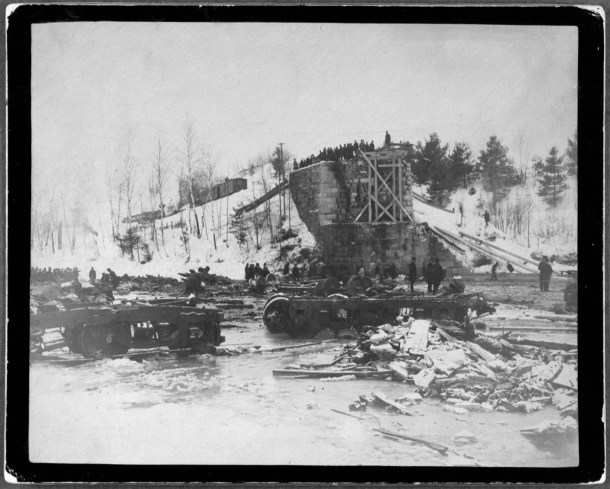
As they struck the thick ice, train cars shattered under the weight of the wheels, killing passengers and trapping others inside. Things only got worse for those who survived the initial crash. Fires from oil lamps and coal stoves quickly ignited the wooden cars, their draperies and upholstery.
Pierce found the brakeman, Parker, on the ice and told him to get help. Parker borrowed a team of horses from a nearby farm and dashed off to White River Junction, which was about 4 miles away. He returned 45 minutes later with rescuers.
In the meantime, passengers and crew members were on their own.
Pinned in his seat, Tewksbury witnessed a horrifying scene as fire advanced through his car. “It was a time of mental torture,” he said, “but I still could not help noticing an old couple who had sat a few seats behind me. They were hopelessly tied down by heavy seats, and the flames were approaching them with frightful rapidity. I could do nothing for them. Before the smoke shut them from sight, I saw them locked in each other’s arms.”
Assuming he was about to suffer the same fate, Tewksbury pulled his fur hat over his eyes “to hide the dreadful view of approaching death.”
Just then, he heard the voices of crew members and called for help. “Two powerful men,” he said, strained to pull him from the wreckage. But they couldn’t budge him. Only his repeated pleas kept them trying.
“I begged them to try once more – to pull my leg off if they had to, but not let me burn,” he said. “They pulled – and, oh, with what a joyous feeling did I feel my feet gradually slipping from my shoes. I cried out that I was moving – to pull, pull, pull! I felt one of my legs break, but I was released.”
The men were about to leave Tewksbury sitting a couple of feet from the burning cars, but he convinced them to put him somewhere safer, leaning against one of the bridge’s stone supports.
Then crew members saw Sturtevant, the conductor, crawling through the car, the back of his clothes on fire. They tried desperately to help, shoveling snow at him through a broken window. He was badly burned by the time they could pull him out. His comrades carried him gingerly to the farmhouse of Oscar Paine, which sat at the north end of the bridge. There he died several hours later.
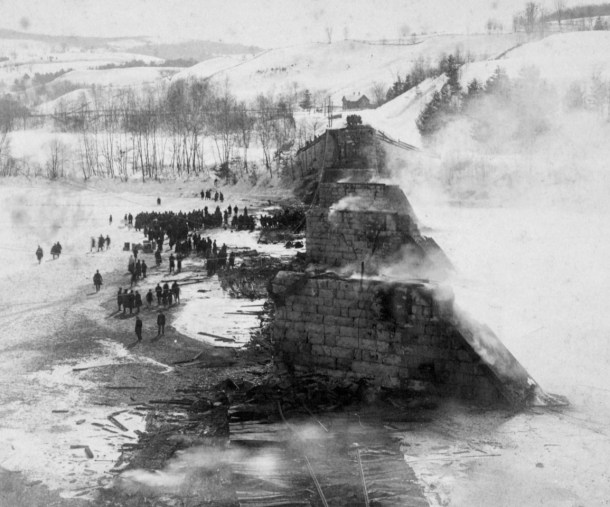
Tewksbury, who by now realized he had also somehow broken an arm, watched the men carry Sturtevant away. He called for them to help him when they returned. He needed moving again. Fire from the train cars had ignited the underside of the bridge above him. Ironically, the top of the bridge had been built with a sheet of iron running its entire length to make it fireproof. No one evidently thought a fire would start from below.
Rescuers returned in time to carry Tewksbury to the Paine farmhouse before the bridge collapsed.

How many of the 89 passengers and crew members died in the wreck is unclear. Various accounts list the number variously as 30, 31, 34 and 37. Some state the number accurately, though not precisely, as “many.”
Part of the uncertainty must be due to the mess the fire left behind. Photographs of the wreck show large heaps of charred debris strewn across the ice. They could be photos of a plane accident, if not for the horse-drawn wagons and men wearing derbies milling about.
The cause of the wreck was pinned on a defective rail discovered by a professor and students from Dartmouth’s Thayer School of Engineering who visited the site 10 hours after the accident.
“The defect in the rail could not have been discovered before it broke,” declared the state’s Railroad Commission after investigating.
The commission concluded that “there was no culpable negligence on the part of the railroad company,” which may have indicated that this was a time that accepted that accidents happen, or that the commission was cozy with the railroad industry.
But that doesn’t mean that the wreck didn’t teach a valuable lesson. Congress and state legislatures reacted in horror to the carnage. They decided that if they couldn’t stop trains from derailing occasionally, they could at least make them less like rolling Molotov cocktails. Congress and the states established new safety regulations, calling for the replacement of gas lights and coal stoves with electric lights and steam heating.
It might be a coincidence, but in the years following the West Hartford wreck, the nation’s annual railroad death toll dropped 60 percent. That might not be as riveting as Tewksbury’s recounting of Gettysburg or his own harrowing escape from death, but it is a tale worth telling.

