

[P]ITTSFORD — A police panel adopted an anti-bias policy for law enforcement Tuesday that advocates say doesn’t go far enough to protect undocumented immigrants.
“While this may not make everyone happy, again, this body is following the legislative mandate we’ve been given,” said Brandon Police Chief Christopher Brickell, chair of the Vermont Criminal Justice Training Council, after a unanimous vote Tuesday adopting the policy as presented.
About 30 people attended the meeting Tuesday at the Vermont Fire Academy in Pittsford. Many were advocates for undocumented immigrants, and several others were law enforcement members.
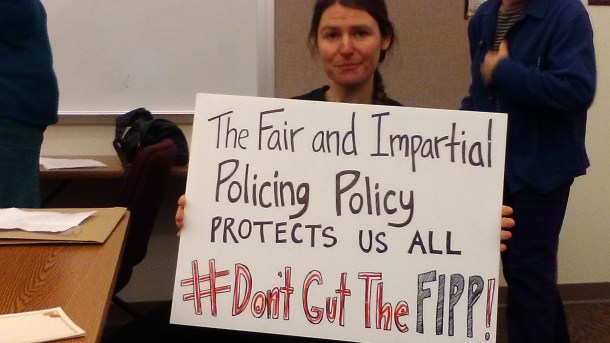
A few people in the crowd held signs, with one reading, “Human rights have no borders.”
Act 54, approved in the last legislative session, required the council to consult with stakeholders and update a policy on fair and impartial policing adopted last year. The goal is to prevent racial bias from influencing law enforcement.
A working group of the council has been meeting since July with interested groups, including Migrant Justice and the Vermont chapter of the American Civil Liberties Union, on drafting the policy.
Will Lambek, a Migrant Justice organizer, said after the meeting that he wanted to remove exceptions in the policy that allow law enforcement in Vermont to share information about immigrants with federal authorities in certain situations.
“What we were asking for is a clear guideline that keeps law enforcement out of the business of deportation,” Lambek said.
Before the vote, leaders of advocacy groups for undocumented immigrants spoke, urging the council to strengthen protections that had been weakened in the final draft of the policy.
Several speakers also sought to persuade the panel to delay action in order to allow more time to hammer out remaining differences.
The legislation called for the council to approve a policy by Dec. 31 that is in compliance with federal law, and for all law enforcement agencies in the state to adopt it by March 1.
Advocates for undocumented immigrants said the Legislature, which returns in January, could extend the council’s deadline beyond Dec. 31.
Enrique Balcazar, 24, a Migrant Justice activist, was one of the speakers urging the council to take more time. He is facing the possibility of deportation as an unauthorized immigrant in the coming months, after being stopped in Burlington by federal immigration authorities in March.
“Small changes in words can have big impacts on lives,” said Balcazar.
Brickell said the council’s working group had considered proposed changes the advocacy groups backed and did its best to incorporate those concerns in the document while remaining in compliance with federal law.
“We’ve had many conversations and lots of discussion about very specific things, very small changes and minute tweaks to language where we feel it would ultimately benefit the immigrant community but still allow law enforcement to do its job,” he said. “This has been progressing for a lengthy period of time.”
Assistant Attorney General David Scherr, representing the Vermont attorney general’s office on the council, said he didn’t know whether more time, if that were even possible, would result in any changes.
“To be blunt, I think most of them we’re at somewhere of an impasse,” Scherr said.
The council and advocacy groups differed over a part of the policy dealing with unauthorized immigrants who are victims or witnesses of crimes.
Jay Diaz, a staff attorney with Vermont ACLU, had called for a handful of changes to the policy to provide greater protections for unauthorized immigrants.
Diaz said after the vote Tuesday that although he was pleased the council adopted a policy, he was “discouraged” by a handful of key provisions.
“This is a good step for Vermont,” Diaz said. “It does have substantive protections. It will be meaningful, and we are hopeful by some of the comments that further discussion can be had. This is the council’s policy — it can be amended. … The conversation continues.”
The advocacy groups had proposed the following language: “Agency members shall not share information about crime victims/witnesses with federal immigration authorities, unless it is with the individual’s consent.”
The council said that language would put the policy in violation of federal law.
The council’s version stated that law enforcement agencies “should communicate that they are there to provide assistance and to ensure safety, and not to deport victims/witnesses.”
Also, the council’s policy states that when considering whether to contact federal authorities, police agencies in the state “should remain mindful that their enforcement duties do not include civil immigration enforcement” and that law enforcement’s mission in the state is “to serve all Vermonters, including immigrant communities, and to ensure the trust and cooperation of all victims/witnesses.”
Some law enforcement officials also addressed the panel, seeking to separate the immigration issue from the fair and impartial policing policy.

“Don’t muddy the waters by commingling (fair and impartial policing) with a highly politicized and rapidly evolving issue like immigration,” Colchester Police Chief Jennifer Morrison, president of the Vermont Association of Chiefs of Police, told the council.
“I have not heard one word about all the beginning parts of the policy about fair and impartial policing. We don’t disagree. There’s no disagreement in this room,” she said. “It’s only the immigration enforcement piece where we have slight differences of opinion about what is in the best interests of all citizens of the state of Vermont. If more time is needed, separate the issues.”
Lambek, of Migrant Justice, cited a traffic stop in August where a Franklin County sheriff’s deputy called U.S. Border Patrol after a traffic stop of two unauthorized immigrant farmworkers. Lambek said the father and son farmworkers now face deportation.
A public records request by Migrant Justice and the ACLU of Vermont resulted in the two groups receiving body camera footage from the sheriff’s department. A federal agent is captured in the footage using the term “wet,” a slur for undocumented farmworkers.
Migrant Justice and the ACLU included the video in a news release they issued late last week as they worked to raise awareness about Tuesday’s meeting on the policy.
Speaking before the panel, Lambek said he was aware of the competing interests the council had to consider in drafting the policy.
“Given the current political climate on the federal level, we understand that the council and the state of Vermont in general is in somewhat of a bind,” he said. “It’s a difficult position, where particularly on some issues, the desire of the council is butting heads with the federal political climate, and we recognize that.”

