(This story by Chris Mays appeared first in the Brattleboro Reformer.)
[M]ARLBORO — About 130 acres of forested land will stay that way, thanks to efforts at Marlboro College to create an ecological reserve.
“I’m just excited this came to be,” said Adam Katrick, interim director of outdoor programs at the college.
One of the project’s biggest proponents over the years, Katrick had initially begun promoting the idea in 2004. He said the set of trails off the land is one of the most frequently used systems by the students.
The property had been part of Vermont’s Current Use program. The college had received tax benefits, and a management plan saw some timbering over the years. More than 18,400 parcels of land totaling more than 2.4 million acres — or about one-third of the land in the state — were enrolled in the program as of September 2016, according to the state.
The new designation as an ecological reserve means some of the land will now be protected from development.
“We want our great-grandchildren to have the chance to see what happens in a forest that’s set off from timbering or economic development 100 or 200 years from now,” said Kevin Quigley, the college’s president.
Professor Jenny Ramstetter said she has brought classes such as Forest Ecology and Plants in Vermont through the land. Other classes have also had visits.
“It’s fun,” said Lydia Nuhfer, a student who has done research in the forest and shared beechnuts with classmates during a recent walk through the reserve.
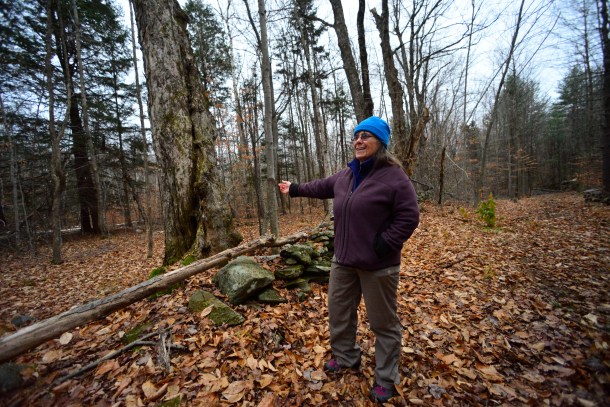
Project leaders want future groups to see the forest go through its natural processes. Ramstetter expects some trees will live up to 200 or 300 years. She showed an area used for sheep pastures in the 1800s and early 1900s. She also pointed out a stone wall, a feature that would mark property borders in the past.

“Now, we have roughly half our forested land in ecological reserve,” Ramstetter said, and the other half is in the Current Use program.
As far as Quigley knows, the reserve would be the first to be contiguous to a main college campus.
“The fact that it’s right next to campus means that it is a resource people will take advantage of because it’s right there,” Quigley said. “I know a lot of liberal arts colleges have these reserves or conservation trusts. But often, they’re a few miles away or a couple hundred. I know some are 1,000 miles away. So they’re probably less likely to be used by the college community.”
Quigley believes the college is making a statement about its values, especially relating to stewardship. He said the land will have “natural uses” including walking, hiking, cross-country skiing, biking and traditional sugaring. He enjoys hiking and wintertime activities.
“I’m very fortunate that they groom the trails by the house I live in,” he said. “So when we have decent snow, I try to either cross-country ski or snowshoe to work.”
The initiative started with a student writing about a proposal for her final plan. Seniors at Marlboro submit these plans before graduation.
The project was also discussed several times during town meeting. The college has a “shared-governance” model, meaning students and faculty are involved in decision making.
The college’s board of trustees approved the designation at a meeting Nov. 4. The decision, Quigley said, “reflects our values and our commitment to being good stewards of our resources.”
“One of our most important resources is our beautiful wooded landscape,” he said. “I think the process was really important because the idea came from the community.”
Some trustees wondered whether prohibiting future development might not be in the best interest of the college, according to Quigley.
“I think they were persuaded this is a very important expression of the college, our educational approach and what we value,” said Quigley, who feels losing the tax benefits of the Current Use program will “be more than offset by this designation.”
He looks at the land as “a living, learning, environmental laboratory.”
Professor Todd Smith, who has been involved in the college’s environmental studies program for 19 years, was on the school’s Environmental Advisory Committee.
The ecological reserve “had been under discussion for quite some time, and it kind of went through periods where there was more interest in it and periods where there was less interest in it,” Smith said. “I got excited about it. I thought it was a wonderful idea, and we spent a lot of time in the committee working on this proposal.”
Smith touted the property’s proximity to campus.
“We can get out there in less than a minute,” he said, adding that the land had been part of the original farm the college was formed from and many community members use the trails. “I certainly have hiked out there and I cross-country skied a lot.”
Smith called the project a good example of democratic participation and said it showed the college’s commitment to environmental issues.
“We also think it’s a valuable resource for the academic program,” he added.