


(This story was updated Nov. 15 at 8:15 p.m.)
[B]ARRE — Saying “she helped destroy a community,” a judge sentenced Jody Herring to life without parole for killing a state social worker and three of her own relatives she believed played a role in her losing custody of her 9-year-old daughter.
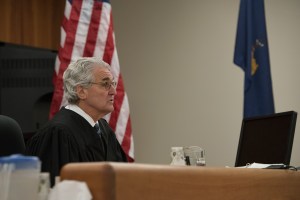
Judge John Pacht imposed the sentence Wednesday afternoon in Washington Superior Court after listening to several victim impact statements, followed by arguments from the prosecutor and Herring’s attorney.
“There were four murders. They were well-planned,” the judge said, adding that Herring “mowed down” with a high-powered rifle her aunt and two cousins on Aug. 7, 2015, before lying in wait in a downtown Barre parking lot to fatally shoot Lara Sobel, a state social worker.
Pacht spoke for more than 30 minutes in a soft voice explaining the reasoning for his sentencing decision.
He told those who had spoken earlier as friends and relatives of the victims that they painted vivid pictures of the people they lost.
Several family members of the victims expressed relief afterward that Herring will never walk out of jail.
“Today was a day that justice prevailed,” Lauren Shapiro, Sobel’s sister, said outside the courtroom after Wednesday’s hearing. “We’re very grateful that the court saw things the way we’ve been seeing them and that Jody Herring will never be out there to live one day of freedom.”
Richard Herring echoed those comments. Jody Herring killed his mother, Julie Falzarano, and his sisters Rhonda and Regina Herring.
“I thought they were going to give her a chance at parole, and we didn’t want that,” he said after the hearing. “I’m a firm believer in capital punishment, but this is what we got.”
Jody Herring stood straight and displayed little emotion as the sentence was handed down.
Earlier she cried while telling the court: “I sat up all night wondering what was I going to say. I’ve never been a mean person in my whole life.”
She spoke through tears and at times looked back at the people seated behind her in the courtroom.
She made her remarks after the presentations by the attorneys on what was the third day of the sentencing hearing. It was her first public comment on the fatal shootings since her arrest in the parking lot where she gunned down Sobel.
Herring referenced comments Sobel’s father, Alex Sobel, made during his earlier victim impact statement about having to cope with the loss of his daughter.
Herring said she agreed with him, pointing out that she had lost custody of three of her children.
“Mr. Sobel is right, the loss of a child is so hard to endure,” Herring said.
“It bothered me for everybody to get up there and listen to those victim impact statements. I know how it feels,” she added. “I’m very sorry. I can’t take back that day. I wish I could, but I can’t. I handle my stress so differently than everybody else does.”
She said she had asked for help several times before the shootings. “I didn’t get it,” she said, adding, “And I’m sorry.”
Herring, 43, pleaded guilty in July to three counts of second-degree murder for killing her three relatives at their Berlin home on Aug. 7, 2015.
As part of a plea deal, prosecutors were able to push for life without parole for Herring, while her attorney could argue for a lesser sentence.
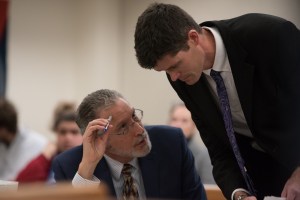
Herring’s lawyer, David Sleigh, didn’t ask for a specific sentence but requested that his client be allowed a chance at parole after a “reasonable” amount of prison time.
After the hearing Sleigh expressed disappointment with the outcome.
“The result couldn’t have been any worse, and obviously we were trying to do better than that for Jody and we didn’t do it,” he said.
Sleigh said he thought the judge viewed the killing of a DCF worker as “systematically threatening,” leading to a harsh sentence for his client.
Life sentences are automatically appealed to the Vermont Supreme Court, he added.
About a dozen family and friends of those slain delivered emotionally charged victim impact statements during the morning session Wednesday. They used terms like “monstrous,” “cowardly” and “unprecedented evil” to describe Herring and her actions.
Several specifically called on the judge to hand down a maximum sentence that would keep Herring behind bars for the rest of her life.
“Your honor, not for vengeance but for justice,” Alex Sobel told the judge in calling for the strictest sentence allowed. “The possibility of parole must never appear on her horizon.”
Richard Herring agreed.
“How do you put into words having a mother and two sisters ripped from you?” Richard Herring said to the judge. “Sometimes when I take the time to think about it, I get angry and just want to take revenge, but I don’t. Other times I break down and cry for no reason.”
He then added, “The only thing that really keeps me going is knowing that someday justice will be served.”
Those delivering the victim impact statements talked of family milestones that the slain will forever miss, of holiday gatherings they will never be a part of again, and of how the grief of their loss is felt every day.
Matthew Levine, an assistant attorney general who assisted in prosecuting Herring, argued for the harshest possible punishment allowed under Vermont law: life in prison without parole.
“This case is an example of one of the most extreme premeditated acts of multiple killings that we are ever witnessing in this state,” he said. “This case is an example of an attack not only on the individuals who were specifically targeted, but in a larger sense, governmental institutions, societal norms as we know them to be, and for that reason it takes on a different aura and different importance setting it apart from other kind of cases.”
The prosecutor added, “She chose to go execute the people that she perceived were interfering with her right to get (her daughter back). That is an attack on the justice system.”
Sleigh argued for leniency, telling the judge that his client endured a lifetime of trauma and suffered from severe anxiety.
She was never able to get the proper care, according to Sleigh, and it all came to a head following her “reckless” and “negligent” release in late May from Rutland Regional Medical Center after suffering a breakdown. The medical center had released her early from what he said should have been a 90-day involuntary hospitalization.
“(It) was her last best opportunity to treat her,” Sleigh said.
Hospital officials, in a statement last week, said they could not comment on a patient’s care or about a pending legal matter.
Had Herring remained at the hospital for those 90 days, Sleigh contended, the murders would never have happened.
Herring, in her statement to the judge, reiterated Sleigh’s contention, saying she wished she had remained at RRMC.
Pacht, in handing down the sentence, also addressed her release from the medical center.
“I think I would share your concern, Mr. Sleigh, that it wasn’t as well thought out as one would hope,” the judge said, adding that it’s much clearer in hindsight.
“It was Jody’s strong advocacy that got her release,” the judge continued. “The sad irony is that we heard so much (about how) no one ever listened to her.”
Shapiro, Sobel’s sister, said after the hearing that she preferred not to think about what Herring said in the courtroom. Instead, Shapiro said, her focus remains on her sister.
“Lara’s legacy is that good people can live a purposeful, meaningful life, they can help others, and they can make a difference in the world,” Shapiro said. “My sister was all about that.”
