

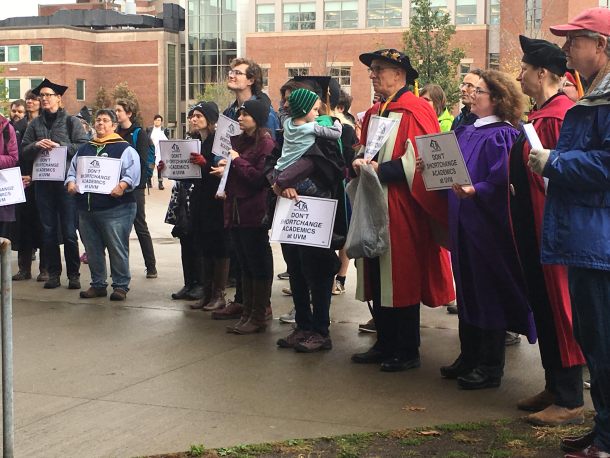
[B]URLINGTON — Members of the University of Vermont’s faculty union were gowned in regalia, singing and chanting as they marched through the busiest portion of UVM’s central campus Thursday during the first round of talks for a new faculty contract for 2018.
The march ended outside a room full of UVM administrators with a rendition of “Amazing Grace.” They changed the original lyrics to include negotiating points on salaries and health care benefits and criticism of the new budget model.
United Academic spokesperson UVM English professor Sarah Alexander said the event was a “reminder to the administration that faculty are at the heart of academics.”
Negotiations reached an impasse in September after more than a year of talks; both parties stated they were committed to negotiating a contract through mediation. Tom Streeter, a sociology professor and United Academics spokesperson said impasse is not unusual and has happened in almost every past negotiation.
The sticking points for the union are health insurance premium hikes and salary increases, Streeter said.
The university recently announced that health care premiums would increase nearly 6 percent. Meanwhile, the university has offered a 2 percent salary increase.
The university released a statement stating that faculty salaries were 104 percent of market level, citing a 2016 Oklahoma State University Faculty Survey Average for Public High Research Institutions.
But the UVM faculty union says these numbers are not comparable to UVM because they are not taken from peer institutions. For UVM to be in line with peer institutions, they state, it would have to invest $11.7 million per year for instruction and research, including faculty salaries.
The union maintains money is going into administration that should be spent on education.
“Only one out of every three dollars of UVM’s budget for compensation goes to funding faculty engaged in teaching and research,” Streeter stated in a press release earlier this week. “Between 2003 and 2016, spending on faculty salaries has increased more slowly than tuition, whereas administrative salary increases have grown faster than tuition.”
Last February, a study released by the union showed that there was a 62 percent decline in tenure track professors, enough for UVM to potentially lose its standing as a “flagship public university,” the union said.
“Education is a public good,” Streeter said. “A public education is good for the state of Vermont, even those that may never set foot at the University of Vermont. I think a better educated, more thoughtful, critical society is very, very badly needed in Vermont, in the nation and around the world, universally.”
The university’s director of labor relations did not respond for comment.
The negotiations are happening at the same time as a relatively new budget model is being implemented and student activism about improving the quality of social justice education is increasing.
The new budget model, “incentive-based budgeting,” gives more money to programs that garner higher student enrollment.
Streeter says that the budget model has become a “Hunger Games” scenario that pits colleges at the university against one another. He pointed to a letter sent earlier this fall from department heads in the College of Arts and Sciences that said the model is harming programs that need to maintain small class sizes for effectiveness, such as humanities and social sciences.
Senior Emily Grace Arriviello said this is part of a larger attempt to defund of education.
“I have heard things from professors like there was a budget surplus but it is going to things like marketing, and I feel frustrated with that because that’s not going to my education, my money is not going to supporting me, it’s going to selling the university to other students,” she said.
Arriviello is a part of the group of 13 student leaders currently negotiating racial reforms at the university. Earlier this year, 200 students presented demands to the administration, including changes to the diversity requirement and more funding for diversity programs.
Arriviello said that courses that are essential to an arts and science education are shrinking. Instead, money in departments like English is being funneled to large introductory courses with over 35 students, such as the diversity courses, a campus-wide degree requirement.
