

[R]egulators, advocates and members of the public continue to raise serious questions about a health reform company’s ability to meet goals under the state’s all-payer model.
The ongoing questions mean OneCare Vermont, the state’s largest health reform company, will undergo at least two more rounds of questioning in front of the Green Mountain Care Board.
Since June, OneCare has been going through its first annual budget process in front of the board, which currently regulates hospital budgets and insurance prices. Regulators are now planning to rule on OneCare’s budget at the end of December.
At a four-hour hearing Thursday in front of the Green Mountain Care Board, officials from OneCare Vermont defended their updated plan to control $599 million in health insurance money used to treat 120,000 patients starting Jan. 1.
OneCare’s original budget estimated $737 million would be needed to treat 137,000 patients, but the company downgraded those numbers in October. Todd Moore, the company’s CEO, said Thursday that the exact number of patients still has not been finalized.
On Wednesday, the day before the hearing, the board’s actuaries issued recommendations saying that OneCare — which has now submitted two versions of its budget to the board since June — to make significant updates and finalize key contracts.
The company has not yet signed contracts with three major insurers — Medicare, Medicaid and Blue Cross Blue Shield of Vermont — that would facilitate the work OneCare wants to do starting Jan. 1, according to Moore. The actuaries said OneCare should provide signed contracts “no later than Nov. 15.”
OneCare needs the contracts because it is planning to be an intermediary that controls the money that insurance companies pay to more than 160 different health care companies, including 10 hospitals. The insurance money is the main basis of OneCare’s budget and health reform goals.
Additionally, under the all-payer model agreement that state officials signed in October 2016, officials said they would limit the growth in the amount of money companies such as OneCare would get each year to 3.5 percent — a number that officials say is lower than the current rate of health care inflation.
However, the actuaries are now questioning whether OneCare will be able to limit its spending growth to 3.5 percent per year. The actuaries pointed to OneCare’s performance under previous health care reform programs, when OneCare did not meet goals to lower spending on certain patients.
“OneCare needs to demonstrate the steps they are taking in 2017 and the future years are effective in controlling the increasing costs and utilization,” the board’s actuaries wrote.
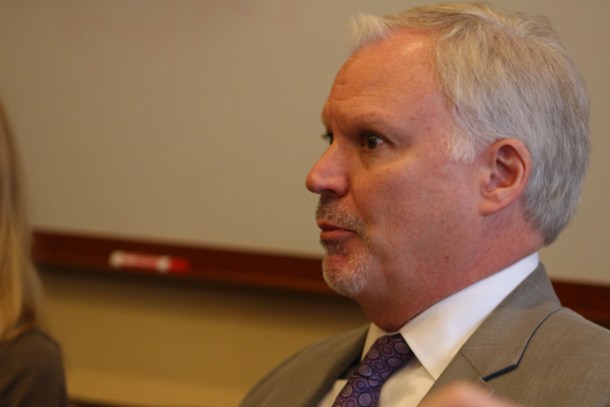
Flanked by his top financial and medical employees, Moore told the board on Thursday that the company has been preparing for five years, since 2012, to take the next steps in health care reform.
In an interview after the hearing, he took the criticism in stride and said that the actuarial review is “extremely helpful” to the company.
“A lot of what’s going on is really interesting, brand new regulation of sort of a major layer in health care, and I think some of it is all of us trying to understand where’s the best balance there in terms of scrutiny, oversight, reporting,” Moore said.
“The more interesting thing from (the review from actuaries) to me is, what’s the board’s responsibility in not letting OneCare move forward if they don’t think that we can do well under the target?” Moore said.
“Really some of their (questions) are, ‘Are they really prepared to do the things it will take to do well on the targets? Are the targets that they might get going to be ones that they won’t sort of end up under water on?’” Moore added.
Moore said he would be open to having a higher spending limit because it would make it easier for him to come in under the limit. “But if the providers are willing to (provide care under the lower spending targets) I think they should let us do that,” he said.
During the public comment portion of the meeting, Dr. Allan Ramsay, a former board member, told Moore and his team that they do not sound like they are a company that represents the views of health care providers.
“Now, you are both a provider and a payer,” Ramsay said. “Every time you make that move, you inch a little closer to the historical model of health maintenance organization — the historic and failed HMO model.”
“My primary care colleagues fear two things,” Ramsay said. “Number one, there won’t be adequate consumer protections. But number two there won’t be adequate provider protections — because none of us want to be moved down that path towards being a gatekeeper again.”
He said a third worry among primary care physicians is whether enough money is being invested into primary care services, including mental health and substance abuse treatment.
Kevin Mullin, the chair of the Green Mountain Care Board, said after the meeting that he continues to have reservations about OneCare’s budget and the all-payer model.
“I share some of the same fears that Dr. Ramsay has, that if things aren’t really done properly that this could turn into just a glorified HMO, and I don’t think that’s what anyone wants to see as the end result, including OneCare,” Mullin said.
Moore said OneCare has no intention of imposing prior authorization requirements — a hallmark of HMOs that requires primary care providers to fill out extensive paperwork before patients can see specialists to get complex medical treatment.
“If we end up running amok and start saying, ‘We are going to have to implement our own prior authorizations because the (provider) network isn’t achieving the results,’ that would be very bad,” Moore said.
“I urge everyone to call us on that if we actually start to go down that pathway,” he added.
