

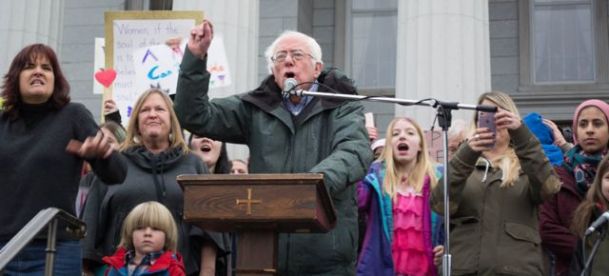
(Jon Margolis writes political columns for VTDigger.)
[B]ernie Sanders is not a woman.
Also, he’s white and not young.
These assertions in and of themselves are neither remarkable nor debatable. But even undebatable facts can inspire debate, and these did as soon as it was announced that Sanders would make the opening speech at a three-day Women’s Convention scheduled to open Friday in Detroit.
Assuming, for the sake of this discussion, that Twitter messages qualify as debate.
“This event is literally called the ‘Women’s Convention,’” noted writer Lily Herman at a website called Refinery29, “so it’d be nice to see, you know, women in the spotlight.” Aruna D’Souza, a writer who has impressive credentials in the intellectual/artistic realm (she’s a former associate director of research at the Clark Art Institute in Williamstown, Massachusetts) tweeted: “I have nothing against Sanders, but the choice of a man to open a Women’s Convention is just bad optics.”
And a liberal New Yorker who tweets as Jenny described Sanders as an “old grifty misogynist” who would be speaking in Detroit, which is “85% black … the demographic Bernie Sanders has the least time and respect for.”
From her photo, Jenny seemed as white as Sanders, but she and the other anti-Bernie writers had followers. A petition on the Change.org website attracted 11,000 signatures in opposition to the Sanders appearance.
Yes, there were some followers of the Women’s Convention who thought Sanders was a good choice, and for a while the leaders insisted via their own Twitter account that they were “so excited” he would be making the opening speech.
Then they caved.
“We know that it has been a painful week for women across the nation,” read a statement from the convention’s Twitter account, acknowledging that the convention leaders had “added to that pain” when their announcement “gave the impression that he is occupying a central role at the convention.”
That’s because he was occupying a central role at the convention.
Whatever, Sanders will not speak. First he was rescheduled to appear on a panel. Then they dropped that one, too. Sanders isn’t going to Detroit this weekend. He’s going to Puerto Rico.
In the great scheme of things, all of this is much ado about very little. Though it is being organized by the same folks who put together the stupendously successful Women’s March of last January, when millions of people all around the country turned out to oppose the new presidency of Donald Trump, the convention has not attracted nearly as much support, or even very much attention.
Perhaps that’s because it has not promoted itself all that effectively. Its mottos – “Reclaiming our time” and “The rise of women IS the rise of the nation” – are distinguished only by being totally meaningless. Aside from Sanders, only one or two of the 60 people (58 women) initially scheduled to speak are even remotely well-known.
Still, the dispute over Sanders illustrates what is happening in at least one segment of the political left, and because Sanders is part of the left, what is happening there affects him, especially if (as appears likely) he is contemplating another run for the presidency in 2020.
In context, this “political left” is not the left as described by, say, the Republican Party, which would include Barack Obama and Hillary Clinton. This is the left-of-liberal left, as is Sanders.
But neither is it the populist left associated with Sanders and his denunciations of the “billionaire class.” This is a left-of-center political gathering only a few blocks from the headquarters of the United Auto Workers Union, whose officials knew nothing about it until asked by a reporter. The “working class” Bernie Sanders so often praises will not be a factor. This is a gathering of the un-populist left – academic, professional, intensely aware of the sensitivities of its various ethnic, cultural, sexuality and gender constituencies.
For two reasons, this Women’s Convention presents liberal Democrats with a problem. First, there is the general argument over how much Democrats should pursue this “identity politics” approach.
Then there are the facts about this particular organization, facts which may help explain why Sanders, rather than prominent female senators, got invited to make that speech in the first place. Why were not Elizabeth Warren, of Massachusetts, Kirsten Gillibrand, of New York, or Kamala Harris, of California, asked to fill that role?
They were, said the convention’s organizers, but they had scheduling conflicts.
Well, they may have had other things to do. But among Democratic and liberal circles in Washington it is also assumed that these senators – some of whom are facing re-election next year – decided for political reasons to have nothing to do with the Women’s Convention.
Perhaps that’s because:
- On July 16, the Women’s March Twitter feed sent birthday greetings to Joanne Chesimard, the convicted murderer who escaped from prison and is now in Cuba.
- When Fidel Castro died last year, Tamika Mallory, one of the March movement’s top leaders (and a major supporter of Sanders’ campaign last year), hailed him as her “commandante,” whose “legacy lives on.”
- Two months ago an affiliate of the Women’s March sent birthday wishes to Rasmea Odeh, another woman who has been convicted of murder (in Israel) and of immigration fraud in the United States. She has since been deported.
All this could be considered guilt by association. But in politics, guilt by association is proper, because no actual guilt is involved. Political discussion sends no one to prison. It merely holds people responsible for the political allies they choose. Having seen the political allies chosen by the Women’s Convention, some political women have decided to have nothing to do with it.
That decision no doubt was reinforced when convention leader Linda Sarsour, after CNN’s Jake Tapper questioned why no one on the left had complained about the birthday greeting to Chesimard, tweeted that Tapper “joins the ranks of the alt-right.”
That was a statement of sufficiently mind-boggling inanity to repel any politician, or, come to think of it, any discerning person.
Including Sanders, who by now may be happy to be off to Puerto Rico. But the convention gig might have helped Sanders, who often seemed uncomfortable last year when facing advocates of the left’s various subgroups. Blogger Jenny overdid it when she said Sanders had “the least time and respect” for African-Americans. But he often found it difficult to connect with black audiences, and he annoyed feminist activists when he urged liberals to “go beyond identity politics.”
There is a segment of the left – and that segment dominates the Women’s Convention leaders – that embraces identity politics, though it sometimes seems selective about what qualifies as an “identity.” Speaking at the convention might have given Sanders an opportunity to show those identity activists that he is one of them.
Or perhaps prove that he was not.

