

[T]owns wanting to take school district mergers to voters in time to get tax breaks presented their cases last week at a marathon meeting of the State Board of Education. Unification plans can still be proposed, but they won’t translate into savings for taxpayers, and small-school grants will dry up.
Two towns that said no to separate merger plans in the spring — one because it would mean closing its high school — pitched proposals that would close Black River High School in Ludlow and Rochester High. Another merger, in Franklin Northeast, would keep two nearby high schools on life support.
Pawlet and Rupert returned with a plan that gives kids more opportunities but raises taxes. And Peacham got what it wanted: to be left alone.
Because enrollment numbers have been dropping over the last two decades, Act 46 requires communities to discuss voluntarily merging into larger districts to give students more options and reduce costs. Study committees bring proposals to the state board for approval, then local voters decide whether to unite.
The newer Act 49 added ways for districts to join together and still get tax breaks as long as they get voter approval by Nov. 30. Districts that don’t merge are to bring an “alternative proposal” to the board showing they can remain viable, give students more educational opportunities, and achieve good results.
Black River High would close in two years
Last spring, Ludlow voters rejected a merger that would have closed Black River High School to send students to North Clarendon. Residents in Mount Holly, which shares Black River with Ludlow, voted for the plan, but because it is a union district both towns have to agree.

Ludlow and Mount Holly operate pre-K-through-6 schools and send students to Black River starting in seventh grade. The new plan would keep the elementary schools and offer choice to high school students after two transitional years.
Superintendent Meg Powden, of Two Rivers Supervisory Union, said it’s been hard to pull the plug on the high school. “We have students and families very tied to that school,” she said. But over the last 20 years it has seen enrollment drop by 142 students. The 130 to 150 high-schoolers will be able to pick Mill River Union High School in North Clarendon, Green Mountain Union High School in Chester, or a private school. Closing Black River is expected to save $600,000.
The study committee report said residential education tax rates would go down from $1.72 per $100 of assessed property value in Ludlow and $1.64 in Mount Holly to $1.52.
Not everyone on the study committee supported the new proposal, according to Powden.
The board-approved plan goes to voters Nov. 28.
Closing Rochester High
Rochester, with one of the most expensive schools in the state, might close the high school, pay tuition for students to attend elsewhere, and join districts with Stockbridge.
This was the third time Rochester’s Act 46 committee members appeared before the state board. The district first wanted to merge with Bethel and Royalton. But after Royalton rejected the idea in April, Rochester reconsidered.
Nearby Stockbridge, which has a pre-K-through-6 elementary school and then choice, dropped out of an earlier study committee when another town balked over which grades it would teach.
Study committee Chair Carl Groppe said this arrangement was not about tax cuts. “This is not an 11th hour attempt to get tax incentives,” he said. “We saw an opportunity when Rochester pivoted and indicated they would be open to an operating model we have used for years in Stockbridge.”
If Rochester doesn’t change, it faces a tax rate of well over $3 per $100 of property value in the future.
Stockbridge wants to keep its small-school grant and reduce some operating costs.
If voters agree, Rochester and Stockbridge will merge into one school district, run two elementary schools, and tuition students to middle and high school. A yes vote in Rochester closes the high school.
Rochester voters would have saved more on taxes if they had merged with Bethel and Royalton. Joining forces with Stockbridge will raise the tax rate to $1.99 in 2021.
If Stockbridge doesn’t complete a merger, its taxes are expected to increase to $2.14 by 2021. Uniting with Rochester would let the town keep its elementary school and keep taxes at $1.99.

Rochester had 33 students in kindergarten through sixth grade last year, and Stockbridge had 41. State board members were concerned about keeping both schools open when they are only 11 miles apart.
State board Chair Krista Hulling asked why it made sense to reduce taxes and keep tiny schools afloat when there aren’t any big changes for kids. “I’m struggling with seeing how this is not creating more problems looking into the future,” she said.
Steven Dale, the consultant for the study committee, called Rochester’s the “most challenging financial situation.” Dale said: “The real number of high school costs (for Rochester) are close to $30,000 per pupil. It is definitely in the interest of the state of Vermont if this budget is decreased substantially.”
The state board approved the plan, but John O’Keefe voted against it.
Franklin Northeast: Close but still so far
The board approved a plan that combines Bakersfield, Berkshire and Montgomery into one school district, supports pre-K-through-8 schools with one six-member school board, and continues high school choice.
Voters rejected the first merger plan to come out of the five rural towns of Bakersfield, Enosburgh, Berkshire, Montgomery and Richford.
Jean-Marie Clark, Bakersfield study committee member, said some people didn’t want to give up school choice and others thought: “If I say no to this Act 46, it is going to go away.”
The new plan lets families pick their elementary school. Most of the students choose to go to Enosburgh or Richford for high school. The study committee found the high schools aren’t offering the same opportunities to students. Enosburgh and Richford operate pre-K-through-12 schools, and they would join into one school district and act as one side of a side-by-side merger with the other three towns.
Enosburg Falls Senior High School had 327 students last year and a student-to-teacher ratio of 13-to-1. In 2010 the school had 345 students and a ratio of 11-to-1. Richford had 144 students in grades nine through 12 last year and a 13-1 ratio. In 2010, the school had 188 students and an 11-1 ratio.
Superintendent Lynn Cota stressed the importance of keeping both high schools open even though they are only 11 miles apart.
Under the plan, any decision to close a high school or change programs requires the agreement of five of the six board members, in addition to a two-thirds majority vote of the town.
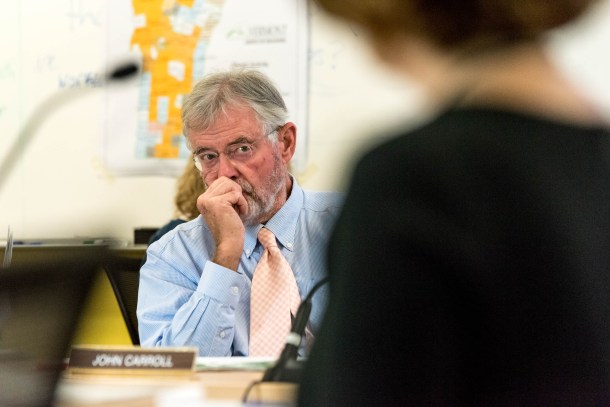
“You set a high bar for making significant changes,” said John Carroll, a state board member.
Richford board member Wally Steinhour said Act 46 is not about closing schools, so there shouldn’t be a problem with setting a high bar. “We didn’t want a decision (to close a school) to be something that could happen quickly or easily,” Steinhour said.
But Carroll said that is putting programming and curriculum in the same boat. “I wish there were some difference: a high bar for closing schools and a low bar for flexibility,” he said.
Cota said there is a fear in the community they would make one of the schools a middle school and the other a high school. “That is not the intention behind this,” she said, adding these measures are meant to reassure the community.
The board approved the plan unanimously. Voters will get a chance to weigh in Nov. 28.
Rupert and Pawlet ditch New York school agreement
In September the board sent Rupert and Pawlet back to rewrite their plan. The first proposal required New York high schools to be designated for students with choice. The New York schools cost only $5,000, but a parent wanting to send a child to a different school would pay the difference. Board members said this created inequalities for kids. The low cost also kept tax rates artificially low in the two towns.
The new proposal gets rid of designation and gives all students tuition for grades seven through 12, which will raise taxes. The two towns will operate one elementary school.
“We will see cost increases instead of cost savings,” said Bennington-Rutland Supervisory Union Superintendent Jacquelyne Wilson.
Bill Myer, Rupert member of the study committee, said he expects his town to vote no. “There is an awful strong feeling not to make the best of it,” he said.
The state board approved the plan to go to voters Nov. 21.
Backed into a corner by Act 49
Four Caledonia County towns pitched an Act 49 merger that would make Peacham a single district while giving the three other communities tax breaks.
Under the plan, Barnet, Walden and Waterford would form the Caledonia Cooperative Unified Union School District. Peacham would join the three towns within the same supervisory union but keep its own board and budget. Peacham residents won’t get tax breaks, but the others will.
Act 49 allows such so-called 3-by-1 mergers. The one — Peacham in this case — gets to keep its school board and is exempt from potentially being forced into a merger by a statewide plan coming in 2019.
State board members felt forced to keep an expensive school in Peacham open so the other towns could merge. Barnet, Walden and Waterford had been part of a broader previous proposal that fell apart when voters in other towns balked. Act 49 made it possible for another kind of merger that could deliver tax breaks to the three towns.
State board member Peter Peltz said Act 49 seemed to be written for Peacham. “You are still going to lose your small-schools grant; you are still going to lose your phantom students; your taxes are going to be compounded; you are not protected by this merger,” he said. “We are between a rock and a hard place. We spoil your (Caledonia) situation if we say no.”
Peacham’s pre-K-through-6 school had 56 students last year and a student-to-teacher ratio of 9-to-1, according to [enrollment reports at AOE.] Study group members said the school has turned around and students are performing well.
The state board’s Carroll said the data doesn’t support that assertion. “You have all the socio-economic advantages and very ordinary results with a rapidly collapsing (student enrollment) — 35 percent over 20 years — the highest in your area. Students are leaving your area. Your district is one of the most expensive in the state. You have been heavily dependent on the state to prop up your district,” he said.
The plan was accepted 5-3 in a roll call vote. Local voters are to weigh in before the Nov. 30 deadline.
Correction: The number for Peacham student enrollment for last year has been corrected.

