


[T]OWNSHEND — With classes resuming next week at Leland & Gray Middle and High School, officials are hoping they’ve finally solved a lingering radon problem.
Windham Central Supervisory Union discovered elevated levels of the potentially hazardous gas at three of its schools earlier this year. Corrective steps quickly solved the problem at two elementary facilities.
But radon is causing more persistent issues at the supervisory union’s largest building.
Now, officials say they finally have preliminary test results showing that radon is within acceptable limits at Leland & Gray. They’re hoping those numbers will be confirmed by final tests, which will be available “in the coming weeks,” Principal Bob Thibault said.
“I certainly appreciate the patience of the community as we have worked hard to resolve this lingering problem,” Thibault said.
Officials have been dealing with the issue for six months.
In March, Leland & Gray’s school board alerted parents and staff about elevated radon readings based on tests done in February. Measurements in the library, music room, weight room and a nearby classroom all exceeded 4 picocuries per liter of air, which is the U.S. Environmental Protection Agency’s “action level” for radon.
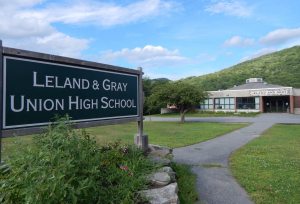
Further testing also revealed higher-than-expected radon readings at NewBrook Elementary in Newfane and Townshend Elementary, located near Leland & Gray in Townshend.
Such findings caused concern because long-term exposure to high levels of radon is linked to increased risk of lung cancer, especially among those who smoke. The gas is odorless, colorless and naturally occurring, so the only way to find unsafe levels is through testing.
Windham Central officials told residents there were no immediate health concerns and undertook remediation projects at all three schools. Superintendent Bill Anton said the two elementaries are now “all clear.”
“They came in, did one mitigation, no problem,” Anton said.
But at Leland & Gray, a contractor “had to keep going back and working with it,” Anton said.
At a recent meeting, Thibault told Leland & Gray board members that additional ventilation measures in the music and water tank rooms had produced preliminary radon levels below 4 picocuries per liter.
The library also had shown acceptable levels, so “we’re very hopeful,” Thibault said.
With no students there over the summer, the building’s windows have been closed, he said. “That actually helps our test results be more accurate,” he added.
Anton said he’s not sure why the problem has been so persistent at Leland & Gray, other than the fact that the school is built into a hillside. The EPA says radon results from the breakdown of uranium in soil, rock and water, and it seeps into buildings from the ground.
The school’s radon mitigation contractor, Anton said, has been “great” and “very transparent.” Nevertheless, the bills are adding up: Anton estimated the price tag of Leland & Gray’s ongoing radon project is between $10,000 and $20,000.
Based on the events of the past six months, officials say they plan to keep a closer eye on radon at all Windham Central schools.
“We’ll do annual testing from this point forward,” Anton said. “If it ever changes, we’ll mitigate it again.”

