

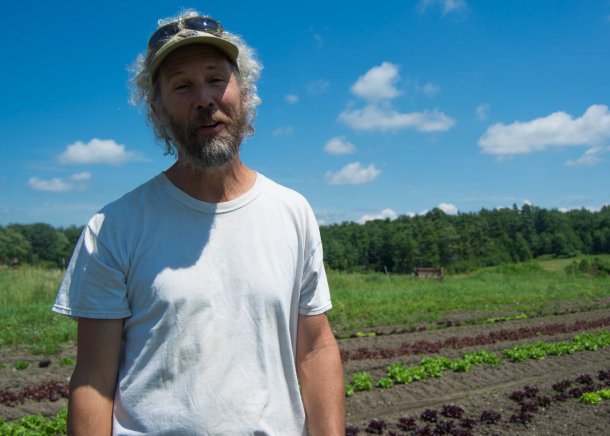
[C]HARLOTTE — “There’s nothing I’d rather do than harvest lettuce in the morning,” says Neil Dominieckl, manager at Stony Loam Farm in East Charlotte. “It’s like meditation.”
Rain or shine three days a week, farmer Dave Quickel and his crew at Stony Loam are harvesting the crop for Burlington’s salad eaters.
The farm grows seven varieties, all certified organic. If you buy lettuce in summer from places like City Market Co-op or Healthy Living, or enjoy it at restaurants such as American Flatbread and Stone Soup in the Burlington area, it probably came from Quickel’s field.
On a busy Friday, when wholesale orders peak, Stony Loam harvests and processes nearly 120 pounds, or 700 heads of lettuce. From May through September, the farm plants 5,700 heads every week. The farm is 32 acres, with 3 acres devoted to its lettuce operation.
According to Todd Taylor from the Community Engagement Department at City Market, 80 percent of the lettuce sold at the co-op during peak summer months comes from Stony Loam.
“Their growing techniques combine in a way that provides us with the quality lettuce we need at the time we need it,” Taylor said of the farm’s operators. “Vermont summers can be difficult on lettuce production, so their ability to do this is tremendously important.”
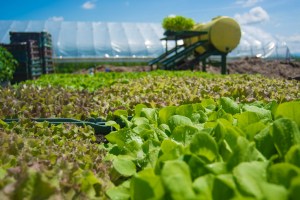
“Clay soil can be hard to farm, but lettuce has a really shallow root,” Quickel said. “The clay has the capability to keep the lettuce from bolting in the heat of the summer, and it prevents the lettuce from getting bitter in the hottest weather.”
However, the soil doesn’t come without its challenges for Quickel’s main crop. During particularly rainy summers the ground can stay wet for days, preventing him from seeding the fields for the next batch his customers are relying on. Summer storms also pose a threat that Quickel said has been more abundant this year, as hail can knock out an entire batch.
“I used to feel fairly secure growing the lettuce,” he said. “But now I feel on the verge of a hailstorm that’s going to decimate everything. We’ve been dodging bullets all year.”
Leafy greens didn’t always reign as Quickel’s most important product. When he began farming on leased land in East Charlotte 15 years ago he grew primarily under the community-supported agriculture system, in which consumers pay the farm directly for goods, usually in advance. While the farm still boasts an active CSA program of more than 100 members, Quickel needed a way to grow the business.
He first started wholesaling to Shelburne Market, pounded the pavement for more customers and then bought the 32-acre parcel that today is home to Stony Loam.
There is still scope to expand. Quickel is scouting out more land in Charlotte. If he eventually decides to buy, he would work toward providing larger grocery store chains like Hannaford with his lettuce.
“Ten years ago I was vocally against my farm wholesaling,” he said, “believing CSA was the only way to go. I guess I’m a sellout, but now I love it.”
