

(“Then Again” is Mark Bushnell’s column about Vermont history.)
[T]he men traveled incognito. They wanted to get away from the madding crowd and the crushing pressures of their jobs. Their journey was primarily for pleasure, though they couldn’t help mixing in business along the way – they were both compulsively active men.
By the time they reached Bennington on June 3, 1791, however, word of their planned visit had filtered north and appeared in the pages of the town’s paper, Anthony Haswell’s Vermont Gazette. When Moses Robinson, a former governor and then a U.S. senator, learned they were in town, he wouldn’t hear of Thomas Jefferson and James Madison staying at the local tavern. He invited them to dine and lodge at his home.
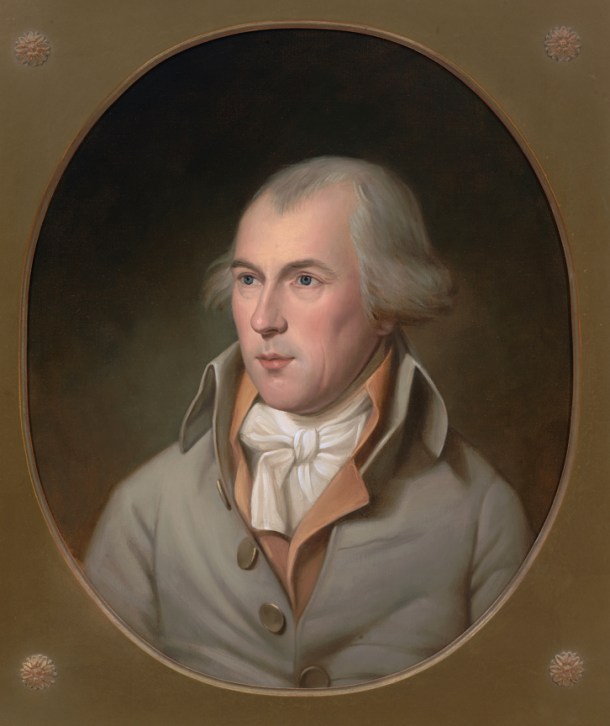
Jefferson and Madison were on the homeward leg of a journey that Madison had suggested. He had proposed taking a month to travel as far north as they could before returning to their work in the national capital, which was then in Philadelphia. The men had been major forces in creating the United States. Jefferson had written the Declaration of Independence, and Madison had been so influential in the drafting of the Constitution that he was dubbed its father. In 1791 Madison was an influential member of the House of Representatives and Jefferson was President Washington’s secretary of state.
Madison had suggested they travel up the Hudson River to Lake George and Lake Champlain, and return via the same route. Jefferson asked whether he might add Vermont to the itinerary. He was curious about the newly minted state, which he believed held great promise.
Madison wrote back obligingly: “Health, recreation & curiosity being my objects, I can never be out of my way.”
Madison and Jefferson wanted to get away from Philadelphia’s heat, both climatic and political.
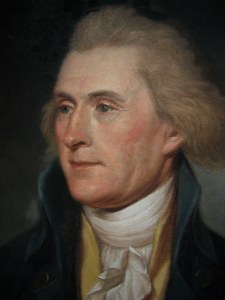
All in all, Jefferson decided, he would rather not be in Philadelphia.
Historians credit Jefferson with numerous inventions, among them automatic closing doors, the swivel chair and a way to duplicate documents. Vermont historian Willard Randall suggests one more: the summer vacation. Though many prosperous Americans had made a tradition of taking a once-in-a-lifetime grand tour of Europe, Jefferson had begun making regular, shorter jaunts. He’d picked up the habit while U.S. minister to France and transposed it to America upon his return.
Jefferson couldn’t simply relax; he had things he wanted to accomplish on this trip. One was to take notes on the prevalence in the north country of the Hessian fly, which was causing widespread crop damage.
He also wanted to see Americans in their natural element, and to find ways to improve their lives. As he once explained to his friend the Marquis de Lafayette, “You must ferret the people out of their hovels as I have done, look into their kettles, eat their bread, loll on their beds under pretense of resting yourself, but in fact to find if they are soft. You will find a more sublime pleasure … when you shall be able to apply your knowledge to the softening of their beds and the throwing of a morsel of meat into their kettles of vegetables.”
The men traveled north with Jefferson’s slave James Hemings, who might also have been his brother-in-law. Hemings was purportedly the half-brother of Jefferson’s late wife.
They passed through Albany, New York, where their visit was reported in the local paper, which is apparently how Haswell, the Bennington editor, learned of their trip. From Albany, they hoped to move about more anonymously. The mismatched pair – Jefferson was 6-foot-3 and Madison a foot shorter – made their way to Lake George, which Jefferson declared “the most beautiful water I ever saw.” In the lake area, Jefferson, an accomplished naturalist, created a list of the plant species he saw: “honeysuckle, wild cherry … black gooseberry, Velvet Aspen, cotton Willow, paper birch … bass-wood wild rose.”
There, the two slave-owning Virginians encountered what must have been an astonishing sight for them, and perhaps also for Hemings. They met Prince Taylor, a black man who employed six white men on his 250-acre farm, and they came away impressed. Madison wrote that “by his industry and good management (he) turns (his farm) to good account.”
Then they visited the ruins of Fort Ticonderoga, which today prides itself on being the nation’s first heritage tourism site.
The next day they ventured onto Lake Champlain. Sailing north, they encountered a fierce storm and made little more than 10 miles that day. They were obliged to stay the night at Chimney Point, on the Vermont side.
Vermont would have had particular interest to Jefferson, who three months earlier as secretary of state had officially attested to the state entering the union. He had high hopes for Vermont. As Randall notes, Jefferson saw Vermont as a new Virginia, without the deep-rooted slave system and aristocracy, where ordinary farmers could own land and make a living.
His view was reaffirmed when he crossed the slender section of lake separating Vermont and New York. While New Yorkers were tenant farmers, Vermonters owned their own farms. These Vermonters led simple lives, he noted. “Their living extremely plain and economical,” he wrote, “particularly in the table and ordinary dress. Their expense is chiefly on their houses, which are of wood and make a good figure (outside), but are very scantily furnished within.”
After spending the night at the inn at Chimney Point (today a state historic site), the men continued sailing north. Again they faced a north wind. Already behind schedule, they scrapped plans to sail to the Canadian border and then cross the Green Mountains. Instead, they would head to Saratoga, New York, scene of the great northern victory during the recent Revolution, then travel by land to Bennington.
News of their travels beat them to Bennington. They accepted Robinson’s invitation and that afternoon ate with a group of Vermont political leaders. Upon arriving, Jefferson had stood enthralled by an immense balsam poplar in Robinson’s yard. Jefferson was that sort of guy, and this was a new world to him.
But it was a different sort of tree he spoke of over dinner. Jefferson had noted the abundant maple trees that blanketed Vermont and thought they could be used to benefit the nation. He envisioned a maple sugar industry that would eliminate the nation’s dependence on foreign sugar, then the country’s largest import.
The Vermont Gazette trumpeted the news of Jefferson’s plans to have a Dutch company set up a maple operation in the state. “Refineries are about (to be) established by some wealthy foreigners resident in the Union,” the paper reported. The Dutch firm’s plant did indeed open, but soon failed. Vermonters, however, had gotten the message that their maple trees were valuable.
Jefferson and the other guests no doubt also discussed politics. At the dinner, Madison and Jefferson apparently learned the distressing news that the British had built an armed blockhouse just south of the Canadian border (on North Hero) and that a British warship was harassing shipping on the lake.
They would have left the next morning, but it was a Sunday and Vermont had strict laws prohibiting travel on the Sabbath. The men instead accompanied Robinson to the town’s Congregational meetinghouse, where they received a cold reception from the minister, Job Swift, who viewed them as godless slave owners.
Despite Swift’s iciness, the two men had seen promise in this new state. Perhaps the future presidents discussed Vermont’s potential as they rose before dawn the next morning and rode toward home.
/

