


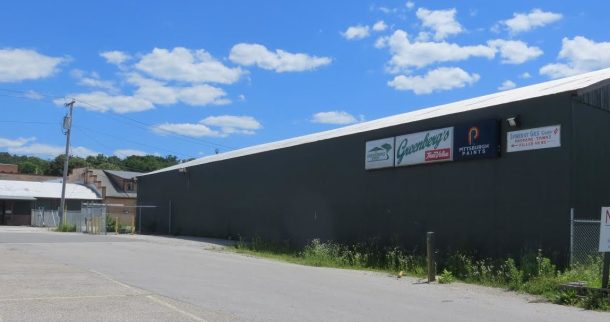
The report on underground contamination was compiled by Nobis Engineering Inc. on behalf of Bennington Redevelopment Group, LLC, which proposes a $54 million project to revitalize six downtown parcels that encompass 4.3 acres around the historic Putnam Hotel building. The first phase of the community-oriented investment group’s plan is expected to go out to bid later this year.
The environmental investigation report and proposed corrective action plan for the subsurface contamination has been posted for public comment, and will be submitted to the state Department of Environmental Conservation for approval.
The report includes proposed remediation of trichloroethene, or TCE, and polycyclic aromatic hydrocarbon contamination in the soil, and TCE in groundwater and soil gas.
Based on the Nobis assessment and prior site assessment work done on the Putnam parcels, the properties have been used for dry cleaning, auto repair, battery service or storage; newspaper printing, paint storage, carpet cleaning; a hardware store with lumber yard, the hotel; blacksmith operations, cold storage and general storage, according to the report.
The Putnam Block project site consists of six parcels bounded by Main Street, South Street, Franklin Lane, and Washington Avenue.
Maps filed with the assessment show TCE contamination primarily under the area between the former H. Greenberg & Son hardware store entrance and the lumber storage barns of the former business, bordering Washington Avenue and Franklin Lane.
Trichloroethene was used as a solvent, such as in dry cleaning, and as a degreaser for metal parts.

Gasoline tanks at a current convenience store and gas station at Main Street and Washington Avenue would be removed. That corner parcel is slated for new construction during Phase 2 of the project.
Subsurface investigations at the site have detected volatile organic compounds, polycyclic aromatic hydrocarbons, lead and arsenic contamination in soil, as well as volatile organic compounds in groundwater monitoring wells.
The groundwater in the area is not known to be used for human consumption, the assessment report states, adding, “Based on historically very limited VOC detections in soil and groundwater and the non-volatile nature of the petroleum hydrocarbons identified in soil, the primary risk exposure to the contamination is via direct contact with site soil.”
The report states, “Therefore, the focus of the remedial alternatives selected for
evaluation will be to limit exposure via direct contact with impacted soil by future users of the site.”
The assessment analyzes different options for remediation at the site, recommending a limited amount of contaminated soil extraction combined with onsite soil management. Long-term controls would include maintaining the integrity of a clean soil cap limiting direct contact with the contaminated soil and approximately a half-dozen monitoring wells around the site that would be checked twice annually and require a report on volatile organic compounds.
Passive vapor mitigation systems would be required during the construction of proposed new buildings on two of the parcels.
The report adds, “The TCE soils and identified impacted urban fill (PAHs) soils will be removed prior to redevelopment activities in the area of the impacted soils to minimize worker exposure to the most highly contaminated material.”
The cost of the remediation work has been estimated in the $1.2 million range, but Bill Colvin, assistant director of the Bennington County Regional Commission, said the final cost will depend on the plan as approved by the DEC.
Bennington is applying for grant funding to assist in environmental cleanup work associated with the Putnam parcels.
Anyone wishing to read the report can view a copy at the Bennington town offices weekdays between 8 a.m. and 5 p.m.
Comments on the plan are due by July 28 and can be emailed to Kristi.Herzer@vermont.gov, or mailed to M&S Development, P.O. Box 1585, Brattleboro, VT 05302.
The public hearing will be held July 12 at 7 p.m. at the Bennington Firehouse.
Bennington Redevelopment Group, which consists of institutional partners and investors, such as the local hospital the colleges, businesses and private investors, expects to seek bids on Phase 1 of the $54 million project in the fall. That will encompass redevelopment of the hotel, the Courthouse or Pennysaver building and the Winslow Block for a mix of commercial and residential uses.
Phase 2 would involve construction of new buildings for housing and commercial space primarily in the area of the former Greenberg’s lumber yard and parking areas.
