


[A]fter closed-door negotiations stretching over the course of weeks, the Legislature resolved the business of the veto session in a single day.
Democratic leaders in the Senate and House were at odds with the governor for months over the issue of teacher health benefits, which led the governor to veto two bills, including the state budget.
But Gov. Phil Scott, Senate Pro Tem Tim Ashe and House Speaker Mitzi Johnson started Wednesday’s session side-by-side at a press conference to announce the deal, which had been finalized late the previous day.
The three leaders emphasized what they had accomplished.
“We have distinguished ourselves from D.C., and we have a budget that I believe will truly make a difference in the lives of Vermonters,” Scott said.
There was also an element of resignation. No one was excited about the deal.
“Compromise is successful when nobody gets everything they want, and nobody walks away with their last choice option,” said Johnson, D-South Hero. “So we all walked away feeling good about certain pieces and feeling that other pieces could’ve been worse.”
Though there were some grumbles about the deal and how it was crafted, the day unfolded without fireworks.
One of the biggest hiccups was a power outage, caused by a downed tree nearby, that required a battery-powered sound system to be brought in to amplify a presentation on the House floor. The outage also briefly stranded two tourists in the elevator.
Lawmakers across the political spectrum united in their goal to move quickly through the main objectives of the veto session. With broad support for the compromise expected, leadership set a track to wrap up in a single day, rather than the two initially planned.
In the morning, the House proceeded with votes to override the governor’s vetoes of the budget and education finance bills. Both failed, as expected, to get the two-thirds support needed to override.
With that, the attention turned to versing members of both chambers in the details of the deal brokered late Tuesday for how to capture savings from an upcoming switch to cheaper health plans for teachers, other school employees and their families.

Rep. Robin Chesnut-Tangerman, P-Middletown Springs, decried the closed-door process. He said the compromise requires some support staff to pay more for their health insurance premiums than they are currently paying.
Rep. Alice Emmons, D-Springfield, the most senior member of the House, was at Scott’s request part of the negotiating team that produced the compromise.
“I’ve seen a lot of politics, and I’ve seen a lot of leadership,” Emmons said on the floor. “This was a very, very difficult position for all of us to be in. No one wanted to be in this position, us in the House, us in the other body, or in the executive branch.”
Even with considerable debate, lawmakers adjourned by dinnertime, their agenda for the special session complete.
The bill containing the teachers’ health care compromise passed both chambers on a voice vote.
A government shutdown was averted, as Scott had promised. The state budget, altered just with a few technical amendments from the version that passed the Legislature last month, is on track for implementation when the fiscal year starts July 1.
A compromise on a third bill Scott vetoed — marijuana legalization — was the wildcard issue of the veto session. The legislation passed the Senate without debate Wednesday. However, despite having Scott’s backing, it promptly died when House members did not provide the necessary three-quarters support to expedite its consideration. With that, the issue is shelved until January.
Both chambers also took up some new action. They each passed a resolution opposing the withdrawal from the Paris Climate Agreement and commending the governor for joining the U.S. Climate Alliance. The measure drew some debate, but a strong favorable vote of 105-31, on the House floor.
By sunset, the building was emptying out.
For some legislators, the action of the veto session was a bitter pill.
Rep. Gabrielle Lucke, D-Hartford, who was a co-sponsor of the amendment that contained the teachers’ health care deal, said this was a situation “when politics overshadowed leadership.”
“Let’s just say it has not been a collaborative leadership model that we’ve seen here under the dome,” she said.
Lucke said she is “very proud” of how legislative leadership handled the situation but disappointed in the governor, particularly for not bringing forward his proposal for statewide teacher health negotiations earlier. He introduced it publicly in April.
“For this proposal to come at the time that it did, this is a pretty major shift in how we do politics and how we address unions in our state,” Lucke said.
She said she would have liked more time to go through the proposal, to put the idea forward at public hearings, and to consider a range of options.
Asked who emerged victorious from the scramble of the last two months, Lucke replied: “No one won here.”
Others saw the day as a victory for the new occupant of the Fifth Floor.
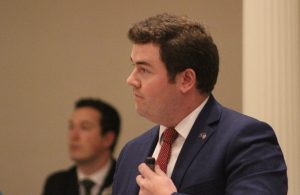
He said he was happy to leave the Legislature with a budget for the next fiscal year that does not raise taxes or revenue, and he celebrated Scott’s leadership in that.
“Without him in the governor’s office, we wouldn’t have a budget this good,” Parent said.
Parent said Republicans’ minority presence in the Legislature hindered their ability to support Scott’s agenda on some topics, like the proposed merger of the Department of Liquor Control and the Vermont Lottery Commission. But in general, he feels the session turned out favorably for Scott.
“I think he’s had a fantastic first year,” Parent said.
Sen. Dustin Degree, R-Franklin, said the day “couldn’t have gone any smoother.”
“I think that the governor and the Republican caucus won, easily,” Degree said.
Degree also lauded Scott’s veto of the budget and education property tax bills, saying it gave lawmakers a chance to come back to capture savings for taxpayers.
“Honestly, I couldn’t think of a more successful session,” he said.
After the daylong session adjourned, Democratic legislative leaders also praised the financial package lawmakers crafted for the next fiscal year.
The fiscal 2018 budget is a “fantastic budget,” said Ashe, and the resolution on the teachers’ health care issue is a “true good-faith outcome in my opinion.”
“The veto sort of overshadowed in some way the rest of the session,” Ashe said. “For 4½ months in the Senate we really had a great environment to do good work.”
Johnson also praised “very strong tripartisan work” in the House earlier in the year, before the impasse with the governor that led to the veto session.
She also praised parts of the final deal and said she feels good about where the agreement ended up.
“While we’re all celebrating that we found a compromise conclusion to the session,” she said, “we’re all still feeling a little bit of loss as well.”
(VTDigger reporter Erin Mansfield contributed to this report.)
/
