


Environmental advocates left this year’s legislative session expressing disappointment that several of their initiatives failed to gain ground.
The foremost issues included the pollution of Lake Champlain, which has progressed to the point that Vermont now stands under a federal order to reduce its contribution to the problem.
Implementing that order is expected to cost the state $25 million to $60 million a year for the next 20 years.
A bill that took shape early in the session put forward dozens of possible revenue sources, but it didn’t advance past the House Natural Resources, Fish and Wildlife Committee, where it originated.
Toward the session’s end, lawmakers secured a fraction — around $4 million annually — of the needed revenue for the next two decades, after threatening to eliminate that source of funding altogether.
The vehicle for this language was S.100, which aims to fund affordable housing for Vermonters.
The bill extends a surcharge on the property transfer tax indefinitely and appropriates $1 million of the revenue for affordable housing. The remainder of the roughly $5 million it pulls in each year will go toward reducing phosphorus pollution in Lake Champlain.
Legislators say they intend to tackle more substantive long-term financing proposals during the next legislative session.
Chemical regulation and pollution
Another contentious topic this year had to do with more than 200 residential wells recently discovered to contain perfluorooctanoic acid, or PFOA, a suspected carcinogen.
The majority of the tainted wells are in and around Bennington.
Gov. Phil Scott last week signed legislation that makes anyone who has released PFOA into the environment liable for funding a source of clean drinking water. In the Bennington area, that is estimated to involve more than $30 million for town water line extensions to affected properties.
The state and the owner of former industrial sites that are believed to be the source of the contamination, Saint Gobain Performance Plastics, have been negotiating over the costs to provide long-term solutions.
The legislation, S.10, was sponsored by lawmakers from Bennington County. They also brought forward another bill, S.103, to accomplish a number of reforms having to do with chemicals and hazardous waste.
That bill would create a committee to study the issue and report back to the Legislature within a year with recommendations to tighten state regulation of hazardous waste and toxic substances.

The report would include recommendations to establish a statewide reporting system, so regulators would know where certain chemicals are in use. Officials have said that a lack of information hindered initial responses to the Bennington PFOA contamination, because it wasn’t clear which companies and industries used the substance.
S.103 would also require new wells to undergo testing for a range of contaminants. State regulators could expand that list to include toxics that are especially prevalent in certain locales.
Finally, S.103 would expand the health commissioner’s authority to adopt rules regulating the sale of certain toys found likely to expose children to potentially harmful chemicals.
The bill ultimately failed to work its way to the governor’s desk, after senators sent it to a committee late in the session when no time remained to bring it back to the floor for a vote.
The bill faced resistance primarily from industry representatives.
An earlier version of the bill would have strengthened Vermonters’ legal protections against companies that harm human health or the environment. This earlier version would have made it easier to hold companies liable for toxic chemical releases and would have enabled Vermonters to sue polluters if state regulators don’t.
Those provisions, too, met with opposition from business and industry leaders and were removed before S.103 was set aside for the year. Proponents have promised to bring the bill back next year.
Environmental measures
One of the few environmental bills to pass this year was H.424, which will establish a commission to study how Vermont’s land use law, Act 250, might be improved.
The bill won bipartisan support, and the governor signed it into law May 23.
Another bill, H.411, puts energy efficiency standards for appliances into effect in Vermont if Congress or the White House eliminates national standards.
President Donald Trump’s proposed budget features dramatic cuts to an array of government functions, including energy efficiency, in order to expand military spending.
The bill sets standards for energy-efficient home, commercial and industrial appliances. The federal regulations were put in place by President Gerald Ford.
The governor signed the bill May 22.
Forestry, agriculture and renewable energy
A wide-ranging bill, S.34, seeks to support Vermont’s forestry, agriculture and renewable energy industries through a variety of measures. It is awaiting the governor’s signature.
The bill creates an entity within the Vermont Housing and Conservation Board to work with municipalities, regional development corporations and businesses to boost rural economies.

The new entity would be called the Rural Economic Development Initiative, and it would aid in securing grants, tax credits and other forms of funding.
In particular, REDI would prioritize businesses that deal in milk, the outdoor industry, forestry, local foods, phosphorus removal technology and composting.
The bill also takes on what representatives of the state’s forestry industry have said is a significant drag on the dwindling sector: workers’ compensation.
Under the bill, state officials would be directed to find a way to reduce the cost of workers’ compensation for certain dangerous jobs, like logging and roofing.
Leaders in the forestry industry say workers’ comp is especially burdensome for high-risk occupations like theirs and that foresters in Vermont pay more for workers’ comp than their counterparts in other New England states.
S.34 contains a number of other provisions.
It would, for instance, reduce or eliminate air pollution fees for emissions from anaerobic digesters. Anaerobic digesters turn food, manure and other organic waste into methane, which is usually converted with a few added ingredients into natural gas. The digesters have rapidly grown in popularity over the past decade.
The bill would also provide financial assistance to people or businesses that want to invest in devices to separate phosphorus from manure. Much of the phosphorus that has led the federal government to require pollution reduction in Lake Champlain comes from farm runoff, largely in the form of manure.
On hold
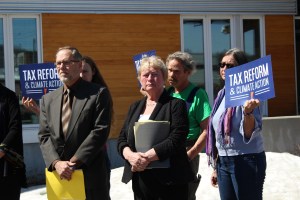
Numerous other bills were set aside until next year, including several carbon tax proposals.
The sponsors of four carbon tax bills said they were intended merely to spark discussion this session, in hopes lawmakers will revisit the bills during the 2018 session.
Legislation meant to slow the fragmentation of Vermont’s forests, titled H.233, made it through the House but not the Senate.
This bill would add consideration of contiguous forest blocks, and wildlife corridors within them, to the existing list of 10 criteria used to evaluate proposed projects under Act 250, Vermont’s land use law.
Numerous other bills dealing in environmental issues failed to make it out of committee.
One of them, H.82, would ban the use of salt brine on Vermont roads. One of the bill’s sponsors said the substance is corrosive and sticks to vehicles more than plain salt. But Vermont agency of transportation officials say salt brine is essential to maintaining the state’s roads in winter and contains no adhesive.
Another, S.51, sought to put into law goals outlined in the state’s current comprehensive energy plan, including one that would require Vermont to get 90 percent of its energy from renewable sources by 2050.
A couple of bills, H.105 and H.88, sought to curb the use of disposable plastic carryout bags. One of the bills would ban them, and the other would impose a 10-cent fee.
A bill meant to protect Montpelier’s water supply advanced only a short distance this year, after an identical one was quashed last year.
The bill, H.6, would allow Montpelier to close Berlin Pond to swimming, boating, fishing and other activities.
Finally, lawmakers pulled back from a plan to keep secret certain pollution control documents that farmers must submit to the state.
A provision in H.495 would have exempted farmers’ nutrient management plans from disclosure under the state’s public records law.
A nutrient management plan describes how a farmer will prevent or reduce pollution, such as phosphorus, going into Vermont waterways.
The bill passed with language establishing groups to study whether the management plans should be public.
(VTDigger’s Jim Therrien contributed to this report.)
/
