




(“Then Again” is Mark Bushnell’s column about Vermont history.)
[T]he profits being made by woolen mill owners in Massachusetts were hard to ignore. Textile mills in places like Lawrence and Lowell were cranking out fabric and profits. The mills were the envy of the industrializing world. If Massachusetts could pull off this economic miracle, why not Vermont?
That was apparently what a half-dozen Burlington area businessmen were thinking in 1835 when they created a woolen mill in Winooski: They hoped to replicate the success of Lawrence and Lowell. Though the factories in those communities dwarfed the original Winooski mill, it was an enormous undertaking by Vermont standards and one that would dictate the history of Winooski.
The mill was hardly the first to appear on the banks of the Winooski. Ira Allen had built the first ones in the early 1770s. They were a gristmill and a sawmill, a common pairing during that period, since they provided key raw materials on which settlers relied for food and shelter. A settlement, known as the village of Winooski Falls, which was then a part of Colchester, grew up around the mills.
Since the other necessity of life is clothing, it was perhaps inevitable that the next to spring up would be a woolen mill. Amos Weeks built his mill in 1802 for fulling and carding wool. In the fulling process, wool was soaked in a trough in a soapy solution and struck with hammers driven by waterpower. The process removed oils and dirt from the fibers and thickened them. Carding further cleaned the fibers, while also straightening and intermingling them.
Weeks’ mill soon began dyeing the fabric and napping it. Napping involved brushing the cloth with spiny, thistle-like plants called teasels to raise small naps in the fabric that were then trimmed with shears. (The name “teasel” comes from an Anglo-Saxon verb meaning “to pull or pluck.”)
After Weeks died in 1814, Charles Burnham ran the mill until 1830, when a flood washed it away. Burnham died three years later, having never rebuilt it.
Burlington men Sidney Barlow, Carlos Baxter, Philo Doolittle, Samuel Hickok, Luther Loomis and Henry Moore decided that Burnham had been onto something. In 1835, they stepped in to build their own mill. The Legislature issued them a charter to operate as the Burlington Mill Co.
The mill could rely on a plentiful local wool supply. A boom in sheep farming meant that by 1840, the state was home to an estimated 1.7 million sheep.
Initially, the quality of the mill’s wool fabric was of middling quality, according to historian David Blow, in an essay in the book “The Mills at Winooski Falls,” published in 2000. The main problem was apparently that the factory owners and workers were new to the business.
The workers probably also struggled with the demands the factory owners placed on them. The factory ran every day but Sunday. Workers arrived at 6 a.m. and labored about 13 hours, with only two brief meal breaks. There was no second shift. Originally, workers were expected to stay at their jobs well past sunset. Factory owners eventually made sunset quitting time, reducing the typical workweek from 78 hours to 69. This wasn’t out of an interest for the workers’ well-being, Blow says, but because the owners calculated that the cost of lighting made night work uneconomical.
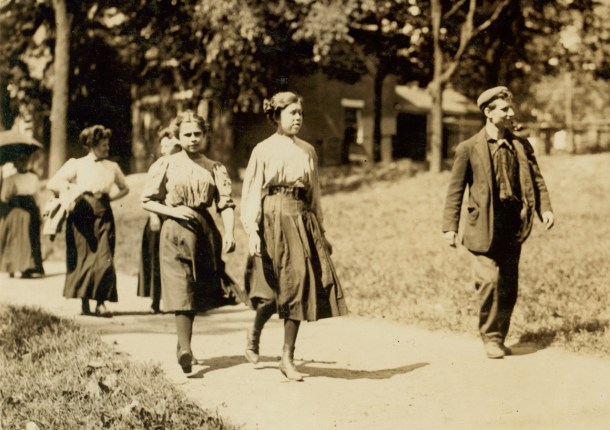
The new factory owners began offering workers lodgings in the form of boarding houses and tenements. Boarding houses, which were overseen by widows or married couples, provided housing for many of the unmarried young women who came to the mills to work.
These women, generally ages 14 to 25, came from farm families that were glad to have someone watching out for their daughters and sisters. The women were pleased to have a chance to earn cash, which they couldn’t on the farm. Consequently, they made up a major part of the mill labor force.
Women were joined later by immigrants, including French Canadians, Irish, Italians, Poles, Germans, Russians, Armenians and Syrians. The influx gave Winooski a richer ethnic mix than most of Vermont.
Mill owners were happy to hire women and recent immigrants – groups that had limited employment options – because they would work for lower wages. The mill owners also benefited from the housing arrangement, since it provided them leverage in labor negotiations and disputes, notes historian Susan Ouellette in “The Mills at Winooski Falls.”
The Winooski woolen mill, which grew into a series of large mill buildings and a cotton mill, was similar to many enterprises during the Industrial Revolution, frequently on the verge of closing. The factory ran into trouble when a depression struck the country shortly after the mill opened.
Further encumbering the company was the U.S. government’s decision to lower its tariff on imported wool. The influx of foreign wool drastically lowered the price of American woolen cloth. At one point, things grew so bad that the mill’s owners were forced to sell cloth for less than they paid for raw wool.
Deeply in debt in the fall of 1840, the company reorganized. Some owners left, while those remaining increased their investment to pay off debts and provide some liquidity. This remedy worked only until 1845, when Massachusetts investors bought a majority interest and hired James Cook, a seasoned mill manager from Lowell, to oversee operations. Under Cook, the company upgraded the mill machinery and started buying cheaper wool from Pennsylvania and Ohio.

As the Winooski workforce gained experience, it started producing highly regarded wool fabrics. The factory flourish in the late 1840s by producing wool for uniforms during the Mexican-American War.
But the hard times weren’t over. In 1850, the factory closed in the wake of a lawsuit filed by one of the company’s major shareholders.
Charles Harding, of Massachusetts, an experienced textile executive, bought the factory and went into business with his brothers. The Hardings repaired and upgraded the mill, but they too ran into trouble: Massachusetts mills were recruiting the Hardings’ most experienced men. When the economy weakened, the Winooski mills looked likely to close again.
Then the Hardings began experimenting with using cheap Argentinian wool. The trouble with the wool was that it often had bits of thistle stuck in it that were impossible to dislodge. But they found a way to crush the thistles and wash them from the wool. The mills were still in business.
The eruption of the Civil War in 1861 proved a boon for business, as the Union need vast amounts of wool fabric for military uniforms. Charles Harding, who had bought out his brothers, sold the company to a Boston interest calling itself the Burlington Mill Corp., which ran the factory for another four decades, employing about 700 workers in 1880s.
The corporation went bankrupt at the turn of the 20th century and was purchased by the American Woolen Co., a national conglomerate, which operated the Winooski mills for more than a half century. A boom during World War II, when the factory again produced wool for the U.S. military, saw employment rise to 3,000.
But in 1954, in search of lower wages and higher profits, the company closed the mills and moved the jobs to the South. The mill jobs are long gone, but the massive buildings — since converted to offices, condominiums and shops — remain a hallmark of Winooski, as does the cultural mix the mills brought to town.
/
