

(This story by Matt Hongoltz-Hetling was first published in the Valley News on May 13, 2017.)
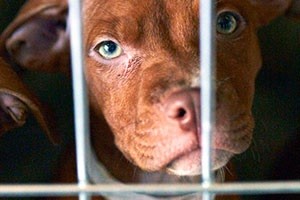
HARTLAND — An overhaul of Vermont laws on what, exactly, constitutes inhumane living conditions for dogs and cats living in cages has led to a debate among different stakeholders in the animal welfare community.
“Nobody who has a cat or dog as a beloved companion animal would ever confine their animal in the way that this bill allows,” said Sue Skaskiw, director of the Vermont Volunteer Services for Animals Humane Society, during a telephone interview on May 12.
But Kathryn Finnie, executive director of the Vermont Veterinary Medical Association, said in testimony to the House Committee on Agriculture and Forest Products in February that the bill was an improvement.
“These changes will provide humane investigators with a more specific checklist and measurable standards when they review cases of alleged animal cruelty, and we strongly support passage of this bill,” she said.
The difference of opinion is over H.218, a bill that has passed both the House and Senate and needs only a signature from Gov. Phil Scott to become law.

It’s the final product of more than two years of work by the bill’s sponsor, Rep. John Bartholomew, D-Hartland, who worked as a professional veterinarian in animal research laboratories.
He said a variety of stakeholders, including the Vermont Humane Federation and the Vermont Federation of Dog Clubs, helped him to craft the language, which defines things like what types of tethers can be used for dogs, what type of access they need to food and water, the minimum amount of time they need to be let out of their cage each day, and the size of that cage.
It’s that last portion — the size of the cage — that Skaskiw, a Bridgewater resident who founded Vermont Volunteer Services for Animals Humane Society in 1986, takes particular issue with.
Under current Vermont law, caged dogs need to be provided a minimum amount of living space based on which of five weight divisions the animal falls into. Dogs weighing less than 25 pounds should get a minimum of 12 square feet, dogs of 100 pounds or more should get 30 square feet.
The new law would do away with a simple weight standard, and apply a more nuanced set of guidelines, with three different standards. Dog breeders, veterinarians and animal research laboratories would be required to use the measure that would give the most space to each animal.
The first standard is by weight — small dogs that weigh less than 33 pounds would get 8 square feet; medium-sized dogs of between 33 and 66 pounds would get a minimum of 12 square feet, and large dogs of more than 66 pounds would get 24 square feet.
The second standard uses a formula based on the length of a dog, as measure from the tip of the nose to the base of the tail. The longer the dog, the more space it gets.
“Some dogs are heavy-bodied and weigh a lot of for their size,” said Bartholomew, who previously worked for the Research Animal Management Branch of the National Institute of Child Health and Human Development, part of the National Institutes of Health. “Others, like Great Danes, are very large dogs but they don’t weigh that much.”
And the third standard is based on what the dog can do in the cage — it must be able to turn freely, sit, lie down and stand.
“The dog has to be able to sit, lie down and stand normally,” Bartholomew said. “If its ears hit the top of the cage, it’s not big enough.”
The minimum cage size for a dog is 8 square feet, the same amount given to cats under the bill, but less than the 12 square feet allotted to small dogs under current law.
Skaskiw said the new law will give leeway to hundreds of dog breeding operations across the state to confine dogs to tighter spaces for the rest of their lives. She said the rules are particularly cruel to animals at breeding facilities, where dogs and cats live in cages for extended periods of time.
Calculations by the Valley News indicate that the new standards could scale back on cage size for several typical dog sizes.
Small dogs, like an 8-pound Chihuahua or an 18-pound cocker spaniel, get the minimum cage size of 12 square feet under current law, and would get 8 square feet under Bartholomew’s bill.
A medium-sized dog, like a 50-pound bulldog, gets 20 square feet under the current law, and 12 square feet under the bill.
And a very large dog, like a 120-pound Saint Bernard, gets 30 square feet under the current law, and 24 square feet under the bill.
Bartholomew said the size standards will help law enforcement officials to have more measurable standards when investigating cases of animal abuse, and that the standards are based on federal cage size standards in the USDA Animal Welfare Act.
Peggy Larson, a Williston veterinarian who has been active in animal advocacy, submitted testimony opposing the bill, in which she said those federal standards were for “animals in laboratories, not animals in the general public. They are not meant for long-term care. Therefore, they should not apply to state laws nor used as a model for governing privately owned animals.”
The text of the federal Animal Welfare Act indicates that it is for research facilities, but also dealers and exhibitors of dogs and cats, among other animals.
Skaskiw also opposes the bill because it grants an exemption to the law that requires outdoor dogs be given adequate shelter.
Under the current law, “a dog maintained out-of-doors must be provided with suitable housing that assures that the dog is protected from wind and draft, and from excessive sun, rain and other environmental hazards throughout the year.”
Bartholomew’s bill grants an exception to this shelter requirement for “a healthy livestock guardian dog that is maintained outdoors in an enclosure.”
Skaskiw says the change will create animal suffering, because unsheltered dogs could be left to freeze outside.
But Bartholomew said the change is meant only to apply to a very specific range of uncommon certified guardian dog breeds –— such as Anatolian shepherds and Maremma sheepdogs — that are actively guarding sheep or other livestock.
“If it’s too cold for the sheep to be outside, and the farmer brings them into the barn, then the dog goes into the barn, too,” he said.
The bill easily cleared both chambers, but it is unclear what Scott’s stance will be.
“Governor Scott has not taken a position on this bill during the session, and will review it closely when it reaches his desk before making a decision,” said Rebecca Kelley, Scott’s communications director.
